
Of all the Christmas songs in print, here’s what one writer has called “the most underrated.” It was included in the 1990 “Trinity Hymnal,” when the editor found it in a paperback InterVarsity Christian Fellowship songbook. He had heard it on a Christmas recording with a smaller choral ensemble from Coral Ridge Presbyterian Church in Fort Lauderdale, Florida years earlier. He has since discovered several churches that include it every year in their special Christmas music festival services. It deserves to become more widely known and utilized. It has also been a pleasant surprise to discover several recordings of it being sung in churches as an anthem recently.
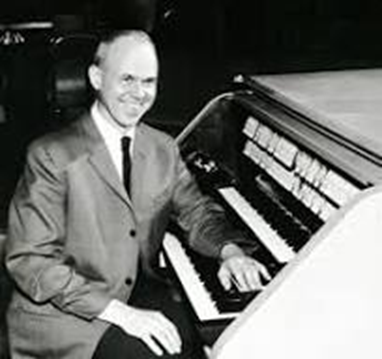
It is “Lovely Child, Holy Child,” written in 1968 by David Nathaniel Johnson (1922-1987). Born in San Antonio, Texas, he was an American organist, composer, educator, choral clinician, and lecturer. He studied organ and composition at the Curtis Institute of Music in Philadelphia (1940-1942). Between 1942 and 1946 he served in the U.S. Army Signal Corps/Air Corps in India, Burma, and China, receiving a Meritorious Service Award and campaign ribbons. He continued his music studies at Trinity University (Texas) with a Bachelor of Music degree in 1950 and Master of Music in 1951 and Ph.D. in 1956. He also earned the associate certificate from the American Guild of Organists (AAGO).
He was a lecturer at Syracuse University in 1951. From 1960 to 1967, he was college organist and organ instructor at St. Olaf College, Northfield, Minnesota. He was named music department chair at St. Olaf in 1965. In 1967, he succeeded Arthur Poister as professor of music and university organist at Syracuse University. He moved to Arizona in 1969, where he taught at Arizona State University in Tempe. He was married to Margaret S. Teal, and they became parents of six children. Johnson was organist and choir director at Trinity Episcopal Cathedral in Phoenix. His publications include “Instruction Book for Beginning Organists” and “Organ Teacher’s Guide.” His compositions number over three hundred and include hymn tunes, varied harmonizations, and hymn preludes.
Johnson’s much-loved “Trumpet Tune in D” (1962) for organ was the opening and closing theme for the weekly radio show “With Heart and Voice,” with host Peter DuBois. That program (with different music) continues now as “Pipedreams,” with host Michael Barone. Several of Johnson’s Trumpet Tunes have been recorded by Christopher Herrick in his Organ Fireworks series on the Hyperion record label. While serving as music department chairman at St. Olaf College, he composed “Earth and All Stars” and published it in his “Twelve Folksongs and Spirituals” (1968). Johnson’s Trumpet Tune in D was also the first of two processionals used for the 1971 wedding of Richard Nixon’s Daughter, Tricia, who was married in the White House Rose Garden with music provided by a string orchestra. Since this work was originally composed for organ, it had to be transcribed for string orchestra for its performance at the wedding.
Johnson’s best known vocal/choral work is “The Lone, Wild Bird.” It was inspired, in part, by his seeing a solitary white bird while enroute by ship (in the early 1940s) from Los Angeles to Bombay, India, hundreds of miles from the nearest land in the middle of the South Pacific. Haunted by the image of that bird, Johnson later paired an American folk tune, “Prospect” from “The Sacred Harp” (1844), with a 1925 poem by the Rev. Richard McFayden (also McFadyen), entitled “The Lone, Wild Fowl,” also taking some poetic license with the title. It first appeared in “Twelve Folksongs and Spirituals” (1968), compiled and arranged by Johnson. The pairing is so natural that many assume it is the tune’s original text, and vice versa. Johnson died in Tempe, Arizona in 1987.
This Christmas hymn first addresses Jesus as if in a lullaby. The text reflects the gentle character of such a theme. It imagines that we have come to the manger (or home) where the young child lay, bringing our gifts, perhaps to add to those of the Magi. It is to this Jesus that we sing, until the fourth stanza, when our voices turn to those around us, calling them to join us in worship of this divine child. The repeated refrain at the end of each stanza has a unique beauty, musically. While the words are very simple, just alleluia repeated four times (“praise Yahweh”), it becomes almost magical when sung correctly. The first and third alleluias are to be sung at forte volume, while the second and fourth are to be sung noticeably softer, piano, as a meditative echo. Additionally, the second measure in both of the last two lines of the refrain contains an unexpected change in harmony. The second chord in that measure has in the melodic line a c-natural instead of the expected c-sharp. It’s almost as if the music causes our knees to bend in adoration at that moment!
Stanza 1 lauds the Savior with a series of adjectives that accent His greatness even in His humility: lovely – holy – gentle – mild – undefiled. No other child has ever come into the world with this pure goodness. And all this and more continued throughout Jesus’ entire life, from His childhood to His teen years and early adulthood, all the way to His perfect sacrifice at Calvary. This infant and fairest King is worthy of the gift of our hearts and is the proper object of the anthems we sing to Him and of Him.
Lovely child, holy child, gentle, mild, undefiled;
Infant King, fairest King, gifts we’ll bring and anthems sing.
Stanza 2 continues as our song beside the manger, compounding our ascriptions of honor to Him, as we gaze on His incarnate glory. The one who came as the Light of the World was born a “child of light” in His birth, as heavenly lights – an angelic host – sang His praise above the heads of Bethlehem’s shepherds. This is not merely a child whose birth should be admired, or even merely adored. No, the significance of His coming into this fallen world was news that demands to be declared everywhere.
Child of light, born tonight, our delight, promise bright;
Child so fair, see Him there; now declare Him ev’rywhere.
Stanza 3 once again carries our words to the ears of this heaven-born begotten Son of God. And once again a lullaby attitude motivates our desire that He would “rest Your head, sweetest head.” And now for the second time we sing of gifts that we bring to Him. What gifts can we mortals bring to this eternally existing royal sovereign? Elsewhere Christina Rossetti’s famous Christmas poem says it well in the hymn “In the Bleak Midwinter.”
What can I give Him, poor as I am?
If I were a shepherd, I would bring a lamb;
If I were a Wise Man, I would do my part;
Yet what I can I give Him: give my heart.
Johnson’s text concludes the stanza with the repeated desire that this message we celebrate “be outpoured” for all to hear.
Rest Your head, sweetest head; gifts we’ll spread at Your bed,
Jesus Lord, be adored, may this word now be outpoured.
Stanza 4 turns our attention to those standing nearby listening to us as we have sung of Jesus’ royal birth. We conclude by calling on them to realize that we are employing “hymns of joy” to celebrate His birth. Then, calling Him “Child so fair,” we invite these other folk to “see Him there” along with us, and to join us as together we “now declare Him ev’rywhere.”
To this boy, our great joy, we employ hymns of joy;
Child so fair: see Him there; now declare Him ev’rywhere.
The tune BETHLEHEM was a folk carol of unknown origin which Johnson arranged and matched to his lyrics.
Here is a link to hear it as an anthem.