The birth of Jesus Christ is described differently among the four Gospels. Mark makes no reference to it or gives any specifics about it, simply jumping in at the first chapter with Jesus’ public ministry. His account starts with the Savior’s baptism by John in the Jordan River, and then returning from His temptations in the wilderness, preaching the same message as John: “Repent, for the kingdom of God is at hand.” It’s to Matthew and Luke that we look for our Christmas Scripture readings. Matthew gives us Jesus’ genealogy through the line of Matthew, and then the worship of the Magi. Luke is more thorough with the four nativity songs, the annunciations, shepherds, and manger scenes, followed by His genealogy through the line of Mary.
But when we come to the Gospel of John, we have something startlingly different, yet also widely appreciated in the scripture readings for Christmas services of our churches. Matthew, Mark, and Luke probably wrote 60 years after Jesus’ birth. John, on the other hand, most likely wrote more than 90 years after those events of the incarnation. His account of the birth of Jesus goes back into eternity, long before Bethlehem! “In the beginning was the Word, and the Word was with God, and the Word was God.” In chapter one, and throughout his Gospel, the Holy Spirit has given us through John a more mature theological account of what all this meant.
And so John went into much more detail with Jesus’ miracles (John called them “signs”) and Jesus’ teaching. There may be fewer events recorded in his Gospel, but he included far more explanations through the narrative of Jesus’ words that make this book the ideal place for a new Christian to begin reading so as to understand who Jesus is and what the substance of the Christian Gospel of salvation involves, that which comes simply through “believing in His name.” John includes seven miracles, seven I AM statements, with details about the seven days between Palm Sunday and Easter Day. (Incidentally we also find the number seven to be very prominent in his book, Revelation.)
Turning now to this hymn study, our attention is drawn to John’s Prologue in chapter one. These are some of the most profound words ever penned. Jesus has existed from eternity as God Himself, the second person of the Holy Trinity, forever in perfect union and loving relationship with the Father and the Spirit. He has become flesh to rescue us from the wrath of God which we deserve due to our sin. And in verse 16 we read, “For from his fullness we have all received, grace upon grace.” Some expositors have paraphrased that as meaning that in the process of saving us by grace, throughout our lives, God continues to add to the previous measure of grace yet even more grace, and thus grace is piled on top of grace. How wonderful is that realization, and that reality!
One of the new hymns included in the 2025 Getty Sing! Hymnal is based upon that phrase. It was written in 2004 as part of a song cycle inspired by John 1. It bears the title from its opening line, “Fullness of Grace.” Like several hymns from these modern composers, it comes from a trio of writers, a special group which we might call modern-day magi, or three wise people (two men and one woman). Their wisdom is communicated not just in the marvelous music and words which they have created, but also in the worshipful joy this hymn communicates to and through all who sing it. That new Irish magi trio is, of course, Keith Getty (b. 1974), his wife Kristyn Getty (b. 1980), and their good friend Stuart Townend (b. 1963).
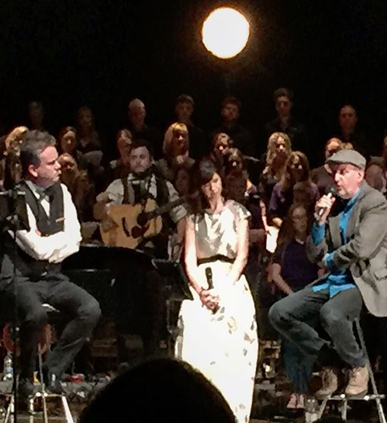
Keith Getty is an internationally known composer of Christian hymns. His song “In Christ Alone” is sung by an estimated 100 million people worldwide each year and was voted the third most popular hymn of all time in Britain on BBC’s “Song of Praise.” Since releasing that song in 2001, he has written or published 38 of the top 500 songs sung in churches in the USA and UK as measured by CCLI (Christian Copyright Licensing International). He and his music organization have become very well-known through their concerts (including the Kennedy Center for the Performing Arts, Royal Albert Hall, Sydney Opera House, and Carnegie Hall at Christmas!), books and CDs, and the annual Sing! conferences.
In 2017 Christianity Today described Getty and his wife Kristyn as “preeminent” hymn writers whose songs have “changed the way evangelicals worship.” In 2018 Getty was officially named Officer of the Order of the British Empire (OBE) by Queen Elizabeth II for contributions to “Music and Modern Hymn Writing,” making him the first contemporary church musician to receive this award. Getty and his wife also own and operate their own record label, with their touring and song publishing company known as Getty Music. The couple also co-founded a charitable non-profit, the Getty Music Foundation, to implement global educational initiatives.
Getty was born in Lisburn, Northern Ireland, to Helen Getty (née Irwin) and John Getty. The eldest of four children he began making music at age 11, learning to play the classical guitar. At 12 years old he began playing the flute. During school, Getty was influenced by classical music, Irish music, and church music of all kinds. As a young adult, he studied music at St. Chad’s College, Durham University, graduating with his Bachelor of Arts in 1995. As a student, Getty completed special conducting opportunities at the Canford Summer School of Music and the Tanglewood Music Center in Massachusetts. Getty participated in a summer master class under Irish flautist Sir James Galway.
He met his wife, Kristyn in 2002 after being introduced to her by Kristyn’s uncle, British scholar John Lennox. Lennox is now a retired professor of mathematics at Oxford University and author and speaker on the subject of biblical creationism. Kristyn was attending a nearby university and asked Getty for some musical advice. After dating for two years, the couple married on June 16, 2004. The couple have four daughters and live between Portstewart, Northern Ireland and Nashville, Tennessee.
Kristyn and Keith write and release hymns together. In 2020, Kristyn recorded the entire English Standard Version (ESV) Bible which is now available to hear for free on the ESV Bible app. Kristyn, together with her husband, has written and produced a number of children’s worship albums. In 2017, Kristyn and Keith performed for former US Vice President Mike Pence and his wife, Second Lady Karen Pence, at the vice president’s residence, which is on the grounds of the Naval Observatory. They two have performed for George W. Bush, the United Nations, former South Korean president Lee Myung-Bak, the enthronement of the Archbishop of Canterbury, and for former UK prime minister Theresa May. They continue to write and publish new songs (like “Christ Our Hope in Life and Death”), and to market additional CD recordings.
The third member of this modern-day magi trio is Stuart Townend. He grew up in West Yorkshire, England, the youngest son of an Anglican vicar. He started learning piano at a young age, and began writing music at age 22. He has produced albums for Keith Routledge and Vinesong, among many others, and has also released eight solo albums to date. Some of his better-known songs include “How Deep the Father’s Love,” “The King of Love,” and “The Power of the Cross.” He continues to work closely with Keith and Kristyn Getty, and is currently a worship leader in Church of Christ the King in Brighton, where he lives with wife Caroline, and children Joseph, Emma and Eden.
His father, Rev. John Townend, was vicar of Christ Church, Sowerby Bridge from 1974 until his death in an auto accident in 1985. Townend started learning to play the piano at age 7. At the age of 13, he made a commitment Christ as his Savior, and began songwriting at age 22. He studied literature at the University of Sussex. Townend has led musical/sung worship and performed events across the world at multiple conferences and festivals. In 2005, “Cross Rhythms” magazine described Townend as “one of the most significant songwriters in the whole international Christian music field.” The Christian website Crosswalk.com commented, “the uniqueness of Townend’s writing lies partly in its lyrical content. There is both a theological depth and poetic expression that some say is rare in today’s worship writing.” Cranmer Award for Worship by the Archbishop of Canterbury “for his outstanding contribution to contemporary worship music.”
Christmas carols have come to us from multiple centuries and have become an indispensable part of our annual Christmas celebrations. What would Christmas be like without “O Come, O Come, Emmanuel,” “Joy to the World,” “O Come, All Ye Faithful,” or “Silent Night?” Newer Christmas songs are now gradually finding widespread acceptance and familiarity to become part of this music heritage. “Fullness of Grace” seems destined to become one of those.
The music for this new carol has an almost plaintive feel, written in the key of d minor. It needs to be slowly and meditatively, reflecting the combination of longing in the midst of all our weaknesses and needs, combined with the strength of our hope in the one who has promised “grace upon grace” to sustain is and carry us through to the glorious triumph that is coming. It will be easy for congregations to learn since the first two lines are identical and are repeated in part at the conclusion, being structured in a pattern of A – A – B – A.
This is a didactic song, like many of the Psalms, as it is not a prayer or praise addressed to God. Neither is it addressed to those unbelievers around as a testimony of our faith and an invitation to them to join us in embracing these truths. Rather, it is instructional as we sing to one another to learn more and more about the riches of this grace that has been lavished on us by our God of love and power. We are constantly in need of such instruction because of our ignorance and forgetfulness. The more we hear about such doctrines and promises, the greater will be our love for Him and the richness of the worship we offer to Him.
Stanza 1 looks back to Bethlehem and the wonder inspired by what Jesus has done, “laying aside His power and glory” to enter our world through the “scandal of a virgin birth.” Here is what theologians call the humiliation of the redeemer in being born in such a mean estate, that preceded His exaltation to bear the name above all names (Philippians 2:5-11).
Fullness of grace in man’s human frailty;
This is the wonder of Jesus.
Laying aside His power and glory,
Humbly He entered our world.
Chose the path of meanest worth;
scandal of a virgin birth.
Born in a stable cold and rejected:
Here lies the hope of the world.
Stanza 2 looks up to the love of the Father shown back at Calvary. Truly that was an instance of God’s grace being enormously full in loving us and paying that price to redeem our fallen souls. Truly, the cross is the greatest demonstration of the love of God, “shown in the face of Jesus” as He stooped “to bear the weight of humanity.” That’s where He “took our sin and punishment, was “despised and rejected,” that we might be loved and accepted.”
Fullness of grace, the love of the Father
Shown in the face of Jesus.
Stooping to bear the weight of humanity,
Walking the Calvary road.
Christ the holy innocent
Took our sin and punishment.
Fullness of God, despised and rejected:
Crushed for the sins of the world.
Stanza 3 looks around us now in our forgiveness and our new “fullness of life and joy unspeakable” and full of glory (1 Peter 1:8). The stanza then concludes with the response that should be ours to being beneficiaries of such love. As Paul challenges believers in Romans 12:1 to present our entire selves as living sacrifices, so here “all our hopes and dreams we bring gladly as an offering.
Fullness of hope in Christ we had longed for,
Promise of God in Jesus.
Through His obedience we are forgiven,
Op’ning the flood gates of heav’n.
All our hopes and dreams we bring
Gladly as an offering.
Fullness of life and joy unspeakable:
God’s gift in love to the word.
The meter for this text is quite unusual, to say the least! 10.7.9.7.7.7.10.7.
Here is a link to the official rendition of the song from Getty Music, sing by Kristyn Getty herself.