
The days in which we live, like many times before us, are filled with chaos, conflict, and confusion. We are tempted to think that things are out of control, but as Christians we know better than that. We have access to a peace that passes understanding, because we belong to a Savior who passes understanding! The troubles around us are real and dangerous, from radical political philosophies to immoral behavior to brutal wars. But we understand that sin has produced all this and more, and that there is both an ultimate solution and an immediate source of comfort, both of which enable us to rejoice in the midst of all this.
That attitude of worship has always been one of the great qualities of a deep faith in the Bible and in the God of the Bible. He not only has a wonderful plan for His creation and His redeemed children. He has promised to sustain us as He works all things according to the design of His will (Ephesians 1:11). And so we can continually live before Him with songs of praise in our hearts and on our lips. The theology that underlies that is that God is sovereign as He sits on His throne, ordaining all that take place in His world. It’s not that we shut our eyes to what we see or ignore the reports that we see on the news. It’s that we’re secure in the confidence that God is in control and that He has proven that we can trust Him. As William Cowper wrote in his hymn, “God Moves in a Mysterious Way,” “He plants His footsteps on the sea and rides upon the storm.”
It’s understandable that people are drawn to images and passages … and hymns … about Jesus as a kind and compassionate and loving shepherd. There are certainly many of them. But we need to keep those balanced with images and passages … and hymns … about Jesus as a powerful sovereign enthroned in majesty, one before whom all must bow in trust, adoration, and submission. As Christians, we love to sing the praise of the one who is both gentle and majestic, one who welcomes us into His “family room” and also into His “throne room.”
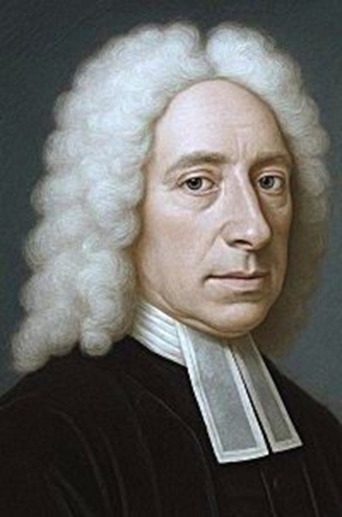
Isaac Watts (1674-1748) believed all that and wrote more than 600 hymns based on that conviction. This study deals with his 1705 composition, modified in 1719, “Before Jehovah’s Awful Throne.” No hymnal today would be complete without a substantial number of his hymns, including “Joy to the World,” “When I Survey the Wondrous Cross,” and “Jesus Shall Reign.” He is called “the Father of English Hymnody” because of the profound effect of his hymn writing in moving congregational worship from exclusive Psalmody to including “hymns of human composition.”
Watts was the son of a schoolmaster, and is said to have shown remarkable precocity in childhood, beginning the study of Latin, in his fourth year, and writing respectable verses at the age of seven. His taste for verse showed itself in early childhood. He was taught Greek, Latin, and Hebrew by Mr. Pinhorn, rector of All Saints, and headmaster of the Grammar School, in Southampton. The splendid promise of the boy induced a physician of the town and other friends to offer him an education at one of the Universities for eventual ordination in the Church of England: but he refused this and at the age of sixteen entered a Nonconformist Academy at Stoke Newington in 1690, under the care of Mr. Thomas Rowe, the pastor of the Independent congregation at Girdlers’ Hall. Of this congregation he became a member in 1693.
Leaving the Academy at the age of twenty, he spent two years at home. It was then that the bulk of the “Hymns and Spiritual Songs” (published 1707-1709) was written, and sung from manuscripts in the Southampton Chapel. In 1698, he became assistant minister of the Independent Church, Berry Street, London. In 1702, he became pastor of that congregation. In 1712, he accepted an invitation to visit Sir Thomas Abney, at his residence of Abney Park, and at Sir Thomas’ pressing request, made it his home for the remainder of his life. It was a residence most favorable for his health, and for the prosecution of his literary labors. He did not retire from ministerial duties, but preached as often as his delicate health would permit.
The hymn “Behold the Glories of the Lamb” is said to have been the first he composed, and was written as an attempt to raise the standard of praise. In answer to requests, others succeeded. The hymn “There Is a Land of Pure Delight” is said to have been suggested by the view across Southampton Water. The next six years of Watts’s life were again spent at Stoke Newington, in the post of tutor to the son of an eminent Puritan, Sir John Hartopp. To the intense study of these years must be traced the accumulation of the theological and philosophical materials which he published subsequently, and also the life-long enfeeblement of his constitution.
Watts preached his first sermon when he was twenty-four years old. In the next three years he preached frequently; and in 1702 was ordained pastor of the eminent Independent congregation in Mark Lane, over which the famous Dr. John Owen had presided, and which numbered Mrs. Bendish, Cromwell’s granddaughter, Charles Fleetwood, Charles Desborough, Sir John Hartopp, Lady Haversham, and other distinguished Independents among its members. His health began to fail in the following year, and Mr. Samuel Price was appointed as his assistant in the ministry. In 1712 a fever shattered his constitution, and Mr. Price was then appointed co-pastor of the congregation which had in the meantime moved to a new chapel in Bury Street. It was at this period that Watts became the guest of Sir Thomas Abney, under whose roof, and after his death (1722) that of his widow, he remained for the rest of his suffering life, residing for the longer portion of these thirty-six years principally at the beautiful country seat of Theobalds in Herts, and for the last thirteen years at Stoke Newington.
Watts died November 25, 1748, and was buried at Bunhill Fields. A monumental statue was erected in Southampton, his native place, and there is also a monument to his memory in the South Choir of Westminster Abbey. “Happy,” said one champion of Anglican orthodoxy, “will be that reader whose mind is disposed, by his verses or his prose, to imitate him in all but his non-conformity, to copy his benevolence to men, and his reverence to God.”
The number of Watts’ publications is very large. His collected works, first published in 1720, embrace sermons, treatises, poems and hymns. His “Horae Lyricae” was published in December, 1705. His “Hymns” appeared in July, 1707. The first hymn he is said to have composed for religious worship, is “Behold the Glories of the Lamb,” written at the age of twenty. It is as a writer of psalms and hymns that he is everywhere best known. Some of his hymns were written to be sung after his sermons, giving expression to the meaning of the text upon which he had preached. Montgomery calls Watts “the greatest name among hymn-writers,” and the honor can hardly be disputed. His published hymns number more than six hundred. It was his work on the Psalms that has been so particularly valuable in Reformed churches. Some have said “he christianized them.” As an example, He took Psalm 72, a Psalm celebrating the coronation of King Solomon, and re-cast it as a celebration of King Jesus in “Jesus Shall Reign.” In treating the Psalms this way, he was focusing on the fulfilment of the Psalm themes in the person and work of Jesus.
This hymn we examine in this study is a paraphrase of truths expressed in Psalm 100, and is one of many hymns based on that Psalm. Watts called it “Praise to the Lord from All Nations.” It provides a strong statement of the sovereign majesty of Almighty God. It challenges us to think about God on His throne, and also about what kind of throne that is. We might think of the throne in England on which we have watched British monarchs being crowned. The throne is visible, surrounded by dazzling pomp and majesty, with a king or queen wearing flamboyantly impressive robes and wearing a crown sparkling with priceless jewels.
But that is not what should come to our minds as we consider this “awful throne” on which God is seated. That British throne is largely for show, since the one who sits on it has very little actual power and authority. It’s mostly symbolic of Great Britain’s heritage and once-impressive worldwide empire. In contrast to that, the throne on which God is seated as King of kings and Lord of lords represents His absolute power and authority over all His creatures – and all His creation – and all their actions. As one has expressed it, God is not merely watching what takes place. This is the control center of the entire universe, and the one who is seated there in glory is none other than the creator, redeemer, and commander of all that exists and occurs.
Such power should terrify us who are not only weak and mortal (with our every breath and heart-beat coming from His will) but are also incredibly vile and traitorous (deserving His eternal wrath and displeasure). And yet, because of the gospel message of the Bible, that power is motivated by equally incredible love and mercy, as He has sent His Son to take our sins to the cross and to rise in victory. It is a throne from which a royal decree has been issued that nothing in all of creation shall be able to separate us from His love, that all things should work together for good to those who are His, and that He has ordained an end to all things material that will usher in an eternity of joy in the new heavens and new earth. Such is the meaning of that throne on which Jehovah sits and from which He orders all that occurs to us and in us and around us and for us.
So why should we tremble at the upheavals on our cities’ streets and in the halls of government and in the courts and universities of the land and in the reports of wars and rumors of wars and in the often-biased and misleading reports on the news? He has told us to expect all these things. But He has also proven that He is in charge and that however out of control things may appear to human eyes, everything is moving forward exactly according to His plan.
It is recorded that on one occasion, Charles Haddon Spurgeon held a service in the Music Hall in Surrey Garden, London, with a gathering of eight to ten thousand people. After the opening prayer, Spurgeon announced this very hymn, “Before Jehovah’s Awful Throne.” Then he read each stanza separately, before it was sung. Describing the experience, one observer wrote, “Most magnificent was the shout of praise that now went up. Not a voice was mute, save where occasionally someone’s nerves were overpowered by the massive rolling chorus that rose on every side. Never did we before realize what congregational singing might become. It was an uplifting of voice and heart such as one can hope to hear only a few times in a lifetime.” Surely it was not just the sound, but the sense of what was sung.
The original version of this hymn was written by Dr. Watts and published in 1719. It began with an entirely different stanza:
Sing to the Lord with joyful voice,
Let every land His name adore;
The British Isles shall send the noise
Across the ocean to the shore.
For obvious reasons, this nationalistic stanza has been omitted. John Wesley did an excellent job of revising the rest in 1737. It is Wesley’s version that is included here. Since the word “awful” carries such negative connotations to minds today, in many hymnals it has been changed to “awesome,” a word that has meaning much more consistent with the author’s intent and with the context of the lyrics.
The hymn is set in the form of a statement of wonderful things about our sovereign God. It is not a prayer addressed to God or praise offered to God, other than the fact that we sing these truths in His presence, which gives Him joy and honor. We sing the words to remind ourselves and others that we have a God, he only true God, who is actively reigning, exercising His rightful authority over His creation and His creatures.
Stanza 1 turns our attention to the authority of this divine potentate, and the response that must be given to Him. This is a throne that is awful in the sense that it is full of awe, which the nations must respect by bowing “with sacred joy.” That is because, as God, He has the power and the right to both create and destroy, two things which He has shown He can and will do.
Before Jehovah’s awful throne,
Ye nations bow with sacred joy;
Know that the Lord is God alone,
He can create, and He destroy.
Stanza 2 turns our attention further to the sovereign power which lies behind that authority. Two wonderful things are named. First is the power by which He made us out of dust “without our aid” by the word of His power. He is our creator. Second is the power by which He brought us to Himself after we had turned away, gathering us “like wandering sheep” into His fold. He is our Good Shepherd.
His sov’reign pow’r, without our aid,
Made us of dust and formed us men;
And when like wand’ring sheep we strayed,
He brought us to His fold again.
Stanza 3 turns our attention to the blessings we receive by being under His watchful care. Salvation is not some purely mechanical judicial act. It is the work of a Father whose love is greater than we can ever comprehend. In other words, He has saved us because He has loved us from before the foundation of the world. And in saving us, He has made us His possession. He owns our souls and bodies, and so we bring “lasting honors” before Him in our worship.
We are His people, we are His care,
Our souls and all our mortal frame,
What lasting honors shall we rear,
Almighty Maker, to Thy name?
Stanza 4 turns our attention to the exuberance with which we will all celebrate Him in His presence. In the book of Revelation, John describes the vision he was given of heaven’s worship. In chapters 4 and 5 we read of a vast sight and sound of saints and angels around the throne, singing “Worthy is the Lamb.” How marvelous beyond words is the realization that we who have trusted in Jesus will be part of that scene, adding our voices to the countless thousands as we “shall fill Thy courts with sounding praise.”
We’ll crowd Thy gates with thankful songs,
High as the heav’ns our voices raise;
And earth, with her ten thousand tongues,
Shall fill Thy courts with sounding praise.
Stanza 5 turns our attention to the immensity and solidity of His rule. Paul wrote in Romans 8 that God causes all things to work together for good for those who are the called to be His. And so in the midst of what seems so chaotic in our current world situation, it remains true that this entire world is under His command. And while we don’t know the details of the future, we know the one whose plans are “firm as a rock.”
Wide as the world is Thy command,
Vast as eternity Thy love;
Firm as a rock Thy truth must stand,
When rolling years shall cease to move.
The lyrics have been set to a number of different tunes. Often, it will be the tune PARK STREET, which was written about 1810 by Frederick Marc Antoine Venua (1788-1872). Born to an Italian family in France, he attended the Paris Conservatory. Subsequent to that, he studied composition in London. He directed and composed for the ballet orchestra at the King’s theater. He belonged to the British Royal Society of Musicians. Married twice, he retired in Exeter in 1858 and died there. Other than that, he is not very well known.
Here is a link to the singing of the hymn, though to a different tune, OLD HUNDREDTH, which would be very appropriate since the text is based on Psalm 100.