
If you’re taking note of major seasons in the church year, don’t forget Epiphany. Not all denominations observe this sequence of seasons, but most at least observe dates nearest the Christas and Easter seasons. There is no biblical mandate for this, though in the Old Testament God regulated definite events and times, something that was set aside with the coming of Christ. The earliest reference to a liturgical calendar seems to have been in a sermon by the early church father John Chrysostom in Antioch in December, 386.
Among the liturgical dates observed today is Epiphany, sometimes called “Three Kings Day,” and celebrated on January 6, twelve days after Christmas Day. On this day, Western Christianity recognizes Christ’s manifestation to the Gentiles. The Gentiles were represented when the Magi visited the child Jesus and showed how God’s gift of the Good News is for everyone. Eastern Christianity observes Jesus’ baptism on this day. His baptism revealed his identity to mankind. Epiphany celebrates God revealing himself to the world in the East or the West, and especially with the arrival of the Magi affirms that salvation is for the whole world, Gentiles as well as Jews.
Sometimes we fail to look past the three gifts brought by the Magi. Those were certainly wonderful and significant, not just because of the costliness and the value of those gifts, but also because of the likely spiritual symbolism behind each of them. We are reminded of the gold pointing to Jesus’ royalty as the King of kings, the frankincense pointing to Jesus’ priestly intercession for us, and the myrrh pointing to the anointing of Jesus’ body as He came to die for us. Yes, these all may have provided the finances needed to support Mary and Joseph and their child while in Egypt.
But the account of the Magi also pointed to something more. We don’t know exactly where they had come from, other than that it was from the east. Perhaps they came from the area of ancient Persia (modern day Iran or Iraq), having inherited prophecies given hundreds of years earlier through Daniel while that prophet was living in Babylon. The main thing, though, is that these men demonstrated at the very beginning of Jesus’ incarnate life that the gospel is not just for Jews, but also for us who are Gentiles. And therefore we should be like them, rejoicing with exceeding great joy! (Matthew 2:10). That’s why we need to take note of Epiphany, so that we can appreciate being among those for whom Jesus has come.
When we look for hymns to sing on the Sunday before Epiphany, one stands out (far superior to “We Three Kings”), even though many hymnals do not include it in the Epiphany section (if they even have such a section!). It is the hymn “How Brightly Shines the Morning Star” (sometimes translated as “How Lovely …”). A favorite among Lutheran composers, both baroque and modern, including notably Dietrich Buxtehude and the Roman Catholic Praetorius. Buxtehude, Bach, his brother, and two of his sons, among others used this tune in works for organ. It continues to be used in organ, vocal, and other instrumental settings. A major favorite organ setting is an organ fantasy by the late Romantic Bavarian Composer Max Reger from 1899. The hymn has been given the well-deserved nickname “The Queen of Chorales.” That is alongside another of Nicolai’s hymns, “Wake, Awake, for Night Is Flying,” known as “The King of Chorales.”
The author (1597) and composer (1599) of “How Brightly Shines the Morning Star” was Philipp Nicolai (1556-1608). He wrote it at a time of great suffering in his town. In 1597, Unna, in Westphalia, was stricken by a deadly plague. Fourteen hundred people died. Nicolai, the Lutheran pastor, saw a steady stream of funeral processions past his window. This deluge of death turned his thoughts to the glorious future awaiting the saints, through Christ. This became the inspiration for the present hymn and one other one. In his 1907 “Dictionary of Hymnology,” John Julian described the experience in this way.
One morning in great distress and tribulation in his quiet study, he rose in spirit from the distress and death which surrounded him to his Redeemer and Savior, and while he while he clasped Him in ardent love, there welled forth from the inmost depths of his heart this precious hymn of the Savior’s love and of the joys of heaven. He was so entirely absorbed in this holy exaltation that he forgot all around him, even his midday meal, and allowed nothing to disturb him in his poetical labors till the hymn was completed–three hours after midday.
Pastor Nicolai called the text, “A spiritual bridal song of the believing soul concerning Jesus Christ, her heavenly Bridegroom, founded on the 45th Psalm of the prophet David.” If you look at the psalm, you’ll see that it is actually attributed to “the sons of Korah” (temple musicians), not to David (though it’s not impossible that David wrote it and dedicated it to them). Psalm 45 is a royal wedding psalm. And given that Christ was to come from the house of David, it is appropriate to see a prophetic application to Him and His heavenly bride, the church. It is the Lord Jesus Himself who says, “I am the Root and Offspring of David, the Bright and Morning Star” (Revelation 22:16). He is “the brightness of His [the Father’s] glory” (Hebrews 1:3).
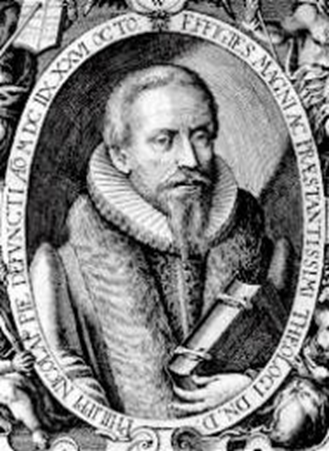
Born in Mengeringhausen, Waldeck, Germany, Nicolai lived an eventful life. He was the son of a Lutheran pastor in Westphalia. After the invasion by the Spanish Army in 1586, he fled, sparred with Roman and Calvinist opponents, and ministered to plague-stricken congregations. Educated first at Erfurt and then at Wittenberg University, he had been ordained a Lutheran pastor in 1583 in the city of Herdecke. In 1588 he became chief pastor at Altwildungen and court preacher to Countess Argaretha of Waldeck. During that time Nicolai battled with Calvinists, who disagreed with him about the theology of the real presence of Christ in the Lord’s Supper. These doctrinal controversies were renewed when he served the church in Unna, Westphalia. During his time as a pastor there, the plague struck twice, and Nicolai wrote both “How Brightly Shines the Morning Star” and “Wake, Awake.” Nicolai’s last years were spent as Pastor of St. Katherine’s Church in Hamburg.
In October, 1596, he became pastor at Unna, in Westphalia, where he again became engaged in heated controversy with the Calvinists. He passed through a frightful pestilence, and then on December 27, 1598, had to flee again before the invasion of the Spaniards, and did not return till the end of April, 1599. Finally, in April 1601, he was elected chief pastor of St. Katherine’s Church, at Hamburg. On October 22, 1608, he took part in the ordination of a colleague in the St. Katherine’s Church, the “diaconus” Penshora, and returned home feeling unwell. He contracted a violent fever, under which led to his death just a few days later.
In Hamburg Nicolai was universally esteemed, was a most popular and influential preacher, and was regarded as a “pillar” of the Lutheran church. In his private life he seems to have been most lovable and estimable. Besides his fame as a preacher, his reputation rests mainly on his hymns. His printed works are mostly polemical, often very violent and acrid in tone, and such as the undoubted sincerity of his zeal to preserve pure and unadulterated Lutheranism may explain, but cannot be said to justify. Of his hymns only four seem to have been printed. The two noted here (“Wake, Awake” and “How Brightly Shines”) rank as classical and epoch-making. The former is the last of the long series of Watchmen’s Songs. The latter marks the transition from the objective churchly period to the more subjective and experimental period of German hymn writing; and begins the long series of Hymns of Love to Christ as the Bridegroom of the Soul, to which Franck and Scheffler contributed such beautiful examples. Both are also worthy of note for their unusual and perfect rhythms, and for their splendid melodies.
Since this was so widely embraced by so many churches, it’s no surprise that Nicolai’s German text has been translated into multiple languages. For the English speaking world today, most hymnals uses variants of the text that has come from a combination of multiple translations. Many have drawn in part from one by William Mercer (1811-1873). He was born at Barnard Castle, Durham, England and educated at Trinity College, Cambridge. In 1840 he was appointed Incumbent of St. George’s, Sheffield. He died at Leavy Greave, Sheffield on August 21, 1873. His principal work was a large collection of psalms and hymns, “for the use of Congregations and Families.” For many years this collection was at the head of all the hymn-books in the Church of England, both in circulation and influence. Its large mixture of Wesleyan hymns, and of translations from the German gave it a distinct character of its own, and its grave and solemn music was at one time exceedingly popular. To it Mercer himself contributed several translations and paraphrases from the Latin and German, the latter mainly from the Moravian hymn-books. But his hymn-writing was far less successful than his editing.
Most hymnals today usually give only several stanzas, much abbreviated from the original German text. Some of these are up to six stanzas and reflect the English translation from Catherine Winkworth. Here is one of the compilations of the text in three stanzas, as found in the 1991 “Trinity Hymnal.” And many have noticed that Nicolai’s hymn is full of Scriptural allusions. One might almost expect to find a “proof text” version identifying the biblical references, line by line!
Add this hymn to list of those which are addressed to Jesus Himself. It is a long-song to the Savior, hailing His redeeming love for His people. It acknowledges His worthiness as the object of our adoration. The text is filled with images of the Lord Jesus.
Stanza 1 sings of the nations who see the glory of this great “King of grace.” And what a king He is, “lowly” at the same time that He is “glorious.” He is described as “the Morning Star,” shining brightly not only over the universe, but over history.
How lovely shines the Morning Star!
The nations see and hail afar
The light in Judah shining.
Thou David’s son of Jacob’s race,
My bridegroom and my King of grace,
For Thee my heart is pining.
Lowly, holy,
Great and glorious, Thou victorious Prince of graces,
Filling all the heav’nly places.
Stanza 2 sings words of invitation to the Lord, asking that He come to our “waiting heart,” to impart more of His amazing grace to us, won by His dying for us. It is our desire that we be united to His body to draw our life from Him, “e’en as the branch” draws its life from the tree.
Now richly to my waiting heart,
O Thou, my God, deign to impart
The grace of love undying.
In Thy blest body let me be,
E’en as the branch is in the tree,
Thy life my life supplying.
Sighing, crying,
For the savor of Thy favor, resting never
Till I rest in Thee forever.
Stanza 3 sings to the Father who has loved us from before the foundation of the world, expressing our gratitude that “Thy Son hast made a friend of me.” That gives us such security, even “in tribulation,” that “nothing me from Him can sever.”
Thou, mighty Father, in Thy Son
Didst love me ere Thou hadst begun
This ancient world’s foundation.
Thy Son hast made a friend of me,
And when in spirit Him I see,
I joy in tribulation.
What bliss is this!
He that liveth to me giveth life forever;
Nothing me from Him can sever.
The music was also written by Nicolai, two years after the text was completed. The beautiful harmonization used in hymnals today was written in 1730 by Johann Sebastian Bach. The hymn may not extremely familiar in many modern evangelical churches, but it is very well-known to organists because of the many versions composed for that instrument. It is frequently played during the Christmas season as well as at Epiphany.
Here is a link to hear “The Queen of Chorales.”