Sometimes we might get a little too sophisticated for our own good. Yes, there are great hymns with glorious melodies and harmonies and with rich and profound lyrics. But there are also wonderful hymns – “classic” hymns – with simple but beautiful music and with uncomplicated but immediately understandable lyrics. We need to maintain, and perhaps renew, our appreciation of the gospel songs we learned as children in Sunday School. We might be tempted to think these songs to simplistic and sentimental, characteristics of much of the hymn writing of the Victorian era. But isn’t the gospel simple enough for a child to understand, and a truth that has not touched us unless it has also touched out emotions?
Such are the hymns (more than ten thousand of them!) from the heart and pen of Francis Jane Van Alstyne, whom we know as Fanny Crosby (1820-1915). The daughter of John and Mercy Crosby, was born in Southeast, Putnam County, New York, March 24, 1820. She became blind at the age of six weeks from maltreatment of her eyes during a spell of sickness. A traveling “medicine man” (!) offered to help with an eye infection when she was just an infant. The poultice he prepared and applied to her eyes permanently burned them, preventing her from ever gaining sight. Her family sought professional medical care later, but to no avail. She remained blind for her entire 95 years.
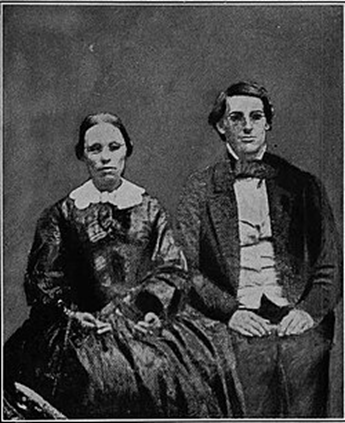
When she was eight years old she moved with her parents to Ridgefield, Connecticut, the family remaining there four years. At the age of fifteen she entered the New York Institution for the Blind, where she received a good education. She became a teacher in the institution in 1847, and continued her work until March 1, 1858. She taught English grammar, rhetoric and American history. Though her poetic skill and phenomenal memory showed up early in life, her secular poems have little to do with her world-wide fame. It is as a writer of Sunday-school songs and gospel hymns that she is known wherever the English language is spoken, and, in fact, wherever any other language is heard. Fanny was married March 5, 1858, to Alex. Van Alstyne, who was also a fellow student and then scholar in the same institution in which she was educated. They had only one child, a daughter named Frances born in 1859, who died in her sleep shortly after birth. It was likely this tragedy that inspired Fanny to write one of her most famous hymns, “Safe in the Arms of Jesus.” That heartbreak led to the couple living apart for many years, though they remained married until his death in 1902.
Her years at the Institution for the Blind were the great developing period in her life. During the vacations of 1852 and 1853, spent at North Reading, Massachusetts, she wrote the words to many songs for Dr. George F. Root, then the teacher of music at the blind institution. Among them were, “Hazel Dell,” “The Honeysuckle Glen,” “Rosalie, the Prairie Flower,” “Music in the Air,” “Proud World, Good-bye, I’m Going Home,” “All Together,” “Never Forget the Dear Ones,” and others. Subsequently she wrote the words for the cantatas of “The Flower Queen” and “The Pilgrim Fathers,” all of which were very popular in their day, though it was not generally known at the time that she was the author.
While teaching at the institution she met Presidents Van Buren and Tyler, Hon. Henry Clay, Governor William H. Seward, General Winfield Scott, and other distinguished characters of American history. Concerning Mr. Clay, she wrote the following: “When Mr. Clay came to the institution during his last visit to New York, I was selected to welcome him with a poem. Six months before, he had lost a son at the battle of Monterey, and I had sent him some verses. In my address I carefully avoided any allusion to them, in order not to wound him. When I had finished, he drew my arm in his, and, addressing the audience, said through his tears: ‘This is not the first poem for which I am indebted to this lady. Six months ago she sent me some lines on the death of my dear son.’ Both of us were overcome for a few moments. Soon, by a splendid effort, Mr. Clay recovered himself, but I could not control my tears.”
In connection with her meeting these notable men, one might add that Miss Fanny Crosby had the honor of being the first woman whose voice was heard publicly in the Senate Chamber at Washington. She read a poem there on one occasion. In addition to the thousands of hymns that she has written (about ten thousand poems in all), many of which have not been set to music, she has published four volumes of verses. The first was issued in 1844 and was entitled “The Blind Girl, and Other Poems,” a second volume, “Monterey, and Other Poems,” followed in 1849, and the third, “A Wreath of Columbia’s Flowers” in 1858. The fourth, “Bells at Evening and Other Verses,” with a biographical sketch by Rev. Robert Lowry, and a fine half-tone portrait, came in 1897, the sales of which reached multiple editions, published by The Biglow & Main Co., New York.
She began to write Sunday-school hymns for William B. Bradbury in 1864. Her first hymn,
“We are going, we are going, To a home beyond the skies,” was written at the Ponton Hotel on Franklin Street, New York City, on February 5th of that year. This hymn was sung at Mr. Bradbury’s funeral in January, 1868. Beginning in 1864, she supported herself by writing hymns. She resided in New York City nearly all her life, where, she said, she was “a member of the Old John Street M. E. Church in good standing.” She spent regular hours on certain days at the office of The Biglow & Main Co., the firm for which she did most of her writing, and for whom she has composed over four thousand hymns. Her hymns were in great demand and have been used by many of our most popular composers, among whom may be mentioned Wm. B. Bradbury, Geo. F. Root, W. H. Doane, Rev. Robert Lowry, Ira D. Sankey, J. R. Sweney, W. J. Kirkpatrick, H. P. Main, H. P. Danks, Philip Phillips, B. G. Unseld, and others. She could compose at any time and did not need to wait for any special inspiration, and her best hymns have come on the spur of the moment.
She always composed with an open book in her hand, generally a copy of “Golden Hymns,” held closely over her eyes, bottom side up. She learned to play on the guitar and piano while at the institution, and had a clear soprano voice. She also received a technical training in music, and for this reason she could, and did, compose airs for some of her hymns. One of these was, “Jesus, dear, I come to Thee, Thou hast said I may.” “Safe in the arms of Jesus,” probably one of her best known hymns, was her own favorite. Fanny loved her work, and was very happy in it. She was always ready either to sympathize or join in a mirthful conversation, as the case may be.
The secret of this contentment dates from her first composition at the age of eight years. “It has been the motto of my life,” she said. It is: “O what a happy soul am I! Although I cannot see, I am resolved that in this world Contented I will be.” This continued to be her philosophy throughout her life. She said that had it not been for her affliction, she might not have so good an education, nor so great an influence, and certainly not so fine a memory. She knew a great many portions of the Bible by heart, and had committed to memory the first four books of the Old Testament, and also the four Gospels before she was ten years of age.
Her scope of subjects was wide, embracing everything from a contemplation of heaven, as in “The Bright Forever” and “The Blessed Homeland,” to an appeal to the work of this world, as in “To the Work” and “Rescue the Perishing.” Most of Fannys published hymns have appeared under the name of Fanny J. Crosby or Mrs. Van Alstyne, but quite a large number have appeared under the nom de plumes of Grace J. Frances, Mrs. C. M. Wilson, Lizzie Edwards, Ella Dale, Henrietta E. Blair, Rose Atherton, Maud Marion, Leah Carlton, and nearly two hundred other different names, so desirous was she to avoid drawing attention to herself.
The theme of the hymn is stated in the first line and then driven home in the repeated refrain after each of the stanzas: it is to be “Near the Cross.” By this, Fanny Crosby certainly did not mean the idolatrous adoration of a man-made wooden or metal cross. She meant to have as the passionate desire and longing of our heart to stay near the Jesus who died on the cross, understanding and trusting in what He accomplished there by His vicarious, substitutionary death. It’s what the Apostle Paul meant in Galatians 2:20 when he wrote, “But far be it from me to boast except in the cross of our Lord Jesus Christ.”
One on-line devotional helpfully identifies four benefits we receive when we stay “Near the Cross.” Doing so keeps us humble, since we boast in nothing in ourselves, but only in the cross. Doing so makes us thankful, as we rejoice in what the cross has given us. Doing so keeps us focused daily, as we take up our cross daily to follow Him. And doing so keeps us hopeful, as we look forward to the cross carrying across the river Jordan into heaven.
Stanza 1 is a passionate request made to the Lord Jesus. Having been brought by Jesus to His cross in our regeneration, we now sing that Jesus would keep us near to Him. We recognize that without His maintaining and increasing our devotion, we will tend to wander into careless forgetfulness of the meaning of that work of redemption, allowing other things to distract us from what should be central in our lives, that “precious fountain” from which comes our spiritual life and hope, that “haling stream” that flows from Calvary. It is at the cross that we find our true identity. Fanny Crosby included in this stanza that simple but wonderful dimension of God’s saving grace. It is “free to all.”
Jesus, keep me near the cross,
There a precious fountain,
Free to all—a healing stream,
Flows from Calv’ry’s mountain.
In the refrain singers speak to themselves, expressing the longing that this cross would “be my glory ever,” all the way through our lives as believers, all the way until our “raptured souls shall find rest beyond the river.” Here Fanny Crosby must have had in mind Paul’s classic words in Galatians 6:14, “But far be it from me to boast except in the cross of our Lord Jesus Christ.”
In the cross, in the cross,
Be my glory ever;
Till my raptured soul shall find
Rest beyond the river.
Stanza 2 turns the singer’s attention away from Jesus (stanza1) and away from self (refrain) to address others, as a personal testimony about what happened to his or her own soul. Having come “near the cross” as a soul trembling with the weight of sin, “love and mercy found me.” That of course refers to Jesus coming in love and mercy. Fanny Crosby more directly speaks of Him as “the Bright and Morning Star,” alluding to Revelation 22:16 as one of the nearly 40 verses in Scripture that refer to the Savior in that imagery.
Near the cross, a trembling soul,
Love and mercy found me;
There the Bright and Morning Star
Sheds its beams around me.
Stanza 3 turns again to Jesus, the “Lamb of God” slain for sinners, asking Him to bring the cross into view again in our minds’ eyes. “Bring its scenes before me.” That happens when we read or just remember the passion narratives in the Gospels that describe that redemptive event. But our remembering is not enough if our lives are not affected by that remembrance. Just as we needed the lord to bring us to Calvary’s cross, we need Him just as much to help us walk in such a way that the shadow (meaning the reality and significance and power) of the cross falls upon us, so that we live with the consciousness and influence of Jesus’ saving love for us in all our comings and goings.
Near the cross! O Lamb of God,
Bring its scenes before me;
Help me walk from day to day,
With its shadow o’er me.
Stanza 4 looks to the future with the expectant hope and intentional commitment to remain near the cross all the way to that river that we have sung about in the refrain after each stanza. Our desire is not only that we would remain faithful to Him to the end, but that Jesus would remain faithful to us to the end. His promise to do so is found in many passages of Scripture (as in Romans 8 and Hebrews 13), so that our “hope” is not that of wishful thinking, but of absolute confidence.
Near the cross I’ll watch and wait,
Hoping, trusting ever,
Till I reach the golden strand,
Just beyond the river.
The tune NEAR THE CROSS, written by William H. Doane (1832-1915) in 1869, was obviously composed for this text. He was born in Preston, Connecticut. His father was head of the firm of Doane & Treat, cotton manufacturers. At the early age of fourteen, he was the chosen leader of the choir of Woodstock Academy, a Congregational school, where he had been placed by his father. During the last year of his stay there he was converted. His mother being a Baptist, he united with that church at Norwich, Connecticut. In 1847 he became a clerk in his father’s office, and three years later engaged himself with the firm of J.A. Fay & Co., manufacturers of wood-working machinery, whose principal office was then at Norwich, Connecticut. In 1860 he became the managing partner of the firm, with headquarters in Cincinnati, Ohio. At the death of the senior partner, the firm became an incorporated company, of which he was made president. It was one of the most extensive businesses in its line at the time, having connections in many of the principal mercantile centers of the world.
With such large business interests in his charge, it would seem remarkable that he should have gained such eminence in music. But music was in him and it must find expression. It would not be smothered, hence at every stage of his career, it was asserting itself. He composed his first piece of music in his sixteenth year. In 1852 he was conductor of the Norwich Harmonic Society. In 1862 his first book appeared, entitled “Sabbath School Gems,” followed in 1867 by “Little Sunbeams,” and in 1868 came the notable book, “Silver Spray,” which was perhaps was the most popular Sunday-school book of its day. Then followed in 1870,the popular “Songs of Devotion,” for use in churches. He then became associated with Rev. Robert Lowry in many musical works, most of which were issued by Messrs. Biglow & Main, New York. Dr. Doane was justly celebrated on account of his Christmas cantatas. He fairly popularized the Christmas cantata business by the issue of one entitled, “Santa Claus.” The circulation of books bearing his name became world-wide, and the copies sold are counted in the millions.
Dr. Doane was described as of medium height, nervous temperament, and rapid in all of his movements; always cheerful, warm-hearted and generous. Coupled with his educational attainments and ripe business experience he was a lover of home, church, and country that endeared him to lovers of American institutions wherever he was known. He had a beautiful residence on Mount Auburn, one of the Cincinnati hills, where he lived in happiness with the wife of his youth, she being the daughter of his father’s former partner, and two accomplished daughters.
His famous study, or music room, was a unique feature of his home. It was as complete in all respects as taste, culture, research, and money could make it. As one entered it, over the door in the transom was wrought in ground glass in musical characters the opening strains of “Home, Sweet Home.” On the ceiling inside, at various points, were frescoed bits of celebrated musical compositions beautifully and artistically arranged. Fine pictures, mostly of musical subjects, adorned the walls, with a most extensive collection of antique instruments from Egypt, Mexico, Burma, Japan, Africa, Russia, Turkey, and Syria, some of which were said to be several hundred years old. And there was a grand pipe organ, run by a water motor, and over the organ, in fresco, four measures of the “Hallelujah Chorus.” There were also pianos, a cabinet organ, harp and many other modern instruments. The library was exceptionally fine, and one of the largest in the country at the time, containing vellum manuscript dating from the eighth century, facsimiles of the original score of Handel’s Messiah, and original manuscript and autographs of nearly all the old masters, including Beethoven, Mendelssohn, Mozart, Handel, Meyerbeer, and also Dr. Lowell Mason, Dr. Thomas Hastings, William Bradbury, Dr George Root, Philip Bliss, Robert Lowry, and other American composers.
Doane was an active member of the Mount Auburn Baptist Church, Cincinnati, and for several years was superintendent of its flourishing Sunday School, one of the largest in the city. He and his family spent nearly two years in Europe, visiting the Holy Land, the occasion being the exhibiting of some of his machinery at an European exposition, on which, by the way, he took the highest award. The Mount Auburn Sunday School gave a welcoming service on his return. It was a splendid affair. The schoolroom was tastefully decorated, and on the platform sat a large floral ship named the “Majestic,” in honor of the one that had brought the Doctor and his family over the ocean on their return. When he came in they all, young and old, gave him the Chautauqua salute, and proceeded with a specially prepared service that was unique and beautiful. The demonstrations were universal and hearty, and showed that their superintendent had a warm place in their hearts.
Dr. Doane was a generous man. Among his benefactions are Doane Hall and Doane Academy of Denison University; and he and the late Mr. John Church, of the John Church Co., donated from the receipts of the “Silver Spray” money to purchase the large pipe organ in the Y.M.C.A. Hall in Cincinnati. The organ is called“Silver Spray.” Doane was an active member of the Y.M.C.A., and one of its active supporters. He wrote his music at home in the evenings. Yet he carried his little note-book with him, so as to be prepared to note down, wherever he might be, the inspirations that would come to him.
Doane compiled some forty books, and wrote about twenty-three hundred songs, ballads, cantatas, etc., as well as a number of vocal and piano pieces in sheet form. Some of his most popular pieces are: “Safe in the arms of Jesus,” “The Old, Old Story,” “Pass Me Not,” “A Few More Marchings,” “More Love to Thee, O Christ,” “Every Day and Hour,” “Rescue the Perishing,” “Near the Cross,” “Draw Me Nearer,” “Will He Find Us Watching,” and many others. In 1875 Denison University bestowed upon him the title of Doctor of Music.
Here is a link to the performance of the hymn.