
Jesus’ letter to the church in Ephesus in Revelation 2 identified many very commendable things about the church in that city. They were doctrinally discerning, diligent in ministry activities, and persevering in serving the Lord. But there was one overwhelmingly devastating problem, they had forsaken their first love. The first and greatest commandments is that we are to love the Lord our God with all our heart, soul, strength, and mind (Matthew 22:37). The believers in Ephesus had that love in the beginning. But by this time that love for Jesus had grown cold. It’s a powerful lesson to teach us that busyness and orthodoxy are no substitutes for devotion for the lover of our souls.
Two of the Bible’s most prominent themes are God’s love for us and our love for Him. The cross is the greatest proof of God’s love for us. And the essence of the Christian life is our love for Him. The first motivates and thrills us, and the second shapes how we please Him. As our Bibles are full of passages about both, so also are our hymnals full of compositions about both His love for us and our love for Him. A quick check of the topics in the table of contents in the front and those in the topical index at the back will not confirm that, but also make an impressive demonstration of that.
To love Jesus is not merely a command (it is that!). It is the natural reaction of the soul that has been redeemed by Him at such great cost and motivated by such love. As believers, we don’t just love Him because we’re supposed to, any more than we love our marital spouse because we’re supposed to. In a sense, if we are savingly united to Christ (similar to our being maritally united to our spouse), we will love Jesus with all our heart as the natural, instinctive attitude we have toward Him. And the more we know about Him, and spend time with Him, the more we will love him.
In a small book of daily devotions for the Advent season (“Good News of Great Joy,” Crossway, 2021) John Piper has written this on pages 124-125. He was describing one of the implications of 1 John 3:8, that “the reason the Son of God appeared was to destroy the works of the devil.” Since the work of the devil is sin, and has been from the beginning, Jesus came to overcome it. But having come as our Redeemer, Jesus has not only secured our forgiveness; He has also brought us a new nature that fights against sin. But we still sin, even as believers, and we’re tempted to think its hopeless; that we should just give and stop even trying. Here’s how Piper responds to that temptation.
The second implication of the twofold truth that Christ came to destroy our sinning and to forgive our sins is this: we make progress in overcoming our sin when we have hope that our failures will be forgiven. If you don’t have hope that God will forgive your failures, when you start fighting sin, you give up.
Many of you are pondering some changes in the new year because you have fallen into sinful patterns and want out. You want some new patterns of eating. New patterns for entertainment. New patterns of giving. New patterns of relating to your spouse. New patterns of family devotions . New patterns of sleep and exercise. New patterns of courage in witness. But you are struggling, wondering whether it’s any use. Well, here’s your second Christmas present: Christ not only came to destroy the works of the devil, our sinning, He also came to be an advocate for us because of experiences of failure in our fight.
So I plead with you, let the fact that failure will not have the last word give you the hope to fight. But beware! If you turn the grace of God into license, and say, “Well, if I can fail, and it doesn’t matter, then why bother fighting sin?” – if you say that, and mean it, and go on acting on it, you are probably not born again and should tremble.
But that is not where most of you are. Most of you want to fight sinful patterns in your life. And what God is saying to you is this: let Christ’s covering of your failures give you hope to fight. “I write this to you that you might not sin, but if you sin you have an advocate, Jesus Christ.”
This is what motivates us to love this Jesus who has so wonderfully loved us. One of the widely-known and often-sung hymns of this theme is “Jesus, Thou Joy of Loving Hearts.” The English text is based on a poem usually attributed to Bernard of Clairvaux, written by him in the 12th century during a period often called the Dark Ages. The church was plagued with spiritual and moral decay at that time. The poem was translated from Latin in 1858 by Dr. Ray Palmer. Since Palmer did a free paraphrase rather than a strict translation, many consider that the hymn as it is known today was written by both Bernard of Clairvaux and Palmer.
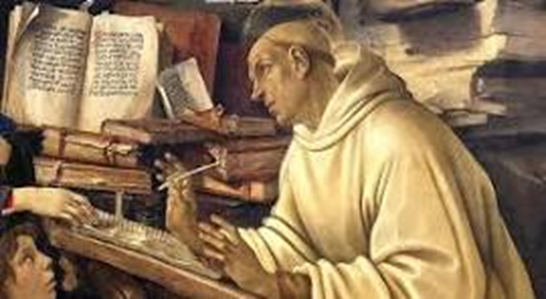
Bernard of Clairvaux (ca. 1091 – 1153) was a French nobleman by birth. His father was a knight, and his mother was a gracious and devout woman. With all the advantages of his upbringing, he possessed a high standard of character, excellent manners, and eloquence of speech. Influenced by the piety of his mother, who taught him the Christian faith, he grew up loving the Lord. Bernard could have continued to enjoy a life of luxury, but after his mother’s death, he gave it all up to become a monk. He wrote from personal experience when he said in the first stanza of the hymn that one can be “unfilled” by “the best bliss that earth imparts.”
Hymns such as this are sometimes criticized because they sound too much like a medieval monk, secluded in a monastery, unaware of the needs in the world, but Bernard broke free from that way of thinking. He understood that for Jesus’ purposes to be accomplished, Christians had to do it. Bernard diligently studied the Bible and knew the scriptures in his mind that were also real in his heart. His strong personality and leadership made him one of the most influential religious leaders of that time. He held evangelistic campaigns, and his eloquent, strong preaching challenged popes, kings, and political leaders to live godly lives. He also admonished professors to teach the truth. He emphasized a personal relationship with the Lord, Bible study, prayer, holiness, and ministering to the spiritual and physical needs of others. When he was selected to lead the Second Crusade in 1146, he required those joining the Crusade to give evidence of a personal conversion experience. Bernard of Clairvaux was a bright light in the spiritual decay of the Dark Ages.
His father, Tecelin, or Tesselin, a knight of great bravery, was the friend and vassal of the Duke of Burgundy. Bernard was born at his father’s castle on the eminence of Les Fontaines, near Dijon, in Burgundy, in 1091. He was educated at Chatillon, where he was distinguished for his studious and meditative habits. The world, it would be thought, would have had overpowering attractions for a youth who, like Bernard, had all the advantages that high birth, great personal beauty, graceful manners, and irresistible influence could give, but, strengthened in the resolve by night visions of his mother (who had died in 1105), he chose a life of asceticism, and became a monk.
In company with an uncle and two of his brothers, who had been won over by his entreaties, he entered the monastery of Citeaux, the first Cistercian foundation, in 1113. Two years later he was sent forth, at the head of twelve monks, from the rapidly increasing and overcrowded abbey, to found a daughter institution, which in spite of difficulties and privations which would have daunted less determined men, they succeeded in doing, in the Valley of Wormwood, about four miles from the Abbey of La Ferté on the Aube.
On the death of Pope Honorius II., in 1130, the Sacred College was rent by factions, one of which elected Gregory of St. Angelo, who took the title of Innocent II., while another elected Peter Leonis, under that of Anacletua II. Innocent fled to France, and the question as to whom the allegiance of the King, Louie VI, and the French bishops was due was left by them for Bernard to decide. At a council held at Etampes, Bernard gave judgment in favor of Innocent. Throwing himself into the question with all the ardor of a vehement partisan, he won over both Henry I, the English king, and Lothair, the German emperor, to support the same cause, and then, in 1133, accompanied Innocent II, who was supported by Lothair and his army, to Italy and to Rome. When Lothair withdrew, Innocent retired to Pisa, and Bernard for awhile to his abbey of Clairvaux. It was not until after the death of Anacletus, the antipope, in January, 1138, and the resignation of his successor, the cardinal-priest Gregory, Victor II, that Innocent II, who had returned to Rome with Bernard, was universally acknowledged Pope, a result to which no one had so greatly contributed as the Abbot of Clairvaux.
The influence of the latter now became paramount in the Church, as was proved at the Lateran Council of 1139, the largest council ever collected together, where the decrees in every line displayed the work of his master-hand. After having devoted four years to the service of the Pope, Bernard, early in 1135, returned to Clairvaux. In 1137 he was again at Rome, impetuous and determined as ever, denouncing the election of a Cluniac instead of a Clairvaux monk to the see of Langres in France, and in high controversy in consequence with Peter, the gentle Abbot of Cluny, and the Archbishop of Lyons. The question was settled by the deposition by the Pope of the Cluniac and the elevation of a Clairvaux monk (Godfrey, a kinsman of St. Bernard) into his place. In 1143, Bernard raised an almost similar question as to the election of St. William to the see of York, which was settled much after the same fashion, the deposition, after a time, if only for a time, of William, and the intrusion of another Clairvaux monk, Henry Murdac, or Murduch, into the archepiscopal see. Meantime between these two dates, in 1140, at the condemnation of Peter Abelard, Bernard appeared personally as prosecutor, took place at a council held at Sens. Abelard, condemned at Sens, appealed to Rome, and, resting awhile on his way thither, at Cluny, where Peter still presided as Abbot, died there in 1142.
St. Bernard was next called upon to exercise his unrivalled powers of persuasion in a very different cause. Controversy over, he preached a crusade. The summer of 1146 was spent by him in traversing France to rouse the people to engage in the second crusade; the autumn with a like object in Germany. In both countries the effect of his appearance and eloquence was marvelous, almost miraculous. The population seemed to rise en masse, and take up the cross. In 1147 the expedition started, a vast horde, of which probably not a tenth ever reached Palestine. It proved a complete failure, and a miserable remnant shared the flight of their leaders, the Emperor Conrad, and Louis, King of France, and returned home, defeated and disgraced. The blame was thrown upon Bernard, and his apology for his part in the matter is extant. He was not, however, for long to bear up against reproach; he died in the 63rd year of his age, in 1153, weary of the world and glad to be at rest.
The text of “Jesus, Thou Joy of Loving Hearts” is taken from a 192-line medieval devotional poem long attributed to Bernard, “Jubilus Rhythmicus de Nomine Jesu,” also called “The Rosy Hymn”or the “Jubilee Rhythm,” based on the Song of Solomon. It first appeared in the 12th century, around 1150. Other hymns taken from this poem include “Jesus, The Very Thought of Thee” (“Jesu, dulcis memoria”) and “O Jesus, King Most Wonderful” (“Jesu, Rex admirabilis”).
Our English text today comes from a translation rendered by Dr. Ray Palmer (1808-1887). He was born at Little Compton, Rhode Island. His early life was spent at Boston, where he was for some time clerk in a dry-goods store. At Boston he joined the famous Park Street Congregational Church, then under the pastoral care of Dr. S. E. Dwight. After spending three years at Phillips Academy, Andover, he entered Yale College, New Haven, where he graduated in 1830. In 1835 he became pastor of the Central Congregational Church, Bath, Maine. During his pastorate there he visited Europe in 1847. Palmer was a popular preacher and author, writing original poetry as well as translating hymns. He published several volumes of poetry and hymns, including “Sabbath Hymn Book” (1858), “Hymns and Sacred Pieces” (1865), and “Hymns of My Holy Hours”(1868). His complete poetical works were published in 1876.
In 1850 he was appointed to the First Congregational Church, at Albany, New York, and in 1865 Corresponding Secretary to the American Congregational Union, New York. He resigned in 1878, and retired to Newark, New Jersey, where he died. He was pastor of the First Congregational Church of Albany, New York when he translated Bernard’s poem in 1858. He was frequently ill and lonely and found comfort in writing poetry. He was the first American writer to translate Latin hymns into English. He also wrote several hymn of his own, and is best remembered for his hymn, “My Faith Looks Up to Thee,” written when he was fresh out of college.
“Jesus, Thou Joy of Loving Hearts!” expresses the immeasurable peace that comes from a personal relationship with Jesus Christ, the “fount of life’ and the “light of men.” …we also joy in God through our Lord Jesus Christ, “ (Romans 5:11). Christ’s truth will never change, and those who seek Him will indeed find Him as their “all in all.” Christ is identified as the “living bread” and the “fountainhead” from which the believer’s soul is filled. Trusting in Christ results in rest for the believer during difficult times. The hymn then concludes with a desire for Christ’s continuing presence, assured of His promise.… “Lo, I am with you always, even unto the end of the world. Amen” (Matthew 28:20). This hymn should be a reflection of the joy and love in every believer’s heart.
Once again, we find a hymn packed full of Scripture quotations and allusions. What an indictment against our generation that in both pew and pulpit we are so unfamiliar with the Bible that we miss many of these as we sing them.
Stanza 1 pictures Jesus as the fount of life and light. In John’s prologue to his Gospel, he identifies the Lord as the source of both of those. This is set in contrast to “all the best bliss that earth imparts” (Colossians 3:1-2). However, the “best bliss” of earth cannot satisfy our innermost needs and longings, so we must turn, unfilled, to the Lord (Psalm 42:1-2).
Jesus, Thou Joy of loving hearts,
Thou Fount of life, Thou Light of men,
From the best bliss that earth imparts,
We turn unfilled to Thee again.
Stanza 2 pictures Jesus as the truth that saves. Only God’s truth can make us free, and Christ Himself is that truth, which is then revealed to us in His word (John 8:32; 14:6; and 17:17). Because of this truth, Christ will surely save all those who truly call on Him (Acts 2:21; 1 Timothy 1:15). And to those who do seek and find Him, He becomes their all in all (Colossians 3:11).
Thy truth unchanged hath ever stood,
Thou savest those that on Thee call;
To them that seek Thee, Thou art good,
To them that find Thee, all in all.
Stanza 3 pictures Jesus as the living bread and water in a stanza wonderfully suited for occasions of communion when we come to eat and drink at the Lord’s table. Jesus identified Himself as the living bread (John 6:35, 41). Christ is also the fountain of living water which He offered to the woman at the well (John 4:14). And all who come to this fountain for living water will have their thirst filled (John 7:37-38.
We taste Thee, O Thou living Bread,
And long to feast upon Thee still;
We drink of Thee, the Fountain head,
And thirst our souls from thee to fill.
Stanza 4 pictures Jesus as he rest our restless spirits need and can enjoy if we will but heed His invitation to come to Him for that rest (Matthew 11:28-30). When we receive this rest, we can, through spiritual eyes, see His glad smile and be glad (Philippians 4:4). And by holding fast to Him in faith, we can be blessed Matthew 5:3-10).
Our restless spirits yearn for Thee,
Where’ er our changeful lot is cast;
Glad when Thy gracious smile we see,
Blest when our faith can hold Thee fast.
Stanza 5 pictures Jesus as an eternal presence in our lives. He has promised to be with His people as we allow Him to dwell in our hearts by faith (Matthew 28:20; Ephesians 3:17). His presence will chase the dark night of sin away from us (Ephesians 5:8-14). And He will shed over us, and through us over the world, His holy light, light from the one who is the light of the world (1 Thessalonians 5:4-8).
O Jesus, ever with us stay,
Make all our moments calm and bright;
Chase the dark night of sin away,
Shed o’er the world Thy holy light.
The text has been joined to the tune QUEBEC, one of many musical compositions written by Anglican priest and musician Sir Henry Williams Baker (1821-1877). He was the son of Vice-admiral Sir Henry Loraine Baker. His father served with distinction at Guadeloupe in 1815. Sir Henry Williams Baker was born in London on Sunday, May 27, 1821 in the house of his maternal grandfather. After completing his university education at Trinity College, Cambridge, took his B.A. degree and holy orders in 1844, and proceeded to earn his M.A. in 1847. In 1851 he was presented to the vicarage of Monkland near Leominister. At the death of his father, on November 2, 1859, he succeeded him as third baronet.
In 1852, while at Monkland, Sir Henry wrote his earliest hymn, “Oh, What If We Are Christ’s.” His name is chiefly known as the promoter and editor of “Hymns Ancient and Modern,” first published in 1861. To this collection Baker contributed many original hymns, besides several translations of Latin hymns. In 1868 an “Appendix” to the collection was issued, and in 1875 the work was thoroughly revised. The hymnal was compiled to meet the wants of churchmen of all schools, but strong objections were raised in many quarters to Sir Henry Baker’s own hymn addressed to the Virgin Mary, “Shall We Not Love Thee, Mother Dear?”
Sir Henry held to the doctrine of clerical celibacy, and at his death the baronetcy passed on to a relative. He was the author of “Daily Prayers for the Use of those who have to work hard,” as well as of a “Daily Text-book” for the same class, and of some tracts on religious subjects. He died at the age of 55 at the vicarage of Monkland, and was buried in the churchyard of the parish. His last words were from his hymn “The King of Love My Shepherd Is,” which includes the line “Perverse and foolish oft I strayed, But yet in love He sought me, And on His shoulder gently laid, And home, rejoicing, brought me.” Stained glass windows have been put up to his memory in his own church and in All Saints, Notting Hill.
Here is a link to the hymn as sung on a Sunday morning in New York City with choir and organ.