
“Preeminence” is a powerful word in any context. It is the word used to describe something or someone that is at the very top, the greatest in authority, importance, power, influence, or value. In Colossians 1:18, Paul said that Jesus is preeminent. The Greek word he used, proteuo, occurs in no other place in Scripture. It is a very fitting way to speak of Jesus in His all-encompassing greatness. The full section in Paul’s epistle is an awesome statement about Jesus’ preeminence.
15 He is the image of the invisible God, the firstborn of all creation. 16 For by Him all things were created, in heaven and on earth, visible and invisible, whether thrones or dominions or rulers or authorities—all things were created through Him and for Him. 17 And He is before all things, and in Him all things hold together. 18 And He is the head of the body, the church. He is the beginning, the firstborn from the dead, that in everything He might be preeminent. 19 For in Him all the fullness of God was pleased to dwell, 20 and through Him to reconcile to Himself all things, whether on earth or in heaven, making peace by the blood of His cross.
21 And you, who once were alienated and hostile in mind, doing evil deeds, 22 He has now reconciled in His body of flesh by His death, in order to present you holy and blameless and above reproach before Him, 23 if indeed you continue in the faith, stable and steadfast, not shifting from the hope of the gospel that you heard, which has been proclaimed in all creation under heaven, and of which I, Paul, became a minister.
In this section of chapter 1, Paul was describing to the believers in Colossae that preeminence of Jesus in rather extravagant images. In some ways, the way Paul presents Jesus sounds like the account of the dazzling glory of Jesus revealed on the Mount of Transfiguration. That, along with Isaiah 6 and Revelation 1, convicts us that our view of Jesus falls far short of the glory that is inherently His. In Colossians 1:15-23, we have what many have suggested is an early Christian hymn, a hymn about the preeminence of Christ.
The passage is written with elegant prose that sounds like Paul was either enthralled with Jesus at that moment, or was actually quoting a first century hymn that he and the people of Colossae knew. The words don’t have the kind of rhyming structure we find in hymns today. But there is a thematic structure that is clearly evident, suggestive of four stanzas about Jesus’ preeminence. Stanza 1 is about Jesus’ preeminence in creation (by Him all things were created), stanza 2 is Jesus’ preeminence in the church (He is the head of the body, the church), stanza 3 is Jesus’ preeminence in the Trinity (in Him all the fullness of God was pleased to dwell), and stanza 4 is Jesus’ preeminence in reconciliation (through Him to reconcile all things to Himself).
Our hymnals today offer us many possibilities to sing of the Savior’s preeminence. One of the finest is “Join All the Glorious Names,” first published in 1707 by “The Father of English Hymnody,” Isaac Watts (1674-1748). This hymn is generally regarded as one of the finest among his approximately 650 hymns and psalm paraphrases. His hymns are well represented in every hymnal today in the English language, from “Joy to the World” to “When I Survey the Wondrous Cross,” from “Jesus Shall Reign” to “Alas, and Did My Savior Bleed” and “O God, Our Help in Ages Past.”
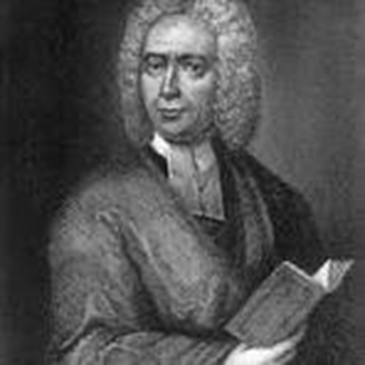
Isaac Watts’s father was a respected Nonconformist, and at the birth of the child, and during young Isaac’s infancy, twice suffered imprisonment for his religious convictions. In his later years, he kept a flourishing boarding school at Southampton. Isaac, the eldest of his nine children, was born in that town on July 17, 1674. His taste for verse showed itself in early childhood. He was taught Greek, Latin, and Hebrew by Mr. Pinhorn, rector of All Saints, and headmaster of the Grammar School in Southampton. The splendid promise of the boy induced a physician of the town and other friends to offer him an education at one of the Universities for eventual ordination in the Church of England, but this he refused; and entered a Nonconformist Academy at Stoke Newington in 1690, under the care of Mr. Thomas Rowe, the pastor of the Independent congregation at Girdlers’ Hall. Of this congregation he became a member in 1693.
Leaving the Academy at the age of twenty, he spent two years at home; and it was then that the bulk of the “Hymns and Spiritual Songs” (published 1707-9) were written and sung from manuscripts in the Southampton Chapel. The hymn “Behold the Glories of the Lamb” is said to have been the first he composed, and written as an attempt to raise the standard of praise. In answer to requests, other compositions followed in succession. The hymn “There is a Land of Pure Delight” is said to have been suggested by the view across Southampton Water. The next six years of Watts’s life were again spent at Stoke Newington, in the post of tutor to the son of an eminent Puritan, Sir John Hartopp; and to the intense study of these years must be traced the accumulation of the theological and philosophical materials which he published subsequently, and also the life-long enfeeblement of his constitution.
Watts preached his first sermon when he was twenty-four years old. In the next three years he preached frequently; and in 1702 was ordained pastor of the eminent Independent congregation in Mark Lane, over which Caryl and Dr. John Owen had presided, and which numbered Mrs. Bendish, Cromwell’s granddaughter, Charles Fleetwood, Charles Desborough, Sir John Hartopp, Lady Haversham, and other distinguished Independents among its members. In this year he moved to the house of Mr. Hollis in the Minories. His health began to fail in the following year, and Mr. Samuel Price was appointed as his assistant in the ministry. In 1712 a fever shattered his constitution, and Mr. Price was then appointed co-pastor of the congregation which had in the meantime removed to a new chapel in Bury Street.
It was at this period that he became the guest of Sir Thomas Abney, under whose roof, and after his death (1722) that of his widow, he remained for the rest of his suffering life. It was a residence most favorable for his poor health, and for the prosecution of his literary labors. He did not retire from ministerial duties, but preached as often as his delicate health would permit. He remained for the longer portion of thirty-six years principally at the beautiful country seat of Theobalds in Herts, and for the last thirteen years at Stoke Newington. His degree of D.D. was bestowed on him in 1728, unsolicited, by the University of Edinburgh. His infirmities increased on him up to the peaceful close of his sufferings, November 25, 1748. He was buried in the Puritan resting place at Bunhill Fields, but a monument was erected to him in Westminster Abbey.
The number of Watts’ publications is very large. His collected works, first published in 1720, embrace sermons, treatises, poems and hymns. His “Horae Lyricae” was published in December, 1705. His “Hymns” appeared in July, 1707. The first hymn he is said to have composed for religious worship, is “Behold the Glories of the Lamb,” written at the age of twenty. It is as a writer of psalms and hymns that he is everywhere known. Some of his hymns were written to be sung after his sermons, giving expression to the meaning of the text upon which he had preached. Montgomery called Watts “the greatest name among hymn-writers,” and the honor can hardly be disputed.
Following his death, a monumental statue was erected in Southampton, his native place, and there is also a monument to his memory in the South Choir of Westminster Abbey. At that time, “Happy,” said a great contemporary champion of Anglican orthodoxy, Charles Hutchins, “will be that reader whose mind is disposed, by his verses or his prose, to imitate him in all but his non-conformity, to copy his benevolence to men, and his reverence to God.” While pictures of him that have survived do not suggest any problem, yet a famous quote has remained from Elizabeth Singer, a poet who was attracted to his mind but disappointed by his physical appearance. When meeting him in person, she is reported to have told him, “I only wish that I could say that I admire the casket as much as I admire the jewel!” (“Casket” was a word once used to refer to a container for jewelry.) He was described as being about five feet tall, with yellowish skin, a large, hooked nose, and a disproportionately large head. Despite this, Watts remained a friend to her.
His learning and piety, gentleness and largeness of heart earned him the title of the Melanchthon of his day. His theological as well as philosophical fame was considerable. His “Speculations on the Human Nature of the Logos,” as a contribution to the great controversy on the Holy Trinity, brought on him a charge of Arian opinions. His work on “The Improvement of the Mind,” published in 1741, was eulogized by Johnson. His “Logic” was for many years a valued textbook at Oxford. “The World to Come,” published in 1745, was once a favorite devotional work, parts of it being translated into several languages. His “Catechisms”and“Scripture History” (1732), as well as “The Divine and Moral Songs” (1715), were for some time the most popular text-books for religious education. The “Hymns and Spiritual Songs” were published in 1707-1709, though written earlier. The “Horae Lyricae,” which contains hymns interspersed among the poems, appeared in 1706-1709. Some hymns were also appended at the close of the several “Sermons” preached in London, published in 1721-1724. The “Psalms” were published in 1719. The earliest life of Watts is that by his friend Dr. Gibbons. Samuel Johnson included him in his “Lives of the Poets.”
Looking at the text of this hymn, we are pointed toward the many glorious names and titles rightly ascribe to Christ. The list of them is very impressive, and drives us to exuberant worship. Among them are the titles of His three-fold office, as first highlighted by Calvin and subsequently included in post-Reformation catechisms and confessions, both Westminster and Heidelberg. Jesus perfectly fulfills the biblical offices of prophet, priest, and king, both in His humiliation and His exaltation, as we see in Philippians 2:5-11. A profitable exercise would be to take all the stanzas of the hymn and list how many names and titles Watts has incorporated into the text. Our love for the Lord Jesus should cause us to find this hymn a particular favorite, as it enables us to laud so many expressions of his divine glory, the Savior who is so precious to us because He has considered us so precious to Himself.
While Watts wrote a number of stanzas for this hymn, typically only five are chosen for inclusion in most hymnals today. And among the stanzas, there has been a surprising variety of minor variations found in modern hymnals and on-line studies. The primary five stanzas are shown below with others in smaller font italics. In some instances, the hymn bears the title, “The Offices of Christ, from several scriptures.” The stanza numbers below correspond with the frequent occurrence in most hymnals today, with seldom-sung stanzas left without comment or numbers.
Stanza 1 announces the overall theme of the hymn: “all the glorious names.” It immediately proclaims the preeminence of Christ, in that there are not enough names to adequately convey all the dimensions of the vast array of His glorious character. The language seems exaggerated by speaking of wisdom, love, and power (that trinity of central divine attributes of His) not only known by mortals but even by angels. And yet that is exactly the point. All of those combined are still “too poor to set my Savior forth.”
Join all the glorious names of wisdom, love, and pow’r,
That ever mortals knew, that angels ever bore:
All are too poor to speak His worth,
Too poor to set my Savior forth.
But O what gentle terms,
What condescending ways,
Doth our Redeemer use
To teach His heav’nly grace!
Mine eyes with joy and wonder see
What forms of love He bears for me.
Arrayed in mortal flesh,
He like an angel stands,
And holds the promises
And pardons in His hands;
Commissioned from His Father’s throne
To make His grace to mortals known.
Stanza 2 begins to list some of those names which have been given to us in the scriptures. Here is the first of the three royal leadership titles from the Old Testament (prophet, priest, and king) which Jesus so perfectly fulfills. As prophet, Jesus declares to us the will and character of God. This is “joyful news” because He gives us what we need to know for our salvation, with three special benefits named here, news “of sin forgiv’n, of hell subdued, and peace with heav’n.”
Great Prophet of my God, my tongue would bless Thy Name,
By Thee the joyful news of our salvation came,
The joyful news of sin forgiv’n,
Of hell subdued, and peace with heav’n.
I love my Shepherd’s voice,
His watchful eyes shall keep
My wand’ring soul among
The thousands of His sheep:
He feeds His flock, He calls their names,
His bosom bears the tender lambs.
To this dear Surety’s hand
Will I commit my cause;
He answers and fulfils
His Father’s broken laws:
Behold my soul at freedom set!
My Surety paid the dreadful debt.
Stanza 3 sets before us the second of those three offices, that of being appointed by the Father to be the Messiah to fulfill the office of High Priest. His work in that position is infinitely greater than any Old Testament priest, even the high priest for the temple in Jerusalem. That human priest was permitted into the holy of holies into the presence of God only once a year, to offer sacrifice for the sins of the people and to intercede on their behalf. But Jesus is God Hmself, and not only offers a sacrifice, He is the sacrifice, offering His own blood once for all to atone for our sins. And He does not enter heaven’s throne room occasionally, but is permanently seated there, applying the merits of His propitiatory work and interceding for the saints night and day.
Jesus, my great High Priest, offered His blood, and died;
My guilty conscience seeks no sacrifice beside:
His powerful blood did once atone,
And now it pleads before the throne.
My Advocate appears
For my defense on high;
The Father bows His ears,
And lays His thunder by:
Not all that hell or sin can say
Shall turn His heart, His love away.
Stanza 4 expands on Jesus’ ministry as our great High Priest. From heaven’s throne He comes to us daily to meet all our needs “according to His riches in grace.” As our Counselor, he brings us wisdom to understand His will and His ways. As our pattern, He shows us by His perfect life how the fruit of the Spirit should be displayed in our living. And as our Guide, He walks with us as the Light of the World (John 9), and as a lamp to our feet (Psalm 119) and guide to our path. In addition, in this stanza He is our Good Shepherd (Psalm 23 and John 10) to keep us near Himself, to keep us from wandering, and to rescue us when we do.
Thou art my Counselor, My pattern and my Guide,
And Thou my Shepherd art; O keep me near Thy side;
Nor let my feet e’er turn astray
To wander in the crooked way.
Stanza 5 brings us to the third of those three great offices, that of King. In that royal position, He rules over us to protect and provide all that we need for life and godliness (1 Peter 1:3). The first dimension of that work as our King was to conquer us, to deliver us from rebellious, treasonous guilt and bondage to Satan and our sin nature. As conquered subjects, we are not bitter slaves but rather are rejoicing children. We praise Him for His power as we “sit in willing bonds beneath Thy feet.”
My Savior and my Lord, My Conqu’ror and my King,
Thy scepter and Thy sword, Thy reigning grace I sing:
Thine is the power; behold I sit
In willing bonds beneath Thy feet.
Now let my soul arise,
And tread the tempter down;
My Captain leads me forth
To conquest and a crown:
A feeble saint shall win the day,
Though death and hell obstruct the way.
Should all the hosts of death,
And powers of hell unknown,
Put their most dreadful forms
Of rage and mischief on,
I shall be safe, for Christ displays
Superior power, and guardian grace.
The tune most often used for Watts’s text is DARWALL, a very familiar one used for multiple texts, often in the same hymnal. It was composed by John Darwall (1732-1789). The son of a pastor, he was born in Haughton, Staffordshire, England. He attended Manchester Grammar School and Brasenose College, Oxford, England, which he entered at the age of 15 between 1752 and 1756. He became the curate and later the vicar of St. Matthew’s Parish Church in Walsall, where he remained until his death. In 1766 he married Mary Whateley, his second wife, a published poet who ran a printing press and also wrote hymns.
Darwall was a poet and amateur musician. He composed a soprano tune and bass line for each of the 150 psalm versifications in the “Tate and Brady New Version of the Psalms of David” (l696). In an organ dedication speech in 1773, Darwall advocated singing the “Psalm tunes in quicker time than common [in order that] six verses might be sung in the same space of time that four generally are.” He is probably best known for his setting of Psalm 148, often known as DARWALL’S 148th. It is most often sung to the words “Rejoice, the Lord is King” by Charles Wesley and to Richard Baxter’s “Ye holy angels bright.” It was first sung at the inauguration of that new organ in 1773. He was buried in the Bath Street Burial Grounds.
This is a very suitable melody for the text. Notice in the first measures how the melodic line rises by ascending thirds to reach a high point an octave above its starting point, to coincide, in the first stanza, with the word “names,” and with similarly key words in the following stanzas And then in the final measures, the melodic line moves up the scale in ascending notes to reach its climax in each stanza, with a concluding glorious statement of Jesus’ greatness.
Here is a link to sing along with this grand hymn.