
Palm Sunday in 2026 included a somewhat ironic, if not humorous, contrast. On the day before this celebration in the Christian church calendar year, Americans across the nation gathered in silly frog costumes and childish masks holding signs to celebrate “No Kings Day,” chanting angry slogans about their hatred for President Donald Trump. And the next day, Palm Sunday, Christians around the world gathered in their Sunday best holding Bibles and hymnals to celebrate “King Jesus’ Day!” singing joyful songs of His triumphal entry, and in passionate longing for His return. What a difference!
The world doesn’t want a king, at least not the kind of divine king Jesus claimed to be and continues to prove Himself to be. His entrance into Jerusalem was an unmistakable statement that He came as the promised Messianic King. The Old Testament prophecy in Zechariah 9:9 was explicit and precisely fulfilled in Jesus’ arrival.
Rejoice greatly, O daughter of Zion!
Shout aloud, O daughter of Jerusalem!
Behold, your king is coming to you;
righteous and having salvation is he,
humble and mounted on a donkey,
on a colt, the foal of a donkey.
Psalm 24 is regularly a part of Palm Sunday services. We celebrate the coming of the King of Glory, entering the gates of the city of Jerusalem.
The crowds had swelled for that Passover week, the city growing from 25,000 to 250,000 with pilgrims arriving from across the empire. They knew those Messianic predictions and therefore understood exactly what Jesus was saying by choosing not a white war horse, but rather a humble foal of a donkey. In the Gospels we read that Jesus often told people whom He supernaturally healed not to tell others. In Gospel of John, we read that was because “His time had not et come.” But on Palm Sunday, the fullness of time had arrived. In the most public and provocative way possible, Jesus made His claim to be long-prophesied Messianic deliverer.
The event is celebrated today in song with hymns like “Lift Up Your Heads, Ye Mighty Gates.” Many hymnals place this in the advent section, which is certainly appropriate, but it matches very well the theme of Palm Sunday’s observances. This was the intent of the author as a hymn focusing on the anticipation of the Savior’s coming. As familiar as this hymn is today, many will be surprised to learn how long it has been around. Appearing first in 1642, it was written by Georg Weissel (1590-1638), a century before Johann Sebastian Bach!
The latter years of Weissel’s life were lived at the time of the horrible Thirty Years’ Way (1618-1648) in Germany. The struggles between the Protestant princes of Bohemia and the tyranny of the Catholic Emperor led to the plundering of the land by troops and untold suffering bringing on disease and famine. Yet, this is an era that has given to Christianity some of its finest German hymns: “Now Thank We All our God” by Martin Rinkart, “Ah, Holy Jesus, How Hast Thou Offended” by Johann Heermann, and the hymns of Paul Gerhardt, several of which were translated by John Wesley.
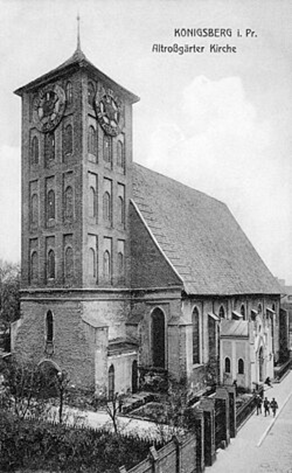
Georg was the son of Johann Weissel, judge and afterwards burgomaster at Doranau, near Königsberg, where he was born. He studied at the University of Königsberg, from 1608 to 1611, and thereafter, for short periods, at Wittenberg, Leipzig, Jena, Strassburg, Basel and Marburg. In 1614 he was appointed rector of the school at Friedland near Domnau, but resigned this post after three years, and returned to Königsberg to resume his studies in theology. Finally, in 1623, he became pastor of the newly erected Lutheran Altrossgart church at Königsberg (pictured here), where he remained till his death, on August 1, 1635.
Weissel was one of the most important of the earlier hymn-writers of Prussia. His hymns, about 20 in all, are good in style, moderate in length, and varied in meter. The earliest seem to have been written for use at the consecration of the Altrossgart church on the second Sunday in Advent, 1623. The majority are for the greater festivals of the Christian year. “Lift up your heads” first appeared in posthumously in 1642 in “Preussische Festlieder” in five stanzas of eight lines each in an 88.88.88.66 meter. The famous British translator of German hymns, Catherine Winkworth (1827-1878), rendered the hymn into English in five, eight-line stanzas as well for her Lyra Germanica (1855). The version that appears in hymnals today usually reduces the hymn to four, four line stanzas in Long Meter (88.88).
Catherine Winkworth is well known for her English translations of German hymns. Her translations were polished, and yet remained close to the original. Educated initially by her mother, she lived with relatives in Dresden, Germany in 1845, where she acquired her knowledge of German and interest in German hymnody. After residing near Manchester until 1862, she moved to Clifton, near Bristol. A pioneer in promoting women’s rights, Winkworth put much of her energy into the encouragement of higher education for women. She translated a large number of German hymn texts from hymnals owned by a friend, Baron Bunsen. Though often altered, these translations continue to be used in many modern hymnals. Her work was published in two series of “Lyra Germanica” (1855, 1858) and in “The Chorale Book for England” (1863), which included the appropriate German tune with each text as provided by Sterndale Bennett and Otto Goldschmidt. Winkworth also translated biographies of German Christians who promoted ministries to the poor and sick and compiled a handbook of biographies of German hymn authors, “Christian Singers of Germany” (1869). She died suddenly of heart disease, at Monnetier, in Savoy.
Stanza 1 follows very closely the phrases from Psalm 24,and has traditionally been associated with the Advent season, especially verse 7: “Lift up your heads, O ye gates; and be ye lift up, ye everlasting doors; and the King of glory shall come in.” (KJV) The first stanza places this verse in the context of waiting for the “King of glory” who is the “Savior of the world.”
Lift up your heads, ye mighty gates;
behold, the King of glory waits;
the King of kings is drawing near;
the Savior of the world is here!
Stanza 2 reflects the pietistic origins of the hymn writer and the time. The gates are not literally openings to a walled city, but a metaphor for the “portals of [our] heart.” Our hearts become a “temple set apart from earthly use for heaven’s employ.”
Fling wide the portals of your heart;
make it a temple, set apart
from earthly use for heaven’s employ,
adorned with prayer and love and joy.
Stanza 3 describes the “King” as on who becomes a “Redeemer” who will “abide” within our wide-open hearts. Once again the focus is not on an external being, but on one whose “inner presence [we] feel” and whose “grace and love in us [are] reveal[ed].”
Redeemer, come, with us abide;
our hearts to Thee we open wide;
let us Thy inner presence feel;
Thy grace and love in us reveal.
Stanza 4 concludes with an eschatological petition to the Holy Spirit to “lead us on until the glorious race is won,” or in other words to lead us to eternity.
Thy Holy Spirit lead us on
until our glorious goal is won;
eternal praise, eternal fame
be offered, Savior, to Thy name!
The tune TRURO was composed by Charles Burney (1726-1814). He was the foremost music historian of his time in England. Burney attended Shrewsbury School and the Free School, Chester. He returned to Shrewsbury, assisted his half-brother, a church organist, and learned violin and French. He was apprenticed to Thomas Arne at Drury Lane from 1744 to 1746, where he collaborated with David Garrick. In 1749, he married Esther Sleepe (one of their daughters was the English novelist Frances Burney. That year he became organist at St. Dionis’ Backchurch, London. In 1751 he moved to King’s Lynn, Norfolk, where he taught and played the organ. That winter he succeeded John Stanley as organist and harpsichordist of the concerts at the King’s Arms, Cornhill. He was elected to the Royal Society of Arts in 1764, was appointed to positions in the king’s musical establishment in 1767 and 1774, received a D.Mus. at Oxford in 1769, and became a fellow of the Royal Society in 1773.
Burney toured France and Italy collecting materials for a projected history of music in 1770, where he met and formed a lasting friendship with Padre Martini, a fellow music historian. This was followed by a visit to the Netherlands, Germany, and Austria in 1772, where he consulted with the famed librettist Pietro Metastasio. On his return he devoted every moment he could spare from teaching to his “General History of Music,” published between 1776 and 1789 in four volumes. Among the many musicians with whom Burney consulted on his trips to the continent were Wolfgang Amadeus Mozart, Frederick II (the Great) (a renowned flutist), and C.P.E. Bach, the most notable of J.S. Bach’s sons.
His final appointment was as organist at Chelsea Hospital from 1783. He was an important supporter of Joseph Haydn (with whom he had been in correspondence) during his two visits to London. He wrote and published a poem in his honor, and his enthusiasm for George Frideric Handel did much to persuade Haydn, on his return to Vienna, to turn his attention to oratorio. Between 1801 and 1805 he wrote the music articles for Abraham Rees’s “Cyclopedia” and was handsomely rewarded with a fee of £1,000. Burney virtually retired in 1805. He was granted a king’s pension in 1806 and in 1810 became a correspondent of the Institut de France. He was also an amateur astronomer.
Burney’s “General History of Music” established him as the foremost writer on music in the country and contributed greatly to burgeoning interest in “ancient music.” Yet his was not an antiquarian’s history but a readable account catering to amateurs as well as professionals. What most interested Burney and his subscribers was contemporary music. He was an enthusiastic champion of Haydn and devoted a long chapter to Italian opera in England. Burney also wrote sympathetically on the music of the Renaissance. Nevertheless, it is principally for its insight into fashionable musical taste in 18th-century London that Burney’s “History” is indispensable. Along with Burney’s influential association with Haydn, his astute descriptions of C.P.E. Bach and the young Mozart in performance may also be counted among his legacies.
When sung energetically, the resounding octave ascent at the beginning of TRURO pictures the raising of the gates. It relates providentially to the opening of another important advent hymn. Sing the first eight notes, but start on a high pitch and descend instead of ascend, and you’ll find yourself singing “Joy to the world! The Lord is come.” “Lift Up Your Heads” is well served by TRURO’s structure of accelerated arrivals. Right from the start we’re possessed with a sense that something unstoppable is coming, and coming so near and so soon that its approach cannot be managed but only received. This is accomplished neither by speeding up the tempo nor by contracting phrase-lengths, which would make the tune difficult, but, more subtly, by timing developments within the phrase so they come at us sooner than is normal in symmetrically-conceived melodies.
Here is a link to the singing of this festive hymn.