
This current year of 2025 marks the 1700th anniversary of the First Council of Nicaea (AD 325), called by Emperor Constantine to address the division brought about by the Arian controversy. This council, one of the so-called Seven Ecumenical Councils (because they were recognized as valid by both the Eastern and Western branches of the church) met in the city of Nicaea in what is today northwestern Turkey near the modern city of Iznik, during the summer months of 325. The earliest centuries of Christendom faced the double challenge of standing firm against persecution and standing just as firm against wrong doctrine. Those years were especially difficult for the church as it needed to clarify a correct articulation of the Trinity, specifically about the relationship between Jesus’ humanity and deity, and then also about the relationships between the three persons of the Holy Trinity.
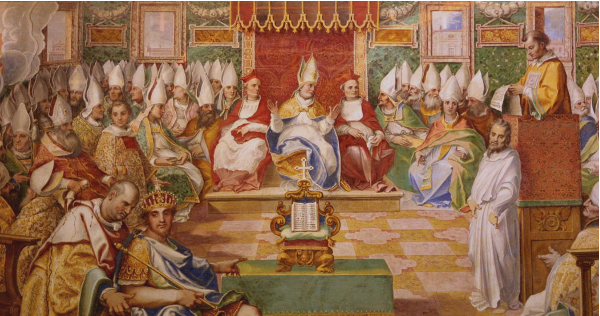
The controversy at the council was caused by the rapid growth and influence of the teachings of Arius (ca. 256 – 336), a Cyrenaic presbyter (pastor) and ascetic. In his attempt to make the mystery of the doctrine of Jesus’ human and divine natures more understandable to believers, he taught that Jesus was not coeternal with the Father, being less than God but more than man, a being created by God. That meant that Jesus was not eternal, but had a beginning. His position has often been summarized as teaching that “there was (a time) when He was not.” And so, Jesus was, in Arius’ view not God in the same way that the Father is God.
He was opposed vigorously by the important early theologian and church father, Athansius of Alexandria. By the time the Council of Nicaea met, Arius’ views were well on the way to becoming the dominant understanding across the empire. Though the Council condemned his views, Arian churches persisted for centuries throughout Europe (especially in various Germanic kingdoms), in the Middle East, and parts of North Africa until military conquest or voluntary royal conversion between the fifth and seventh centuries, about the time of the spread of Islam.
Here is a fascinating tradition about the 318 representatives in attendance (at a time when there were about 1800 bishops empire-wide). Almost all the delegates to the Nicene council were from the Eastern church. One of them was Nicholas, Bishop of the city of Myra on the western coast of modern day Turkey. He became legendary for his affection for children, even sparking the practice of giving gifts to them. A strong adherent of the orthodox position about the full eternal deity of Jesus, so the story goes, at one of the debates, after Arius had presented his (heretical) view, Bishop Nicholas got up out of his seat and slugged Arius! Of course, this man was the origin of the Christmas season’s “Saint Nicholas.” While the story is probably fictional, it is curious to wonder if that’s what the original Saint Nick did! But we are quite confident that Nicholas of Myra was there, and so we can tell children today that the original Santa (Saint) Claus (Nicholas) was a preacher who loved Jesus and trusted Him as his Savior.
Stephen Nichols is President of Reformation Bible College in Orlando, FL and chief academic officer for Ligonier Ministries. For many years he has taught theology and church history. He has written this about the Council of Nicaea, calling it the first of the five most important dates in church history.
Historians love dates—birthdays, anniversaries. They love to celebrate dates not simply for the sake of celebrating, but because dates represent events. Real events in the lives of real people, when real, significant things happened. Dates represent moments, and those moments can help us understand our own lives ….
The first moment is a date—325. I picked this date for several reasons. One, this is the date of the Nicene Council, out of which came that wonderful statement of Christian orthodoxy, the Nicene Creed. This date also represents a crucial moment in the life of the church.
Only a few decades before the Council of Nicaea, Christianity was illegal in the Roman Empire. In fact, the 290s and 300s were an intense time of persecution; almost an unprecedented time of persecution for Christians. Then came Constantine, and his so-called conversion—whether he truly converted is another question, but historians nevertheless speak of his “conversion.” In the wake of that conversion, in 313, he issued the Edict of Milan, which legalized Christianity. A few more edicts followed that contributed to the legality of Christianity—its being no longer an illegal religion, or as the Romans called it, an “illegal superstition.” Not only that, but Constantine also passed legislation that tended to favor churches and Christians, and within a generation, there was a massive spread of Christianity within the Roman Empire.
So, that brings us to the year 313. Just a dozen years later was the first great ecumenical council—the Council of Nicaea.
The council was called because of one man—a presbyter, or elder, named Arius. He had promoted the idea that Jesus is unique—that Jesus is beyond us human beings—but that He’s not God. And, of course, this gets right at the heart of orthodoxy: the statement that Jesus is the God-man. And so, Arius’ teachings were very disruptive within the early church. The bishops therefore came together to settle the matter for the church.
Nicaea is a wonderful city. Today, the city is called Iznik. It’s just off of Lake Iznik in Turkey. Constantine had a summer palace there. He invited all of these theologians to gather there in order to spend time working through these theological disputes, and the result was the Nicene Creed. In addressing this controversy, the council also gave us one of the best lines in theological literature. It is this simple line: “For us and for our salvation.”
Jesus is the God-man. His equality with God, as Paul tells us, is something that He did not have to grasp; rather, He had it already, and yet he took on flesh—He was made human—He became one of us. He didn’t simply appear to be human—He was human—and He was God. He is the God-man. And He is the God-man for us and for our salvation.
What Nichols and others have recognized is that unless we have a Jesus who is both fully God and fully man, we do not have a Jesus who can save us. Only one who was fully man could actually die in our place as our substitute, taking on Himself our guilt and the wrath of God. And only one who was fully God could be raised from the dead. At the Nicene Council, the Creed the delegates produced made this abundantly clear and necessary for orthodoxy. They deliberately chose language which true Christians could profess, but with which no Arian could agree.
There was another matter that was debated and articulated, not at this Council of Nicaea in 325 but at a subsequent council in Constantinople in 381 (the Second Ecumenical Council), which slightly revised the Nicene Creed to become the text we use today. It was the question of whether or not the Holy Spirit proceeds from (has bent sent by) the Father alone or from both the Father and the Son. That debate eventually resulted in language that further clarified that Jesus was of the same (not similar) substance (hypostasis) with the Father (the Greek word homoousias, not homoiousias). And so when Christian parents take their child to see Santa Claus at the Mall, before limbing onto his lap, they should ask that Santa if he believes in homoousias or homoiousias. If that Santa doesn’t know, then you can know that he’s not the REAL Santa!
Creeds are very important for the church in every age. They articulate what we believe the Bible teaches. They draw lines within which Christians can agree, and outside of which true Christianity cannot exist. They are very helpful for teaching young believers and new converts what it is that we profess. And creeds serve as a means of publicly professing our faith in worship, almost as a pledge of allegiance to God and to the gospel. And so it is quite common to find one of these creeds included in the liturgy of worship on a Sunday morning.
The Apostles’ Creed has origins that extend back earlier than the Nicene Creed, probably to the second or third century. It was not written by the Apostles, but is so named because it summarized the teaching of the Apostles. The Nicene Creed differs in that it was officially adopted as the official teaching of Christendom by an ecumenical council, granting it a much higher level of authority, its teaching therefore being binding on Christians in all ages. It is more theologically precise and more doctrinally robust than the Apostles’ Creed. While many churches recite the Apostles’ Creed regularly in morning worship, the Nicene Creed is often used on communion Sundays, since its largest section is on the person and work of Christ, and would serve as a more definitive confession of our faith, fitting for every Lord’s Day gathering.
Here is the widely accepted text of the Nicene Creed. Notice that like the Apostles’ Creed, and like so many of the Reformation era creeds, it follows the Trinitarian structure of the Father, then the Son, and then the Holy Spirit, with the section on the church connected to the Spirit as the place where He is at work in all ages.
I believe in one God, the Father Almighty, Maker of heaven and earth, and of all things visible and invisible.
And in one Lord Jesus Christ, the only-begotten Son of God, begotten of the Father before all worlds; God of God, Light of Light, very God of very God; begotten, not made, being of one substance with the Father, by whom all things were made. Who, for us men and for our salvation, came down from heaven, and was incarnate by the Holy Spirit of the virgin Mary, and was made man; and was crucified also for us under Pontius Pilate; He suffered and was buried; and the third day He rose again, according to the Scriptures; and ascended into heaven, and sits on the right hand of the Father; and He shall come again, with glory, to judge the quick and the dead; whose kingdom shall have no end.
And I believe in the Holy Ghost, the Lord and Giver of Life; who proceeds from the Father and the Son; who with the Father and the Son together is worshipped and glorified; who spoke by the prophets. And I believe in one holy catholic and apostolic Church. I acknowledge one baptism for the remission of sins; and I look for the resurrection of the dead, and the life of the world to come.
Here are a few comments about the key doctrines articulated in the creed, divided into four sections: one for each person of the Holy Trinity, and one for the church.
- I believe. Christianity involves personal agreement with objective statements of truth
- One God, the Father Almighty. As in the first commandment, we worship no other gods.
- Maker of all things. We reject the false theory of atheistic, materialistic evolution
- Jesus, very God of very God, begotten, not made, of one substance with the Father. Contrary to Arius’ false teaching, truly God and not a being created by the Father, the primary reason for the Council of Nicaea, to affirm Jesus’ eternal and full deity.
- For our salvation, incarnate, crucified, buried, rose again, ascended. his summarizes the key historical events in Jesus’ earthly mission of atonement, as a summary of the heart of the gospel, focusing on the person and work of Jesus.
- Sits at right hand of the Father, will come again to judge, kingdom shall have no end. Points us to the present heavenly reign of Christ, to His certain physical return, and to our glorious resurrection hope in a new heaven and new earth.
- Holy Ghost, Lord and Giver of life, proceeds from Father and Son, worshiped and glorified. Here is a reference to our being born again, and that by a sovereign work of the Spirit, one of the major issues that ultimately divided the eastern and western churches, that the spirit proceeds from both Father and Son, and so shares equally with them in deity.
- One holy catholic and apostolic church, baptism, resurrection, world to come. Though the modern church is found in many denominations, there is only one true church, and wherever it is faithful to the teachings of the apostles, it is holy and universal, and all who are part of it will share in the benefits of the resurrection and life eternal.
For a much more extensive article about the Nicene Creed, check this out from Dr. Kevin DeYoung, Senior pastor of Christ Covenant Presbyterian Church in Charlotte, North Carolina.
https://clearlyreformed.org/sermon/the-nicene-creed-we-believe
He begins his article with this powerful endorsement of its importance.
It’s not an exaggeration to say that after the Bible, the Nicene Creed may be the most important Christian text ever written. Since the 4th century, the Nicene Creed has served, certainly, as the most influential, most ecumenical, which just means widespread across the whole globe, and arguably the most widely used statement of faith in the history of the Church.
A well-known Anglican music team has written a song in celebration of this 1700th anniversary of the Nicene Creed, with the title “The God We Love.” CityAlight is a Christian music ministry begin in early 2013 from St. Paul’s Castle Hill Church in Sydney, Australia, known for writing modern hymns with biblically rich lyrics and simple melodies for churches to sing. They are perhaps best-known for their 2018 song, “Yet Not I But Through Christ in Me.” Founded by Jonny Robinson and Richard Thompson, the group’s goal is to create songs for God-honoring and Jesus-focused worship, that are easy and edifying for believers to sing, and with a focus on theological accuracy through a rigorous review process. The performing group is structured like other church-based worship bands, with members often being volunteers from the local church.
On their website, they have posted this about their Nicene Creed song.
This song sets the timeless words of the Nicene Creed to music in honor of its 1700th anniversary since its adoption in A.D. 325. At a time when the church around the world is looking for unity and clarity in the gospel, “The God We Love” offers an anthem rooted in the core truths that have defined the Christian faith for centuries.
Very often we do not know what we believe until we write, speak, or sing it, “The God We Love” is just such a declaration, making clear what we believe, and proclaiming it with joy and confidence. It’s a defense of true Christian doctrine, more vital than ever for a world in desperate need of a firm foundation. It’s our prayer that this song is a blessing to you and your church, and a reminder of the great truths our family of believers has held fast to for centuries.
While it is very fitting to include this in the HYMNS4HIM series, it is not typical of a hymn with a series of stanzas, all following the same structural pattern. It is in the style of many contemporary Christian songs. And so, we print the lyrics here in the style and format in which CityAlight has posted on their website: www.cityalight.com . How wonderful it would be that in this anniversary year, we were to learn of many more churches not only reciting the Nicene Creed in their worship service, but even singing it in this “user-friendly” version from CityAlight. They performed it at the 2025 Getty Sing! conference in Nashville, TN, where it was enthusiastically welcomed.
VERSE 1
We believe in one God, the Father
The Almighty, the Maker of all
The One who rules the seen and unseen
We believe, and we adore
Jesus Christ, one Lord of creation
From the Father, begotten not made
He is the Light from Light eternal
And the God of every age
CHORUS
All glory to the Father now
All honour to the Son
And praise the Spirit, now and always
This is the God we love
VERSE 2
For this world and for our salvation
He came down from the heavens above
Born of a virgin and the Spirit
Truly man and truly God
He was crucified under Pilate,
Suffered death and was laid in the grave
And in accordance with the scriptures
On the third He rose again
Repeat CHORUS
BRIDGE
And Christ has made His ascent
Into the heavens above
Where He sits at the Father’s right hand now
But He will come back again
And He will judge in truth
The Holy Spirit has come,
Voice of the prophets of God
Sent to us, he has given us new life
Forgiven, now and baptised
One holy church, we rise, we rise
Repeat CHORUS twice
LAST LINE WITH TAG:
This is the God we love
This is the God we love
VERSE 3:
Now we wait to be resurrected
And we look for the world without end
This is our creed, our faith, our anthem
This is the God we love
This is the God we love
Here is a link to CityAlight performing their song with Matt Redman in their home church in Sydney.