
There are many images in Scripture to communicate concepts about the Lord’s goodness to us. The Psalms are filled with references to the Lord as shepherd, refuge, fortress, lamp to our feet, the shade at our right hand, a mother hen, judge, and king. And in addition to those, in the New Testament, with the “I ams” in the Gospel of John, we read that Jesus described Himself as being like a vine, a door, the light of the world, the bread of life, as well as the Good Shepherd.
And so, it’s neither surprising nor without biblical warrant that we find hymn writers over the centuries who have provided poetic images of the Lord that enable us to have heightened appreciation of His goodness to us. One of those is found in the hymn “Jesus, Savior, Pilot Me,” written in 1870 by Presbyterian minister Edward Hopper (1818-1888), using vivid maritime imagery to portray Jesus as the guide who leads believers through life’s storms. We know of the pilot who helps steer a ship into port in the harbor, but this is the pilot who takes control of the ship still at sea as the winds and waves threaten her and her crew. This hymn was written especially for sailors in language they knew well: charts, compasses, and the absolute need for a competent pilot to guide their crafts over the tempestuous seas.
While few who sing this hymn today are literally on board ships at sea, every person, including Christians, live in a world filled with storms of many kinds, not to mention the tempests that arise in individual lives. Those storms that threaten all of us include wars on the international stage, persecution of Christians in regions hostile to the faith, and the uncertainties of economic upheavals. On an individual level, diseases, broken relationships, the challenges that come from the aging process, and financial shrinkage are all very real. How are we to navigate those dangers? We need a pilot to take the helm of our lives to not only settle our anxious hearts, but also to chart a course to lead us through them to safety and calm seas.
Jesus meets the bill in wonderful ways. As God, He knows the future because He has planned all things, working all things according to the design of His will. As God, He knows our needs even before we can ask. As God, He has proved His love for us at the cross. And as God, He has promised us that the day is already set on which He will return to take us home and to inaugurate a new heaven and a new earth. And the parables He gave us teach us that He is not only able but also willing to help those who cast their care on Him.
The hymn “Jesus, Savior, Pilot Me,” resonates with Christians who recognize the unpredictability of human experience and the need for divine direction. Its language portrays faith not as self-reliance but as surrender to the wisdom and care of Christ. Its message of trust and divine guidance continues to speak powerfully to believers navigating difficult seasons of life. How important it is that Christians learn the lesson of this hymn: that of placing our implicit confidence in the Pilot of our souls as He guides us through the tempestuous seas of life. And though there may be the storms and waves that at times almost seem to swamp us, we can be certain that our Lord is still in control and will lead us safely to our heavenly home.
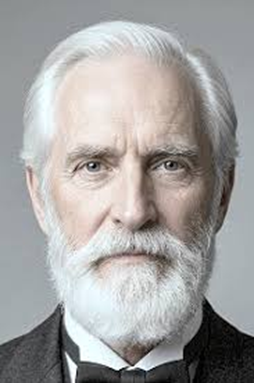
The author of the hymn, Edward Hopper, was born in New York City. His father was a merchant and his mother a descendant of the Huguenots, the persecuted French Protestants. Following his education at New York University and Union Theological Seminary, from which he graduated in 1842, he became a Presbyterian minister. With the exception of eleven years when he preached at Greenville and at Greenville Presbyterian Church in Sag Harbor on Long Island, both in New York State, he spent his entire life in his native city. In 1870 he began the most fruitful phase of his ministry when he became pastor of a small congregation known as “The Church of the Sea and the Land” in New York City harbor, where he served his remaining years until his death. There he devoted his life to the spiritual welfare of the many sailors who made their way to and from their ships.
“The Church of the Sea and the Land” had been established at New York City harbor as a mission for sailors, in whom Hopper had always been deeply interested, probably through due to his contact with them through his father’s business. The congregation consisted mainly of seamen who made their way to and from their ships. Thus, Hopper ministered to sea-faring men from around the world. Having already penned many poems which he never signed or for which he used pen names, he produced this hymn, probably in 1870, for the spiritual needs of his flock. It first appeared anonymously in the March, 1871, edition of “The Sailor’s Magazine.” Later that year, it was published in “The Baptist Praise Book,” with the tune (PILOT) composed by a Philadelphia musician named John Edgar Gould.
In 1880, a special anniversary service of the Seamen’s Friends Society was held at the Broadway Tabernacle in New York City. Hopper was asked to provide a new hymn for the occasion, but instead brought and read “Jesus, Savior, Pilot Me,” which had already become quite well-known. Then, for the first time, he acknowledged it to be his composition, as all of his works previously had been written anonymously. Eight years later, on April 23, 1888, at the age of 82, he was found sitting peacefully at his desk in his New York City study, pencil in hand, having died of a heart attack while writing a new poem on the subject of “Heaven.” At his funeral, someone said, “Suddenly the gentle, affectionate spirit of Edward Hopper entered the heavenly port, as he had requested–safely piloted by that never-failing friend, Jesus, whose divine voice was still tenderly whispering to him, ‘Fear not, I will pilot thee.’”
The imagery of Jesus as Pilot is captured beautifully in this prayer from Banner of Truth’s “Valley of Vision” (a collection of Puritan prayers).
The imagery of Jesus as pilot is captured beautifully in this prayer from Banner of Truth’s “Valley of Vision” (a collection of puritan prayers). It is included in that collection as a prayer for “Year’s End.”
O love beyond compare,
Thou art good when Thou givest,
when Thou takest away,
when the sun shines upon me,
when night gathers over me.
Thou hast loved me before the foundation of the world,
and in love didst redeem my soul.
Thou dost love me still,
in spite of my heard heart, ingratitude, distrust.
Thy goodness has been with me during another year,
leading me through a twisting wilderness,
in retreat helping me to advance,
when beaten back making sure headway.
Thy goodness will be with me in the year ahead;
I hoist sail and draw up anchor,
With Thee as the blessed Pilot of my future as of my past.
I bless Thee that Thou hast veiled my eyes to the waters ahead.
If Thou hast appointed storms of tribulation,
Thou wilt be with me in them;
If I have to pass through tempests of persecution and temptation,
I shall not drown.
If I am to die,
I shall see Thy face the sooner;
If a painful end is to be my lot,
Grant me grace that my faith fail not;
If I am to be cast aside from the service I love,
I can make no stipulation;
Only glorify Thyself in me whether in comfort or trial,
as a chosen vessel meet always for Thy use.©1975 Banner of Truth. Used by permission.
Hopper’s hymn contained five stanzas. Hymnals today include only three of those. They are indicated below with an asterisk. As is so often the case, the hymn is addressed to Jesus as a prayer, asking Him directly to carry out that role of pilot for our souls. And as is also so often the case, such well-written hymns as this are filled with direct allusions to specific scripture passages.
*Stanza 1 asks Jesus to take the helm of our souls. In many ways, life is like a treacherous journey upon the seas of time (Psalm 107:25-30). As sailors do not always know exactly what kind of waves the seas will bring them, so we do not know what the vicissitudes of life will bring us (James 4:14). However, whether facing storms of life or peaceful days, we can always look to the Lord to provide the fulness of joy (Psalm 89:8-9).
Jesus, Savior, pilot me over life’s tempestuous sea;
Unknown waves before me roll, hiding rock and treach’rous shoal;
Chart and compass come from Thee—Jesus, Savior, pilot me.
Stanza 2 asks Jesus to care for us like He did with the Apostles on the Sea of Galilee. On at least two occasions, Jesus was with the Apostles during a storm on the Sea of Galilee (Luke 8:22,25). On one of these occasions, He even walked across the water to aid and comfort them (Matthew 14:22-33). In like manner, God has promised His people that if we give control of our life’s ship to Him, He will guide and protect us (Isaiah 43:1-2).
When th’apostles’ fragile bark struggled with the billows dark,
On the stormy Galilee, Thou didst walk across the sea;
And when they beheld Thy form, safe they glided through the storm.
Stanza 3 asks Jesus to guide us, even during those times when no danger seems to threaten us. Paul knew both how to be abased and how to abound. Sometimes we find that our lives are filled with good and we abound in all things (Philippians 4:12). The word “halcyon” literally means “kingfisher” in Greek and refers to an ancient legend in which a bird, believed to have been the
kingfisher, was supposed to have a calming influence on the sea at the time of the winter solstice. Thus it is defined as tranquil or happy, and this is certainly the kind of life that we all of us would like to lead (1 Timothy 2:1-2). Whether facing storms of life or peaceful days, we should always look to the Lord to guide us (Psalm 31:1-3).
Though the sea be smooth and bright, sparkling with the stars of night,
And my ship’s path be ablaze with the light of halcyon days,
Still I know my need of Thee; Jesus, Savior, pilot me.
*Stanza 4 asks Jesus to be like a mother to our troubled hearts. As a child looks to its mother to calm its fears, so we, as children of God, can look to Him to protect and provide for us in life (James 1:17; 1 John 3:1). And the same divine power which Christ manifested to still the storms on the Sea of Galilee is available to assist us in our problems (Mark 4:35-41). Hence, we can make our journey on the seas of life with trust in God rather than in constant fear (2 Timothy 1:7; 1 John 4:18).
As a mother stills her child, Thou canst hush the ocean wild;
Boisterous waves obey Thy will when Thou say’st to them, “Be still.”
Wondrous Sov’reign of the sea, Jesus, Savior, pilot me.
*Stanza 5 asks Jesus to bring us all the way to shore. The place where the fearful breakers roar refers to death (Hebrews 9:27). The peaceful rest refers to the eternal home of the soul in heaven (Revelation 22:1-5). Therefore, if we truly trust in the Lord, He will show us the path of life to a land where there will be the fulness of joy in His presence and pleasures evermore (Psalm 16:10-11).
When at last I near the shore, and the fearful breakers roar
Twixt me and the peaceful rest —then, while leaning on Thy breast,
May I hear Thee say to me, “Fear not — I will pilot thee.”
We certainly do not expect Jesus to perform miracles today such as He did on the stormy Sea of Galilee. Those miracles are recorded in scripture and provide all the evidence that we need to believe on Him. But we can still expect Him to use His divine power to direct our lives. And this hymn’s simple and direct statement of the need to look to Jesus for guidance in our pilgrimage should motivate us always to pray, “Jesus, Savior, Pilot Me.”
The tune written for Hopper’s text is named PILOT, and was composed by John Edgar Gould (1822-1875). Gould was born in Bangor, Maine, and established a successful music business in New York and Philadelphia with hymnwriter composer and partner William G. Fischer. He was the son of Horace Gould and Mary Ann Allen. He married Josephine Louisa Barrows, with whom he had seven children, raising them primarily in Philadelphia. In 1874, his health began to decline due to an unspecified illness, prompting travels throughout Europe and Africa in search of recovery. His life ended abruptly while in Algiers at the age of only 52. He was buried at Woodlands Cemetery in Philadelphia. His wife outlived him, dying in 1920.
The rural New England environment of early 19th century Maine where he grew up would have offered routine exposure to sacred music traditions prevalent in family and community setting. Bangor was a burgeoning frontier town centered on lumber and river trade, where socioeconomic conditions emphasized self-reliance amid rapid settlement. Local church communities played a central role in social life, nurturing collective hymn singing and shaping the region’s cultural fabric.
This was a period when the Second Great Awakening profoundly shaped religious life in New England, emphasizing fervent devotional singing and hymnody in church services and community gatherings. In Bangor, Baptist churches and revivals featured singing as a central element of worship, with evening meetings including “songs of Zion” amid prayers and exhortations, fostering an environment rich in sacred music. From an early age, Gould exhibited a strong interest in music, likely self-taught through engagement with local hymnody ad basic instruments available in the community, influenced by contemporary American composers active in the era’s revivalist tradition. This formative exposure laid the foundation for his later contributions to sacred music.
He became a prominent figure in the 19th century American music scene though his business ventures and creative output in scared music. His work emphasized accessible, devotional tines that resonated in Protestant worship, influencing hymnals in many denominations. His career began in the mid-1840s when he entered the music trade, managing stores in New York City and later in Philadelphia, where he partnered with composer William Fischer. Together they published several collections, including “The Modern Harp” in 1846 and “The Wreath of School Songs” in 1847, marking the start of Gould’s prolific output of wight religious songbooks between 1846 and 1869. These compilations featured original compositions and arrangements, blending popular melodies with sacred texts to appeal to congregations and choirs. In addition to business, Gould composed over 50 tunes, with PILOT being especially successful, appearing in almost a thousand hymnals worldwide. This tune, with Hopper’s hymn text has been translated into at least 48 languages, including Spanish, German, Afrikaans, Chinese, Arabic, and Xhosa, facilitating its global dissemination in missionary church planting and discipleship.
Gould entered the music retail sector in New York City during the 1840s, establishing operations focused on the sale of sheet music as well as pianos and organs amid the city’s expanding cultural and religious landscape. By 1851, he was operating as a music publisher on Broadway with a residence on Murray Street, capitalizing on the burgeoning market for printed music in an era of rapid urbanization and church growth, which included increasing demand for revival meetings and household music-making. Complementing his retail efforts, Gould initiated publishing activities around 1846. In the early 1850s, Gould relocated from New York City to Philadelphi where he established a major music business focused on retail and publishing. There he entered into a partnership with composer William Gistavas Fischer (1835-1912), forming the firm Gould & Fischer on Chestnut Street. This collaboration proved highly successful, growing to become one of the most prosperous piano merchants in the United States and serving a broad clientele across the Northeast.
Under this partnership, Gould’s operation expanded significantly into large-scale publishing of religious music, catering to churches, singing schools, and educational institutions. This shift marked a departure from Gould’s earlier independent ventures in New York, enabling greater distribution and influence in the religious music market. He contributed to affordable songbook collections such as “The Sunday School Lute” in 1848 and “Songs of Gladness for the Sabbath School” in 1869, offering practical, cost-effective resources for youth education and worship, especially in smaller congregations and institutions. The partnership endured until Gould’s death in 1875, after which Fischer continued the business independently under his own name.
Here is a link to the song, with the three stanzas most often found in hymnals today, along with helpful video of a “tempestuous sea.”