
Our culture today is very concerned about drawing attention to women’s prominence in many arenas, from sports to business to politics. That includes the church, where, unfortunately, the culture has too often been allowed to shape our biblical understanding. There are many legitimate and honored places for women within church ministry. Generally, evangelical and reformed denominations have maintained the historic complementarian position when it comes to ordained leadership in worship, believing that the office of pastor is limited to mature male believers.
But within complementarian groups, women are honored by many and vital and much-appreciated ministry roles. In addition to those positions as teachers and mercy ministry, many well-informed and skilled women writers continue to produce printed literature, from Sunday School material to significant theological works. And we must not forget nor fail to recognize and appreciate women who have written some of our best known and widely sung hymns. These include such familiar names as Fanny Crosby (“Blessed Assurance”), Charlotte Elliott (“Just As I Am”), Cecil Frances Alexander (“Once in Royal David’s City”), and translator Catherine Winkworth (“Now Thank We All Our God”).
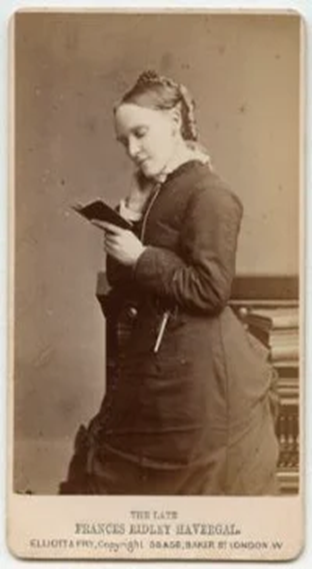
To that special “Women’s Honor Roll” we must add the name of Frances Ridley Havergal (1836-1879). The daughter of the Rev. W. H. Havergal, she was born at Astley, Worcestershire. Five years later her father moved to the Rectory of St. Nicholas, Worcester. Her mother died when she was only eleven, after a lengthy period of suffering. After a carriage accident, her father devoted himself to the improvement of church music in England, and according to hymnologist Albert Bailey, “revived the use of the solid tunes of early English composers and so did much to improve the quality of congregational singing.” He wrote about 100 hymns, himself. Havergal was obviously inspired by her father’s efforts. She possessed a natural musicianship, as well as a love for walking, swimming and mountain climbing. By the age of 7, she displayed a talent for writing verse. She was converted at the age of 14.
In August 1850, she entered Mrs. Teed’s school, whose influence over her was most beneficial. In the following year she says, “I committed my soul to the Savior, and earth and heaven seemed brighter from that moment.” A short sojourn in Germany followed, and on her return, she was confirmed in Worcester Cathedral, July 17, 1853. In 1860 she left Worcester as her father resigned the Rectory of St. Nicholas, and resided at different periods in Leamington, and at Caswall Bay, Swansea, broken by visits to Switzerland, Scotland, and North Wales. She died at Caswell Bay, Swansea, June 3, 1879.
Miss Havergal’s scholastic acquirements were extensive, embracing several modern languages, together with Greek and Hebrew. She does not occupy, and did not claim for herself, a prominent place as a poet, but by her distinct individuality she carved out a niche which she alone could fill. Simply and sweetly she sang the love of God, and His plan of salvation. To this end, and for this object, her whole life and all her powers were consecrated. She still lives and speaks in every line of her poetry. Her poems are permeated with the fragrance of her passionate love of Jesus.
Her evangelical and reformed convictions are distinctly set forth in her poems. The burden of her writings is a free and full salvation, through the Redeemer’s merits, for every sinner who will receive it, and her life was devoted to the proclamation of this truth by personal labors, literary efforts, and earnest interest in Foreign Missions. Some of the best-known of Miss Havergal’s hymns include “Golden Harps Are Sounding,” “I Gave My Life for Thee,” “Jesus, Master, Whose I Am,” “O Master, at Thy Feet,” “Take My Life and Let It Be,” “Tell It Out Among the Heathen,” “Another Years Is dawning,” “Like a River Glorious,” “Who Is on the Lord’s Side?”, and “I Am Trusting Thee, Lord Jesus.” “She also wrote many small devotional tracts and narratives in prose and numerous little books of poems and other hymn texts, all marked by the same earnest and practical piety. Common themes in her writings were faith, consecration, and service.
Frail in health all her life, Miss Havergal one day caught a severe cold which caused inflammation of the lungs. When told that her life was in danger, she exclaimed “If I am really going, it is too good to be true!” At another time she responded, “Splendid! To be so near the gates of heaven. At the very end, it was reported that she sang clearly, but faintly, another of her hymns, “Jesus, I Will Trust Thee, Trust Thee with My Soul.” Then, according to reports by her sister, “She looked up steadfastly, as if she saw the Lord; and surely nothing less heavenly could have reflected such a glorious radiance upon her face. For ten minutes we watched that almost visible meeting with her King, and her countenance was so glad, as if she were already taking to Him! Then she tried to sing; but after on sweet, high note her voice failed, and as her brother commended her soul into the Redeemer’s hand she passed away.”
Frances Ridley Havergal died at Caswall Bay, Swansea, Wales on June 3, 1879, at the age of 42l. On her tombstone at Astley, Worcestershire is engraved her favorite text from 1 John 1:7. “The blood of Jesus Christ His Son cleanseth us from all sin.” Her entire life was characterized by spiritual saintliness. Despite being frail in health she lived an active and productive life until her death.
This hymn rises from the heart of a lady who had a deep love for the Lord, and a passionate desire for the salvation of the lost. The opening phrase must be connected to the rest of the hymn. It is not a desire to hear a private voice from God speaking to her for self-centered advantages. Instead, it is an earnest longing that the Lord would speak (presumably through His Word) to give words that would be most effective in winning others to Christ.
Stanza 1 asks the Lord to help us that we might win others to Him. Of course, the means by which the Lord speaks to us is by His written Word, the scriptures, which will furnish us completely to every good work (2 Timothy 3:16-17). His word reminds us that Jesus Christ came to seek and to save the lost (Luke 19:10). Therefore, as followers of the Savior, we also need to see the erring children and convert the sinner from the error of his way (James 5:19-20).
Lord, speak to me that I may speak in living echoes of Thy tone;
As Thou hast sought, so let me seek Thine erring children lost and lone.
Stanza 2 asks Him to lead and feed us. The Lord leads us as we hear His voice and follow His word (John 10:27). The Lord feeds us as we feast upon His word with its bread of life (John 6:51, 63). The leading and feeding that the Lord does for us then enables us to go out to find the wandering and wavering feet and feed them with manna sweet, even as the shepherd goes seeking the lost sheep (Luke 15:4-7).
Oh, lead me, Lord, that I may lead The wand’ring and the wav’ring feet;
Oh, feed me, Lord, that I may feed Thy hung’ring ones with manna sweet.
Stanza 3 asks Him to strengthen us. We certainly need the Lord to strengthen us with the power of His might (Ephesians 3:16). However, He can strengthen us only as we stand firm on the rock, which symbolizes hearing and doing His words (Matthew 7:24-25). Having received strength from the Lord, we can then stretch out a loving hand to wrestlers on the troubled sea and comfort them (2 Corinthians 1:3-4).
Oh, strengthen me, that while I stand Firm on the rock, and strong in Thee,
I may stretch out a loving hand To wrestlers with the troubled sea.
Stanza 4 asks Him to teach us. The Lord wants us to be discipled by having us be taught all things that He has commanded (Matthew 28:19-20). We then teach the precious things that have been imparted to us unto others (2 Timothy 2:2). Our aim in this is to plant the seed in a good and honest heart (Luke 8:15).
Oh, teach me, Lord, that I may teach The precious things Thou dost impart;
And wing my words, that they may reach The hidden depths of many a heart.
Stanza 5 asks Him to give us rest. That is His promise to us in Matthew 11:28-30, a promise often very helpfully extended in situations of pastoral counseling. The gospel is a soothing message as we read often in the Psalms, where the Lord is our refuge (Psalm 46:1-3). And how wonderful that He has promised to give us the words we need in the moment (Luke 12:12).
Oh, give Thine own sweet rest to me, That I may speak with soothing pow’r
A word in season, as from Thee, To weary ones in needful hour.
Stanza 6 asks Him to fill us. Paul prayed that Christians would be filled with the fullness of God by having the word of Christ dwell in us (Ephesians 3:19, Colossians 3:16). When this happens, our hearts will overflow or abound in all knowledge and discernment (Philippians 1:9). Then, our hearts will show forth the praises of Him who called us out of darkness into His marvelous light (1 Peter 2:9).
Oh, fill me with Thy fullness, Lord, Until my very heart o’erflow
In kindling thought and glowing word, Thy love to tell, Thy praise to show.
Stanza 7 asks Him to use us. The Lord can use us only if we are willing to be vessels of honor (2 Timothy 2:20-21). For this to happen, we must be ready, willing, and able to do what He will, act when He wants, and go where He sends, as Isaiah said, “Here am I, send me” (Isaiah 6:8). We must continue to have this attitude until we come to the end of life and realize the hope of seeing His blessed face and resting in His glory (1 John 3:2-3).
Oh, use me, Lord, use even me, Just as Thou wilt, and when, and where,
Until Thy blessed face I see, Thy rest, Thy joy, Thy glory share.
The most commonly used tune (CANONBURY) is taken from a work by German Romantic composer Robert Alexander Schumann (1810-1856), who was born at Zwickau in Saxon, Germany. His father was a bookseller and publisher who provided a literary atmosphere in which Robert’s unusual musical development was influenced. The tune was first adapted from Schumann’s fourth piano piece in “Nachtstücke,” Opus 23 (1830) and was first associated with congregational singing in J. Ireland Tucker’s 1872 “Hymnal with Tunes, Old and New.” It was titled “A Worker’s Prayer,” intended for lay helpers in the church.
Schumann’s abilities became evident very early, since he began composing at age seven and was writing for chorus and orchestra at age eleven. Following four years at a private school, he studied at the Zwickau Gymnasium for eight years. However, after his father’s death in 1826, his mother wanted him to become a lawyer and sent him to be educated at the universities of Leipzig and Heidleberg. Despite her hopes, he abandoned the study of law in 1830 in order to devote himself to music. Becoming a pupil of Friedrich Wieck, whose daughter, Clara, Schumann married in 1840 (the year in which he composed 168 songs!) against the wishes of his father. He suffered a permanent injury to one of his fingers and was forced to abandon his intended career as a virtuoso pianist, so in 1834 he founded a music journal, “Neue Zeitschrift fur Musik,” which he edited until 1844. Through this medium, he championed the work of young composers and performers such as Johannes Brahms and Joseph Joachim. Also, Schumann continued composing, and his output includes four symphonies, three concertos, and chamber music, but he is best remembered for his piano works and songs.
He received a Doctorate degree from the University of Jena. An aesthete and influential music critic, he was one of the most regarded composers of the Romantic era. He and Clara had four children: Marie, Julie, Eugenie, and Felix. Clara also composed music and had a considerable concert career, the earnings from which formed a substantial part of her father’s fortune. When he and Clara went to Russia for her performances, he was questioned as to whether he also was a musician. He harbored resentment for her success as a pianist, which exceeded his ability as a pianist and reputation as a composer. From 1844-1853 he was engaged in setting Goethe’s Faust to music, but he began having persistent nervous prostration and developed neurasthenia (nervous fears of things, like metal objects and drugs). In 1846 he felt he had recovered and began traveling to Vienna, Prague, and Berlin, where he was received with enthusiasm.
His only opera was written in 1848, and an orchestral work in 1849. In 1850 he succeeded Ferdinand Hiller as musical director at Dusseldorf but was a poor conductor and soon aroused the opposition of the musicians, claiming he was impossible on the platform. From 1850-1854 he composed a wide variety of genres, but critics have considered his works during this period inferior to earlier works. In 1851 he visited Switzerland, Belgium, and returned to Leipzig. That year he finished his fourth symphony. He then went to Dusseldorf and began editing his complete works and making an anthology on the subject of music. He again was plagued with imaginary voices (angels, ghosts or demons) and in 1854 jumped off a bridge into the Rhine River but was rescued by boatmen and taken home.
For the last two years of his life, after the attempted suicide, Schumann was confined to a sanitarium in Endenich near Bonn, at his own request, and his wife was not allowed to see him. She finally saw him two days before he died, but he was unable to speak. He was diagnosed with psychotic melancholia but died of pneumonia without recovering from the mental illness. Speculations as to the cause of his late term maladies was that he may have suffered from syphilis, contracted early in life, and treated with mercury, unknown as a neurological poison at the time. A report on his autopsy said he had a tumor at the base of the brain. It is also surmised he may have had bipolar disorder, accounting for mood swings and changes in his productivity. From the time of his death Clara devoted herself to the performance and interpretation of her husband’s works.
Here is a link to the hymn.