Our culture today is very concerned about drawing attention to women’s prominence in many arenas, from sports to business to politics. That includes the church, where, unfortunately, the culture has too often been allowed to shape our biblical understanding. There are many legitimate and honored places for women within church ministry. Generally, evangelical and reformed denominations have maintained the historic complementarian position when it comes to ordained leadership in worship, believing that the office of pastor is limited to mature male believers.
But within complementarian groups, women are honored by many and vital and much-appreciated ministry roles. In addition to those positions as teachers and mercy ministry, many well-informed and skilled women writers continue to produce printed literature, from Sunday School material to significant theological works. And we must not forget nor fail to recognize and appreciate women who have written some of our best known and widely sung hymns. These include such familiar names as Fanny Crosby (“Blessed Assurance”), Charlotte Elliott (“Just As I Am”), Cecil Frances Alexander (“Once in Royal David’s City”), and translator Catherine Winkworth (“Now Thank We All Our God”).
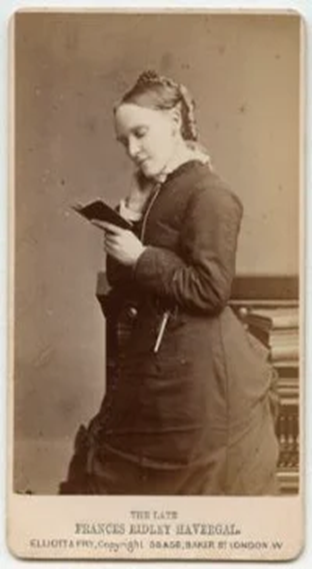
To that special “Women’s Honor Roll” we must add the name of Frances Ridley Havergal (1836-1879). The daughter of the Rev. W. H. Havergal, she was born at Astley, Worcestershire. Five years later her father moved to the Rectory of St. Nicholas, Worcester. Her mother died when she was only eleven, after a lengthy period of suffering. After a carriage accident, her father devoted himself to the improvement of church music in England, and according to hymnologist Albert Bailey, “revived the use of the solid tunes of early English composers and so did much to improve the quality of congregational singing.” He wrote about 100 hymns, himself. Havergal was obviously inspired by her father’s efforts. She possessed a natural musicianship, as well as a love for walking, swimming and mountain climbing. By the age of 7, she displayed a talent for writing verse. She was converted at the age of 14.