
A hymnal without any hymns by Isaac Watts (1674-1748) would be a hymnal …. Well, such a hymnal would not exist! Known as “the father of English hymnody,” we are deeply indebted to him for the songs we bring to the Lord in worship. Look at the index of authors in any hymnal, and you will find Isaac Watts well-represented. Here are just a few: “Our God, Our Help in Ages Past,” “I Sing the Almighty Power of God,” “Joy to the World,” “Alas, and Did My Savior Bleed,” “Join All the Glorious Names,” “Come We That Love the Lord,” and even a setting of “The Beatitudes!”
Beginning with Psalms that he “re-wrote” to make Jesus and New Testament content more explicit (like “Jesus Shall Reign” – Psalm 72) to original hymns of the Savior (like “When I Survey the Wondrous Cross”), we can sing all the Scriptures with depth and joy. He is one of the finest hymn writers in the history of Christian hymnody, combining rich doctrinal substance with splendid poetic excellence. He is recognized as one of the primary agents in the move from exclusive psalmody to “hymns of human composure,” as English hymnody came to be known.
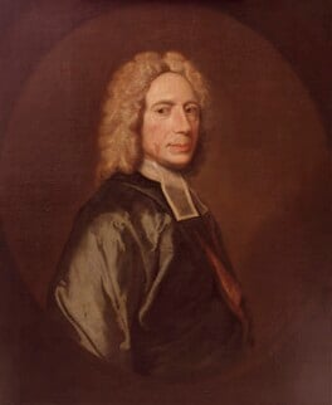
Watts carefully chose the texts for his hymns. They were comprehensive in scope. For example, in “Joy to the World” we sing of events that affect all of creation: the world, earth, every heart, fields and floods, etc. Watts was totally committed to the Reformed faith and his hymns reflect this doctrinal perspective. He always directed attention to the person and work of Jesus Christ and was not content to speak in general terms about God and mercy.
Watts’ hymns are scriptural in flavor. They are full of allusions, paraphrases, and direct quotations from the Bible. They were for use primarily in the public worship of God, not just for use in private devotions; therefore their language is not of me, but of us and to the world. His hymns are vivid in their imagery, emotional in their impact, and full of wonder and awe as they consider the grand dimensions of the sovereignty of God over His creation. In every way, as Reformed churches around the world abundantly testify by their use of Watts’ hymns, his are the Calvinistic hymns, the epitome of Reformed congregational singing.
In analyzing his writing, here are three dominant characteristics that clearly guided his thinking. First, hymnody should be evangelical. It should express those elements of the Christian gospel that come to clear focus in the New Testament. Second, hymnody should be freely composed. It should not be bound to precise words of Scripture, but should faithfully express scriptural truth. Third, hymnody should be contemporary in its expression. It should be the reaction of the singer to the gospel’s work in his own heart, not the recollection of the psalm singer to the promises of the gospel 3,000 years ago.
Watts applied these principles to the Psalms, as well as to other Old Testament and New Testament passages, in these specific ways. First, he identified Old Testament types That is, instead of referring to animal sacrifices, he wrote of the cross where the Lamb of God was slain. Second, he included New Testament concepts. Whereas the Psalms speak of trust in God, Watts wrote of faith in the risen Son of God. And third, he focused on Christ. Instead of singing of prophecies of a Savior, we may now sing of the accomplished fact of our redemption by Jesus.
When it comes to style and content, all of Watts’ hymns share common characteristics. These may be found in his hymn, “When I Survey the Wondrous Cross.” First, Meter: Watts wrote all his lyrics in Common Meter, Long Meter, or Short Meter. “When I Survey” is in Long Meter. By using these metrical forms, Watts’ psalms and hymns could be sing to the tunes already in use. Second, Vocabulary: Look at the words in “When I Survey.” Any of them could be understood by a young person. And notice how many of them are single-syllable words. Third, Opening Line: Watts was able to arrest attention in the first line. “When I Survey the Wondrous Cross” immediately brings a powerful picture to mind. Fourth, Climax: “When I Survey” (“demands my soul, my life, my all”) is a good example of the dramatic climax to which Watts characteristically brought his hymns.
Isaac Watts was the son of a schoolmaster, and was born in Southampton, July 17, 1674. He is said to have shown remarkable precocity in childhood, beginning the study of Latin, in his fourth year, and writing respectable verses at the age of seven. At the age of sixteen, he went to London to study in the Academy of the Rev. Thomas Rowe, an Independent minister. In 1698, he became assistant minister of the Independent Church, Berry St., London. In 1702, he became pastor. In 1712, he accepted an invitation to visit Sir Thomas Abney, at his residence of Abney Park, and at Sir Thomas’ pressing request, made it his home for the remainder of his life. It was a residence most favorable for his health, and for the prosecution of his literary labors. He did not retire from ministerial duties, but preached as often as his delicate health would permit.
The number of Watts’ publications is very large. His collected works, first published in 1720, embrace sermons, treatises, poems and hymns. His “Horae Lyricae” was published in December, 1705. His “Hymns” appeared in July, 1707. The first hymn he is said to have composed for religious worship, is “Behold the Glories of the Lamb,” written at the age of twenty. It is as a writer of psalms and hymns that he is everywhere known. Some of his hymns were written to be sung after his sermons, giving expression to the meaning of the text upon which he had preached. Montgomery calls Watts “the greatest name among hymn-writers,” and the honor can hardly be disputed. His published hymns number more than eight hundred. Watts died November 25, 1748, and was buried at Bunhill Fields. A monumental statue was erected in Southampton, his native place, and there is also a monument to his memory in the South Choir of Westminster Abbey.
“My Shepherd Will Supply My Need” is obviously a setting of the themes of Psalm 23, not a metrical Psalm as would have been typical prior to Watts. It was first published in his 1719 collection “The Psalms of David Imitated in the Language of the New Testament.” Watts actually wrote three paraphrases of Psalm 23, the short meter version of which, beginning, “The Lord my shepherd is, I shall be well supplied,” has appeared in many song books. The tune (RESIGNATION or HOPEWELL) to which the common meter version is usually set is a traditional early American melody of unknown origin. Its first known appearance was in the 1828 edition of “Beauties of Heaven” compiled by Freeman Lewis. It became rather well known after appearing in the 1832“Genuine Church Music” compiled by Joseph Funk. The modern version appeared in the 1854-1855 “Southern Harmony”compiled by William Walker.
The theme of the hymn, as with the theme of the Psalm, is one of most wonderful beneficial for believers, pointing us to the Lord Jesus as our Good Shepherd who has laid down His life for us, His Sheep. And now as our Shepherd King, He does indeed supply every need. He has taught us to pray “give us this day our daily bread,” and He does. The Lord as our provider is one of the most prominent themes in the Bible, and nowhere more so than in the Psalms.
Whether we study or sing Psalm 23, we need to remind ourselves that what we need most from our Good Shepherd is not material things. We need guidance in decisions. We need protection from cultural forces that would de-rail us from our heavenward destination. We need insight and discernment to understand God’s Word and to keep from being led astray by false teachers. We need endurance in pursuing spiritual maturity to keep going when we grow weary in spiritual battles. And we need a power from outside ourselves to recognize and resist the temptations that Satan shows at us like fiery darts (Ephesians 6:16).
The text was originally in six stanzas. In today’s version, two are placed in each, totaling three stanzas. The song points to the Lord as our Shepherd who leads us and provides for our needs. As is typical for Watts (and most good hymn writers), the lyrics and filled with biblical allusions, even in addition to Psalm 23.
Stanza 1 focuses upon our Good Shepherd’s provisions. Because we are as sheep going astray, we need a shepherd (1 Peter 2:25). The name of our shepherd is Jehovah, the eternal one (Exodus 6:3). As our Shepherd, He makes us feed in pastures fresh (Isaiah 40:11).
My Shepherd will supply my need, Jehovah is His name;
In pastures green He makes me feed, Beside the living stream.
He brings my wandering spirit back When I forsake His ways,
And leads me, for His mercy’s sake, In paths of truth and grace.
Stanza 2 focuses upon our Good Shepherd’s presence. The shades of death are dangerous situations in which the Shepherd’s presence drives away our fear (Hebrews 13:5-6). Also, in the sight of our foes, the Shepherd’s presence spreads our table so, again, we have nothing to fear (Matthew 10:28). And His presence causes our heads to be anointed with oil and our cup to overflow, symbolizing the spiritual blessings that He offers His followers (Ephesians 1:3).
When I walk through the shades of death Thy presence is my stay;
One word of Thy supporting breath Drives all my fears away.
Thy hand, in sight of all my foes, Doth still my table spread;
My cup with blessings overflows, Thine oil anoints my head.
Stanza 3 focuses upon our Good Shepherd’s house. The Lord has promised to be with us all of our days (Matthew 28:18-20). As long as we live, we abide in His spiritual house, the church (1 Timothy 3:15). Yet, even after this life is over, we can have a home in heaven and find the settled rest of eternal life (1 Peter 1:3-5; 1 John 2:25).
The sure provisions of my God Attend me all my days;
O may Thy house be my abode, And all my work be praise!
There would I find a settled rest, While others go and come;
No more a stranger, nor a guest, But like a child at home.
Here is a link to an anthem by Mack Wilberg based on this hymn.