While “The Star Spangled Banner” is not technically a hymn of praise to God, since it is found in many hymnals in America and sung or played on so many occasions (baseball games being among them!), it is being including here in this collection of studies. It is the national anthem of the United States of America and will be heard across the nation on this July 4th, 2026, as the country celebrates its 250th anniversary, our semiquincentennial (try saying that quickly five times!).
The lyrics come from the “Defence of Fort M’Henry,” a poem written by American lawyer Francis Scott Key on September 14, 1814, after he witnessed the bombardment of Fort McHenry by the British Royal Navy during the Battle of Baltimore in the War of 1812. Key was inspired by the large U. S. flag with its 15 stars and 15 stripes, that star-spangled banner, flying triumphantly above the fort after the battle.
His poem was set to the music of a popular British song written by John Stafford Smith for the Anacreontic Society, a gentlemen’s club in London. Smith’s song, “The Anacreontic Song,” with various lyrics, was already popular in the United States. This setting, renamed “The Star-Spangled Banner,” soon became a popular patriotic song. With a range of 19 semitones, it is known for being very difficult to sing, in part because the melody stretches so far into higher notes that other voices than a soprano find it challenging to reach.
“The Star-Spangled Banner” was first recognized for official use by then making the song the official national anthem of the United State Navy in 1889. On March 3, 1931, the U. S. Congress passed a joint resolution making the song the official national anthem of the United States, which President Herbert Hoover signed into law. Francis Scott Key’s original hand-written manuscript of his “Defense of Fort M’Henry” is now on display at the Maryland Historical Society. The actual flag is preserved and exhibited at the Smithsonian Institution’s National Museum of American History in Washington, D.C.
Francis Scott Key (August 1, 1779 – January 11, 1843) was an American lawyer, author, and poet from Frederick, Maryland. He was a devout Episcopalian, and helped establish two theological seminaries to train pastors. Key worker as a lawyer in Maryland and Washington, D.C., for four decades and worked on important cases, including the Burr conspiracy trial, and he argued numerous times before the Supreme Court. He was nominated for District Attorney for the District of Columbia by President Andrew Jackson, where he served from 1833 to 1841.
Key owned slaves from 1800, during which time abolitionists ridiculed his words, claiming that America was more like the “Land of the Free and Home of the Oppressed.” As District Attorney, he suppressed abolitionists, and he lost a case against Reuben Crandall in 1836 where he accused the defendant’s abolitionist publications of instigating slaves to rebel. He was also a leader of the American Colonization Society, which sent former slaves to Africa. He freed some of his slaves in the 1830s, paying one as his farm foreman to supervise his other slaves. He publicly criticized slavery and gave free legal representation to some slaves seeking freedom, but he also represented owners of runaway slaves. He had eight slaves at the time of his death.
Key was born into an affluent family. Key’s father, John Ross Key of English descent, was a lawyer, a commissioned officer in the Continental Army and a judge. Key grew up on the family plantation Terra Rubra in Frederick County, Maryland, which is now in Carroll County. He graduated from St, John’s College, Annapolis, Maryland, in 1796 and read law under his uncle Philip Barton Key, who was loyal to the British Crown during the War of Independence. He married Mary Tayloe Lloyd on January 1, 1802. The couple raised their 11 children in their Georgetown residence, the Key House.
On August 28, 1814, William Beanes, a physician who resided in Upper Marlboro, Maryland, was arrested by British forces in his home after the burning of Washington and the raid on Alexandria. A friend of Keys, Beanes was accused of aiding the detention of several British Army stragglers who were ransacking local homesteads in search of food. On September 2, 1814, Key wrote a letter from his home in Georgetown to his mother, ending with:
I am going in the morning to Baltimore to proceed in a flag-vessel to Genl Ross. Old Dr Beanes of Marlbro’ is taken prisoner by the Enemy, who threaten to carry him off – Some of his friends have urged me to apply for a flag & go & try to procure his release. I hope to return in about 8 or 10 days, though [it] is uncertain, as I do not know where to find the fleet. – As soon as I get back I hope I shall be able to set out for Fred[ericksburg] –
Under sanction from President Madison, on September 3, Key traveled 40 miles by land from Washington, D.C. to Baltimore, where he arrived on the morning of September 4. He located Col. John Stuart Skinner, an American agent for prisoners of war, who leased a 60-foot sloop-rigged packet ship belonging to John and Benjamin Ferguson, brothers who owned a cargo and passenger service between Baltimore and Norfolk. The ship had a nine-man crew and was captained by a co-owner, John Ferguson. They sailed from Baltimore the next day (September 5) out through the Patapsco River and then south, down the Chesapeake Bay. As recorded in the British ships’ logs, on September 6, they had rendezvoused with HMS Royal Oak and several British troopships near the mouth of the Patuxant. There they learned Beanes was aboard HMS Tonnant further down in the bay. Rear Admiral Pulteney Malcolm assigned the frigate Hebrus to escort the American sloop to Tangier Island, where he thought Tonnant was located.
On September 7, around noon, they spotted Tonnant near the mouth of the Potomac. The flagship then anchored and brought Key and Skinner aboard. It was aboard Tonnant after dinner, that Skinner and Key secured the release of Beanes after conversing with Major General Robert Ross and Vice-Admiral Alexander Cochrane. Ross initially refused to release Beanes, but relented after reading letters, brought by Key, written by wounded British prisoners of war praising American doctors for their kind treatment. Because Key and Skinner had overheard details of the plans for the attack on Baltimore, they were prevented from going ashore until after the battle, several days later.
From Tonnant, Key, Skinner, and Beanes were transferred to the frigate HMS Surprise on the morning of September 8. The fleet then slowly moved up the Chesapeake toward Baltimore. The truce vessel was in tow with Surprise. On September 11, off the North Point peninsula, Colonel Skinner insisted that they be transferred back to their own truce vessel, which they were allowed to do, under guard. It was still tethered to Surprise. Admiral Cochrane then transferred his flag to the shallow-draft Surprise so he could move in with the bombardment squadron. Having advanced into the Patapsco River, the 16-ship attack force began to fire on Fort McHenry at sunrise on September 13. The bombardment would last 25 hours.
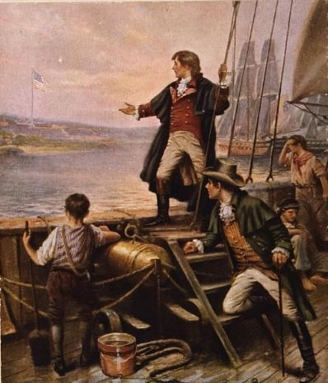
During the rainy day and through the night, Key had witnessed the bombardment and observed that the fort’s smaller “storm flag” (17 by 25 feet) continued to fly, but once the bomb and Congreve rocket barrage had stopped, he would not know how the battle had turned out until dawn. On the morning of September 14, the storm flag had been lowered and the large garrison flag (30 by 42 feet) had been raised.
During the bombardment, HMS Erebus provided the “rockets’ red glare,” while the heavy-mortar bomb ships Terror, Volcano, and Aetna provided the “bombs bursting in air.” Around 1,500 to 1,800 bomb shells and over 700 rockets were fired at the fort but with minimal casualties and damage being done. Four men died and 24 were wounded in the fort. The ships were forced to fire from their maximum range, with minimal accuracy, to stay out of range of the fort’s formidable cannon fire.
Key was inspired by the U.S. victory and the sight of the large U.S. flag flying triumphantly above the fort. This flag (as well as the storm flag), with 15 stars and 15 stripes, had been made by Mary Young Pickersgill together with other workers in her home on Baltimore’s Pratt Street. It was restored in 1914 by Amelia Fowler, and again in 1998 as part of an ongoing conservation program. Aboard the ship that morning, Key began writing his lyrics on the back of a letter he had kept in his pocket. In the late afternoon of September 16, Key, Skinner and Beanes were released from the fleet ,and they arrived in Baltimore that evening. He completed the poem at the Indian Queen Hotel, where he was staying. His finished manuscript was untitled and unsigned.
In 1916, after the U.S. Navy had officially adopted the song in 1889, President Woodrow Wilson ordered that “The Star-Spangled Banner” be played at military and other appropriate occasions. The playing of the song two years later during the seventh-inning stretch of Game One of the 1918 World Series, and thereafter during each game of the series is often cited as the first instance that the anthem was played at a baseball game, though evidence shows that the “Star-Spangled Banner” was performed as early as 1897 at Opening Day ceremonies in Philadelphia and then more regularly at the Polo Grounds in New York City beginning in 1898. The tradition of performing the national anthem before every baseball game began in World War II.
Before 1931, other songs served as the hymns of U.S. officialdom. “Hail, Columbia” served this purpose at official functions for most of the 19th century. “My Country, ‘Tis of Thee,” whose melody is identical to the United Kingdom’s national anthem, “God Save the King” also served as a de facto national anthem. Following the War of 1812 and subsequent U.S. wars, other songs emerged to compete for popularity at public events, among them “America, the Beautiful,” which itself was being considered before 1931 as a candidate to become the national anthem of the United States.
In the fourth stanza, Key’s 1814 published version of the poem is written as, “And this be our motto-‘In God is our trust!’” In 1956 when “In God We Trust” was under consideration to be adopted as the national motto of the United States by the US Congress, the words of the fourth stanza of “The Star Spangled Banner” were brought up in arguments supporting adoption of the motto.
Two especially unusual performances of the song took place in the immediate aftermath of the September 11 terror attacks. . On September 12, 2001, Queen Elizabeth II broke with tradition and allowed the Band of the Coldstream Guards to perform the anthem at Buckingham Palace, London at the changing of the guard, as a gesture of support for Britain’s ally. The following day at a St. Paul’s Cathedral memorial service, the Queen joined in the singing of the anthem, an unprecedented occurrence. The Star Spangled Banner was played by the Coldstream Guards again at Windsor Castle on the 20th anniversary of the attacks.
“The Star-Spangled Banner” has four stanzas, although only the first is commonly performed.
Stanza 1 s
O say, can you see, by the dawns early light,
What so proudly we hailed at the twilight’s last gleaming?
Whose broad stripes and bright stars through the perilous fight,
O’er the ramparts we watched, were so gallantly streaming?
And the rockets’ red glare, the bombs bursting in air,
Gave proof through the night that our flag was still there;
O say does that star-spangled banner yet wave,
O’er the land of the free and the home of the brave?
Stanza 2 s
On the shore dimly seen through the mists of the deep,
Where the foe’s haughty host in dread silence reposes,
What is that which the breeze, o’er the towering steep,
As it fitfully blows, half conceals, half discloses?
Now it catches the gleam of the morning’s first beam,
In full glory reflected now shines on the stream:
‘Tis the star-spangled banner, O long may it wave
O’er the land of the free and the home of the brave.
Stanza 3 s
And where is that band who so vauntingly swore
That the havoc of war and the battle’s confusion,
A home and a country should leave us no more?
Their blood has washed out their foul footsteps’ pollution.
No refuge could save the hireling and slave,
From the terror of flight, or the gloom of the grave:
And the star-spangled banner in triumph doth wave,
O’er the land of the free and the home of the brave.
Stanza 4 s
O thus be it ever, when freemen shall stand,
Between their loved home and the war’s desolation,
Blessed with vict’ry and peace, may the heav’n rescued land,
Praise the power that hath made and preserved us a nation!
Then conquer we must, when our cause it is just,
And this be our motto: “In God is our trust.”
And the star-spangled banner in triumph shall wave,
O’er the land of the free and the home of the brave!
In a version hand-written by Francis Scott Key in 1840, the third line reads: “Whose bright stars and broad stripes, through the clouds of the fight.” In 1861, poet Oliver Wendell Holms, Sr. penned an unofficial fifth stanza during the beginning of the American Civil War, looking hopefully at the emancipation of slaves.
When our land is illumed with Liberty’s smile,
If a foe from within strikes a blow at her glory,
Down, down with the traitor who dares to defile
The flag of her stars and the page of her story!
By the millions unchained when our birthright was gained,
We will keep her bright blazon forever unstained!
And the star-spangled banner in triumph shall wave
While the land of the free is the home of the brave!
When the U.S. national anthem was first recognized by law in 1931, there was no prescription as to behavior during its playing. On June 22, 1942, the law was revised indicating that those in uniform should salute during its playing, while others should simply stand at attention, men removing their hats. The same code also required that women should place their hands over their hearts when the flag is displayed during the playing of the national anthem, but not if the flag was not present. On December 23, 1942, the law was again revised instructing men and women to stand at attention and face in the direction of the music when it was played. That revision also directed men and women to place their hands over their hearts only if the flag was displayed. Those in uniform were required to salute. On July 7, 1976, the law was simplified. Men and women were instructed to stand with their hands over their hearts, men removing their hats, irrespective of whether or not the flag was displayed and those in uniform saluting. On August 12, 1998, the law was rewritten keeping the same instructions, but differentiating between “those in uniform” and “members of the Armed Forces and veterans” who were both instructed to salute during the playing whether or not the flag was displayed. Because of the changes in law over the years and confusion between instructions for the Pledge of Allegiance versus the national anthem, throughout most of the 20th century many people simply stood at attention or with their hands folded in front of them during the playing of the anthem, and when reciting the Pledge they would hold their hand (or hat) over their heart.
Since 1998, federal law states that during a rendition of the national anthem, when the flag is displayed, all present including those in uniform should stand at attention; non-military service individuals should face the flag with the right hand over the heart; members of the Armed Forces and veterans who are present and not in uniform may render the military salute; military service persons not in uniform should remove their headdress with their right hand and hold the headdress at the left shoulder, the hand being over the heart; and members of the Armed Forces and veterans who are in uniform should give the military salute at the first note of the anthem and maintain that position until the last note. The law further provides that when the flag is not displayed, all present should face toward the music and act in the same manner they would if the flag were displayed. Military law requires all vehicles on the installation to stop when the song is played and all individuals outside to stand at attention and face the direction of the music and either salute, in uniform, or place the right hand over the heart, if out of uniform. The law was amended in 2008, and since allows military veterans to salute out of uniform, as well.
The text of the statute is suggestive and not regulatory in nature. Failure to follow the suggestions is not a violation of the law.
Here’s a link to the singing of our national anthem.