
As our nation celebrates its 250th anniversary on July 4, 2026, we Christians turn our minds and hearts toward biblical passages about honoring the rulers God has ordained for us (Romans 13:4 – “he is God’s servant for your good”) and praying for the well-being of the land in which we live (Jeremiah 29:7 – “But seek the welfare of the city where I have sent you into exile, and pray to the Lord on its behalf, for in its welfare you will find your welfare”). And on patriotic occasions we are often reminded of Psalm 33:12 – “Blessed is the nation whose God is the Lord.” Of course, no nation today can claim that the way Israel could in the Old Testament, but is there not an abiding dimension of blessing for us today when our culture (or at least the Christian “remnant” in our culture) honors the Lord?
With the challenge of the unacceptable excesses of “Christian Nationalism” (which almost all evangelical denominations have categorically rejected), we shouldn’t throw the baby out with the bath water (so-to-speak) by being reluctant to enthusiastically celebrate a patriotic spirit at this historic semi sesquicentennial (250th), a once in a lifetime event. In contrast to the radical liberal “wokeists” who scream that America is a terrible nation, we should be in the front line of those who point to the biblical principles that were openly embraced by our founding fathers and the impressive list of things with which God, in His providence, has blessed us. We do so proudly, not because of what we have done, but proud of what our God has done!
Of course, while we should not turn our worship services into praises of our nation, we certainly should be willing to acknowledge with gratitude God’s goodness to us, and to pray for His mercy to preserve and prosper us, especially as Paul wrote in 1 Timothy 2:1-3, “First of all, then, I urge that supplications, prayers, intercessions, and thanksgivings be made for all people,for kings and all who are in high positions, that we may lead a peaceful and quiet life, godly and dignified in every way.This is good, and it is pleasing in the sight of God our Savior.” And as we do, we have in our hymnals resources to sing for those biblical goals, hymns like “God of Our Fathers,” “Our God, Our Help in Ages Past,” “God the Omnipotent,” “Great King of Nations, Hear Our Prayer,” and “O God of Love, O King of Peace.” (See another hymn studies in this series about
“The Battle Hymn of the Republic” to learn why it is not an acceptable song for Christian worship.)
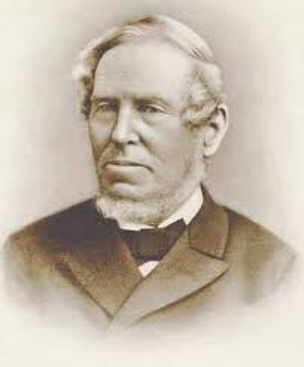
The focus of this study is not really a hymn until we get to the final stanza. But even if we don’t find it in some hymnals, we probably all remember singing “My Country, ‘Tis of Thee” in both church and school in our personal experience in years past. It is so familiar, that many of us could almost sing it by memory! The lyrics of the song were written in 1831 by Samuel Francis Smith, D.D. (1808-1895) when he was a twenty-four-year-old Baptist seminary student at Andover Theological Seminary in Massachusetts.
Smith was asked by composer Lowell Mason to translate some German song books. Inspired by one of the German songs, “God Bless Our Native Land” (set to the tune of “God Save the King,” Smith set out to write an original patriotic song for America set to the same melody. The result was what Smith called “America” and what would eventually be better known as “My Country, ’Tis of Thee.” The song was first performed on July 4, 1831, by a children’s choir in Boston’s famed Park Street Church. He had scribbled out five stanzas in just thirty minutes. The third stanza is generally omitted today, for obvious reasons as one will see when examining the text and its strident tone.
He entered the Baptist ministry in 1832, and in the same year became editor of the “Baptist Missionary Magazine.” He also contributed to the “Encyclopaedia Americana.” From 1834 to 1842 he was pastor at Waterville, Maine, and Professor of Modern Languages in Waterville College. In 1842 he moved to Newton, Massachusetts, where he remained until 1854, when he became the editor of the publications of the Baptist Missionary Union. With Baron Stow he prepared the Baptist collection known as “The Psalmist,” published in 1843, to which he contributed several hymns. Dr. Smith also published “Lyric Gems,” 1854, and “Rock of Ages,” 1870.
Born in Boston, Massachusetts, on October 21, 1808, Smith demonstrated intellectual brilliance early in life, graduating from Harvard University in 1829 before pursuing theological studies at Andover Theological Seminary. It was during his time at Andover that he composed his most famous work. A gifted linguist who mastered fifteen languages, Smith would later take up Russian at the remarkable age of 86, just a year before his death. His linguistic talents extended to hymnody, as he wrote or translated 150 hymns throughout his lifetime. Beyond his literary contributions, Smith served as a pastor in several prominent Baptist churches, co-edited the influential 1843 hymnal “The Psalmist” (which became the standard Baptist hymnal of its era), and later worked as a missionary advocate, even serving as Secretary of the Baptist Missionary Union.The hymn was an instant success, capturing the young nation’s spirit of gratitude and divine reliance.
One contemporary admirer praised it as a hymn where “children and philosophers can repeat the words together,” noting its power to rise above national crises. Though the melody was shared across nations, Smith’s words gave it a uniquely American voice, one that celebrated liberty, natural beauty, and faith in God’s providence. The hymn’s longevity speaks to its rare fusion of theological depth and patriotic fervor, a balance Smith achieved by rooting national identity in reverence for God. While the tune’s European origins remind us of shared musical heritage, Smith’s lyrics, unchanged since their hurried composition in 1832, stand as a testament to the power of words to shape a young nation’s sense of purpose and place in history.
Though “The Star-Spangled Banner” became the official national anthem of the US in 1931, “My Country, ‘Tis of Thee” is far easier to sing and earned Smith a certain level of popularity. The famous 19th century Chicago evangelistic singer, Ira Sankey, cites one example.
“Dr. Smith visited the Board of Trade in Chicago in May of 1887. While sitting in the gallery he was pointed out to some of the members. Soon he became the center of considerable notice. All at once the trading on the floor ceased, and from the wheat-pit came the familiar words, ‘My Country ‘Tis of Thee.’ After two stanzas had been sung, Dr. Smith arose and bowed. A rousing cheer was given by the men on the floor, to which Dr. Smith was now escorted by the secretary of the Board. The members flocked around Dr. Smith and grasped his hand. Then they opened a passage through the crowd and led him to the wheat-pit, where they took off their hats and sang the rest of the hymn.”
With the enduring popularity of this song, it will be a joy to include it in our patriotic celebrations on this 250th birthday of America. It is an unusual text in that, for the most part, it is addressed to the country, until we reach the final stanza, which is clearly addressed to the Lord. May it be a prayer that we can all share in hopes that our God will restore the spiritual heart of the nation back to its focus on biblical truth and morality.
Stanza 1 highlights the “liberty” and freedom” which are at the heart of July 4th celebrations each year. We cherish freedom of speech and freedom of the press, but especially our freedom of religion which enable us to gather for worship and share our faith without interference. The advance of unbelief and intolerance in our age makes such a desire even more urgent, less we lose that privilege. This stanza includes the reminder that these freedoms have come with a cost, as our “fathers” in past generations gave their lives to maintain such benefits that made this the “land of the pilgrims’ pride.”
My country, ‘tis of thee,
sweet land of liberty,
of thee I sing:
land where my fathers died,
land of the pilgrims’ pride,
from every mountainside
let freedom ring!
Stanza 2 adds to the freedom passed on to us from those “noble” patriots of the past, the beauty of this land in which we are blessed to live. Smith eloquently crafted these phrases that paint vivid pictures in our imagination: “rocks and rills” and “woods and templed hills.” The result is that we sing from hearts that are thrilled with “rapture.” In other words, we are excited to laud the grandeur of this land of ours.
My native country, thee,
land of the noble free,
thy name I love;
I love thy rocks and rills,
thy woods and templed hills;
my heart with rapture thrills
like that above.
Stanza 3 sounds quite harsh, and so it is no surprise that is has been dropped from almost all published editions of the hymn. Smith wrote these words in 1831. Was he thinking of the conflict in the Revolutionary War a couple of generations earlier? These lyrics certainly are an accurate representation of our desire today that our land be spared the brutality of tyrants like those we see in Russia and Iran today, along with other regions were Christians experience persecution.
No more shall tyrants here
With haughty steps appear,
And soldier bands;
No more shall tyrants tread
Above the patriot dead—
No more our blood be shed
By alien hands.
Stanza 4 returns to a much more positive spirit, more in conformity with the rest of the stanzas. Still addressing the nation as a personal identity, it becomes our desire that music of freedom would “swell the breeze and ring from all trees.” Perhaps we might imagine residents gathering in a town square, complete with floats in a parade, accompanied by the marching bands of local schools playing patriotic marches by John Philip Sousa, while red, white, and blue banners hang from the trees and festoon the store fronts along the route.
Let music swell the breeze,
and ring from all the trees
sweet freedom’s song:
let mortal tongues awake,
let all that breathe partake;
let rocks their silence break,
the sound prolong.
Stanza 5 is without a doubt the best part of the song, as it becomes more of a psalm than merely a song, addressing the God of our fathers. Here we sing not of Him, but to Him in a petition that He would protect us by His might as our great God, our king. He is the one who brought us and our nation to this point in history after two and a half centuries, and He alone can preserve us amid all the challenges we face so that our children and grandchildren might enjoy the manifold blessings that we have inherited.
Our fathers’ God, to Thee,
Author of liberty,
To Thee we sing;
Long may our land be bright
With freedom’s holy light;
Protect us by Thy might,
Great God, our king.
An abolitionist version was written, by A. G. Duncan, 1843, with lyrics mentioning white and black races. For Washington’s Centennial celebration, another verse was added to the original version. Aretha Franklin sang “My Country, ‘Tis Of Thee” at the first inauguration of Barack Obama (January 20, 2009). Kelly Clarkson sang it at his second inauguration. Long before that, Marian Anderson performed the song at the Lincoln Memorial on Easter Sunday, April 9, 1939. Anderson, an African American singer, had been forbidden to perform at the DAR Constitution Hall due to its whites-only policy. After a national outcry, and with support from, Eleanor Roosevelt, the concert was held on the steps of the memorial, and attracted a crowd of more than 75,000 in addition to a national radio audience of millions. Martin Luther King, Jr. recited the first stanza of the song toward the end of his famous “I Have a Dream” speech at the Lincoln Memorial during the March on Washington on for Jobs and Freedom on August 28, 1963.
Although we know that Reverend Samuel Francis Smith wrote the words to “My Country, ‘Tis of Thee,” the origin of the song’s melody remains a mystery. And the history of its stanzas is even more complex. The son of Henry Carey, a British singer-composer, claimed his father was the first to compose both the words and the music of this tune as “God Save Great George the King” in London in 1740. However, Carey’s son had financial reasons for making such a claim, and music historians argued it was more likely any such tune would have been based on a pre-existing melody. Such an earlier melody, if it did exist, has been attributed to various seventeenth-century sources including the English composer John Bull, the French court composer Jean-Baptiste Lully, and even a military hymn from Switzerland. Although the tune’s exact origin is not confirmed, it was printed in England in 1744 in the tune book “Thesaurus Musicus.”
The performance that led to an explosion in the popularity of “God Save the King” took place in London in September 1745. Dr. Thomas Arne arranged the tune for a September 28, 1745, performance at the Drury Lane Theater. It was also performed concurrently at the Covent Garden Theater for several nights running. The song was intended to show support for the Hanoverian King George II, following the defeat of his General John Cope at Prestonpans, a battle that was the opening salvo in the war against “Bonnie Prince Charlie,” his Stuart rival for the throne.
Before the music of “My Country ‘Tis of Thee” made its way to the United States it was played in many countries. By the 1790s the melody had become that of the Danish national anthem “A Song to be Sung by the Danish Subjects at the Fete of their King, to the Melody of the English Hymn.” Eventually it also became the national anthem of at least six other places, including Prussia (“Heil dir im Siegerkranz,” or “Hail to Thee in the Victor’s Wreath”), Britain (“God Save the King/Queen”) and Liechtenstein.
The first documented version of this melody printed in the American British colonies dates from 1761. The tune of “God Save the King” was used, in a slightly modified form, as the melody for the hymn known as “Whitefield’s Tune,” published in “Urania,” a collection of sacred songs compiled by James Lyon and printed by William Bradford.
After the colonies became independent from England the words were further adapted for use in the United States. For example, George Washington was greeted as he arrived in New York City for his first inauguration in April 1789, with the following homegrown words sung to the familiar air of “God Save the King.”
Hail, thou auspicious day!
For let America
Thy praise resound.
Joy to our native land!
Let every heart expand,
For Washington’s at hand,
With glory crowned.
Thrice beloved Columbia, hail!
Behold before the gale
Your chief advance.
The matchless Hero’s neigh;
Applaud him to the sky,
Who gave you liberty,
With gen’rous France.
A number of popular versions of the song may have evolved in America, with no known documentation as to their source. It would have been known, for example, to many members of the Lewis and Clark expedition (1803-1806) under the title “God Keep America.”
God keep America
Free from tyrannic sway
Till time shall cease
Hush’d be the din of arms
And all proud war’s alarm;
Follow in all her charms
Heaven-borne peace.
Here is a link to a congregation singing the familiar lyrics and tune hymn on a Sunday morning.