
Have you noticed what various religions teach that their deity requires in order to be admitted into eternal bliss after death, in other words “to be saved?” False religions all have this one thing in common: that it requires some kind of meritorious work in this life to earn that reward, perhaps having lived a good moral life, or that good deeds will be found to outweigh bad deeds, or maybe following prescribed religious rituals. All of these fail on several counts. One is that no one is good, and our sin nature will prevent us from following through on the most noble intents. Another cause for failure is that each of these efforts involves, in a sense, bribing a god, or tricking that god into thinking we are better than we actually are (maybe even by failing to see), as we are lost in the crowd of humanity. A third failure is that such a view has too high a view of fallen human nature and too low a view of the holiness of God. That a God who is too pure to even look on sin, and too just to let sin go unpunished, could possibly overlook our wickedness, turns Him into a benevolent Santa Claus who brings gifts at Christmas whether we’ve been bad or good, one who turns a blind eye to our treason, and who treats the criminal in the same way He does the saint.
Add to that the conclusion that if we could make it on our own, then Christ’s death on the cross was useless. Not only that, it turns the Father into a monster. When Jesus cried out in the Garden of Gethsemane, He was pleading with the Father that if there was any other way than the cross, to spare Him. If our efforts would suffice to pay the price of our evil deeds, and the Father knew it, it would mean that He said to His beloved Son (in effect), “No, the cross isn’t necessary; they’re each able to manage on their own. But go ahead anyway and let them torture You and put You to a horrible death.” Is that a God worthy of worship? Is that a God with whom we would want to spend eternity? Not me!
Such is the uselessness of false religion that blatantly propagates the lie from hell that we can earn heaven by our own good deeds. But even within the ranks of modern Christianity, there is a form of that error that is too widely accepted. It is the newer increasingly popular form of unitarianism. It is cloaked in kind-sounding words that elevate the supposed virtue of an all-forgiving God. It assures us that God is too benevolent to be angry at any sinner, and that He will welcome everyone into His eternal presence. That heresy was popularized a few years ago in Rob Bell’s best-selling book, “Love Wins.” It doesn’t take much thought to realize that there’s something fundamentally wrong with the idea that God will treat the Hitlers of history in the same way as the Mother Teresas of the centuries.
But back to the fundamental question implied in the words of the Rich Young Ruler, “What must I do to inherit eternal life?” When Jesus pointed him to the commandments, and then to the call to give all that he possessed to the poor, Jesus was NOT teaching that these good works would save him; He was convicting him of his love for riches, a love of material things that kept him from the one and only thing required, and that is to love the Lord our God with all our heart, mind, soul, and strength. Make sure that you notice how different that is from all false religion. Jesus does not say, “Do this, and do that, and don’t do any of these.” No, He simply says, “Love Me with your whole heart.” Isn’t that wonderful? Just, love Me. Of course, that involves loving Him for who He is and what He has done for us. The Bible calls that saving faith.
And that’s the connection with not only the hymn of this study, but also the vast number of hymns that have to do with loving the Lord. John Piper loves to remind us that the Christian life is one of both duty and delight. It is our duty to love the God who made us, and our delight to love the God has redeemed us. Psalm 116:15 and Isaiah 43:4 tell us that we are precious in His sight, and so it is only natural for us to be able to declare with intensity and sincerity that He is precious in our sight!
In 1862 Godfrey Thring (1823-1903) wrote “Savior, Blessed Savior.” It was subsequently published first in 1866 in “Hymns Congregational and Others,” and then revised in 1882. He was deeply involved in the mid-19th century movement to renew congregational hymn singing in the Church of England. His numerous works often drew on biblical imagery and pastoral themes, aiming to inspire faithful devotion. This hymn reflects this commitment, portraying Christ as the Good Shepherd, who guides, protects, and leads His people.
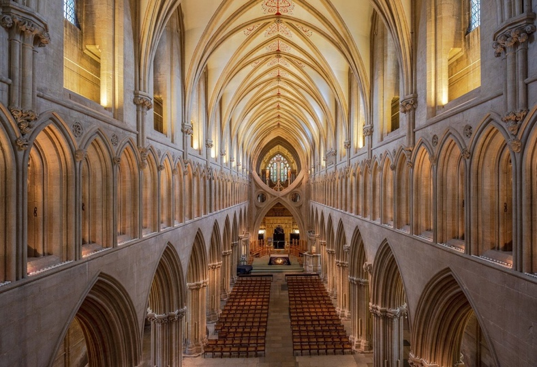
Thring was born at Alford, Somersetshire, England, in the parsonage of Alford, where his father was rector. Educated at Balliol College, Oxford, England, he was ordained a priest in the Church of England in 1847. On taking Holy Orders he was curate of Stratfield-Turgis, 1846-50; of Strathfieldsaye, 1850-53; and of other parishes to 1858, when he became rector of Alford-with-Hornblotton, Somerset, succeeding his father there, a position he retained until his own retirement in 1893. In 1876 he became prebend of East Harptree in Wells cathedral. After 1861 Thring wrote many hymns and published several hymnals, including “Hymns Congregational” (1866), “Hymns and Sacred Lyrics” (1874), and the respected “A Church of England Hymn Book Adapted to the Daily Services of the Church Throughout the Year” (1880), which was enlarged as “The Church of England Hymn Book” (1882). He also added several stanzas to Matthew Bridges’ hymn, “Crown Him with Many Crowns.”
We are familiar with the biblical and hymnodic themes of worship and adoration of the Lord Jesus, that can sometimes come across as just intellectually doctrinal. But we need to balance those with the deeply devotional themes of cherishing and treasuring Jesus as precious to us. Such is the case with this hymn. It is not merely about Jesus, though it is certainly rich in expressions of His role as prophet priest and king, and especially as the Good Shepherd of our souls.
While it will be hard to find a hymnal today with all of the eight stanzas that Thring is reported to have composed, they present a wonderful progression of dimensions of our adoration of our “blessed Savior.” The asterisks below indicate the four that are most commonly utilized in our song books today.
*Stanza 1 sets the scene of our approach to Jesus on His heavenly throne, addressing Him directly, asking that He regard the devotion we offer to Him from body, soul, and spirit. We need not divide these three into separate spheres of our being, as trichotomists might seek to do. It is enough that we think of singing to Jesus with every fiber of our physical as well as spiritual being. And speaking of singing, isn’t it wonderful that when we sing to Him, He is actually listening and finding joy in hearing our voices express our love for Him?
Savior, blessèd Savior, listen while we sing;
Hearts and voices ringing, praises to our King;
All we have we offer, all we hope to be,
Body, soul, and spirit, all we yield to Thee.
*Stanza 2 adds to that initial request the confirmation that we are consciously drawing near to Him, “deep in adoration bending low the knee.” Good hymnody will not only convey feelings and sentiment, but also substantial doctrinal truths. Thring does that here with the reminder that Jesus came “on earth to die” for our redemption. The “modernist’s” social gospel is a sad replacement for the biblical gospel of the substitutionary atonement of the Messiah. The reference to our following Him in this stanza does not sound like Thring merely meant that we should follow Jesus’ example (the moral influence theory of the atonement), but that if we have been redeemed by His precious blood, we will follow Him into heaven where He has “gone up on high” to be seated at the right hand of the Father.
Near, ever nearer, Christ, we draw to Thee,
Deep in adoration bending low the knee;
Thou for our redemption cam’st on earth to die;
Thou, that we might follow, hast gone up on high.
*Stanza 3 focuses on God’s mercy, comparing the mercies we receive from His hand in this life with the glories that will ours one day in heaven. Here now they are “great and greater,” suggesting that the longer we live, the more wonderful those mercies will become to us. But “there” in heaven, they will be glories seen to be “true and everlasting.” Following the descriptions in Revelation 21:4, we will no longer have to deal with pain or sorrow, fear or care. There He will wipe very tear from our eyes. And the 4th and 5th chapters of Revelation paint a thrilling picture of how “the angel legions circle round Thy throne.”
Great and ever greater, are Thy mercies here;
True and everlasting are the glories there,
Where no pain nor sorrow, fear nor care is known,
Where the angel legions circle round Thy throne.
Stanza 4 brings our minds’ eyes back to this present time that is “dark and ever darker,” what Thring labels “the wintry past.” At the present an occasional ray of gladness is cast over our path. But every day and every hour brings us closer to that glorious future when we will experience God’s love in a way that lies beyond our present ability to fully appreciate.
Dark and ever darker, was the wintry past,
Now a ray of gladness o’er our path is cast;
Every day that passeth, every hour that flies,
Tells of love unfeignèd, love that never dies.
Stanza 5 sings of the glimmers of future glory that come to us already in this life, by God’s providential kindness. How wonderful that in the middle of these days of sadness we get glimpses of heaven’s light (hopefully) dawning with increasing brightness. Our sadness here is especially relieved by reminders of sins forgiven. With a view to that future, life loses its shadowy gray and increasingly open our minds’ eyes to the radiance of Jesus’ presence as He sheds His “radiance on a world of sin.” With so much dimness that sin brings into our lives, how we need more and more of that radiance that comes only from and through Jesus!
Clearer still and clearer dawns the light from Heav’n,
In our sadness bringing news of sin forgiven;
Life has lost its shadows, pure the light within;
Thou hast shed Thy radiance on a world of sin.
Stanza 6 reminds us of Henry Frances Lyte’s hymn, “Abide with Me, Fast falls the Eventide.” The sun of our present light might be growing dim, but the hope of our eternal life will grow “brighter still” as the glow that fills the sky at sunset casts its golden glow over all that we have accomplished for the Savior throughout days. “Time will soon be over, toil and sorrow past.” And we look forward to finding rest in our blessèd Savior at last.
Brighter still and brighter glows the western sun,
Shedding all its gladness o’er our work that’s done;
Time will soon be over, toil and sorrow past,
May we, blessèd Savior, find a rest at last.
Stanza 7 leads to the first of two stanzas that are the climax of Thring’s hymn. The Bible in multiple places (like Hebrews 12) describes the Christian life as a journey, a theme picked up by John Bunyan in “The Pilgrim’s Progress.” This stanza also connects with Hebrews 11 and its famous “Hall of Faith” testimonies. Add to that Paul’s reflection in 2 Timothy that he had fought the good fight, finished the race, and kept the faith, as he was then awaiting the crown of righteousness that would be awarded to him.
Onward, ever onward, journeying o’er the road
Worn by saints before us, journeying on to God;
Leaving all behind us, may we hasten on,
Backward never looking till the prize is won.
*Stanza 8 is the concluding stanza which is included in our hymnals today. It is the great hope of all who have trusted in Christ, that when that time comes, he will lift us higher and hearer, bearing our ransomed soul into the throne room of heaven, to be reunited with the saints who have gone before us, and to be readied for the wedding supper of the Lamb. The day is surely coming when “earthly toils” will be forgotten. There, “in joys unthought of, saints with angels sing, never weary, raising praises to their King.”
Higher, then, and higher bear the ransomed soul,
Earthly toils forgotten, Savior, to its goal;
Where in joys unthought of, saints with angels sing,
Never weary, raising praises to their King.
Among the possible tunes for this 6.5.6.5.D text is HERMAS, written in 1871 by the well-known hymn writer Frances Ridley Havergal (1836-1879). The daughter of the Rev. W. H. Havergal, she was born at Astley, Worcestershire. Five years later her father moved to the Rectory of St. Nicholas, Worcester. In August, 1850, she entered Mrs. Teed’s school, whose influence over her was most beneficial. In the following year she says, “I committed my soul to the Savior, and earth and heaven seemed brighter from that moment.” A short sojourn in Germany followed, and on her return she was confirmed in Worcester Cathedral, July 17, 1853. In 1860 she left Worcester when her father resigned the Rectory of St. Nicholas, and resided at different periods in Leamington, and at Caswall Bay, Swansea, broken by visits to Switzerland, Scotland, and North Wales. She died at Caswell Bay, Swansea, June 3, 1879.
Miss Havergal’s scholastic acquirements were extensive, embracing several modern languages, together with Greek and Hebrew. Better known for her lyrics than her music, she does not occupy, and did not claim for herself, a prominent place as a poet, but by her distinct individuality she carved out a niche which she alone could fill. Simply and sweetly she sang the love of God, and His way of salvation. To this end, and for this object, her whole life and all her powers were consecrated. She still lives and speaks in every line of her poetry. Her poems are permeated with the fragrance of her passionate love of Jesus. The burden of her writings is a free and full salvation, through the Redeemer’s merits, for every sinner who will receive it, and her life was devoted to the proclamation of this truth by personal labors, literary efforts, and earnest interest in Foreign Missions.
Among her hymn lyrics are “Golden Harps Are Sounding,” “Thou Art Coming, O My Savior,” “I Am Trusting Thee, Lord Jesus,” “Lord, Speak to Me That I May Speak,” “Take My Life and Let It Be,” “Who Is on the Lord’s Side,” “Thy Life Was Given for Me,” and “Like a River Glorious.”
Here is a link to the singing of the lyrics, but to a different tune. This “virtual” choir includes singers from a number of countries, but primarily Nigeria.