
Jesus has called me to serve Him by being a patient with pancreatic cancer. A part of me finds it hard to believe I just wrote that, but I did. For my own sake, and hopefully for the benefit of others, I want to use one more hymn study to address this and convey the perspective that the Lord is growing in my heart as I process this new reality in my life. At the very beginning, I want folks to see my two prayer requests. 1. Pray with and for me that the Lord will guide me and my wife in the days ahead with wisdom and endurance as we learn what will be involved in the best medical steps for dealing with this cancer. 2. Pray with and for me that the Lord will bless my efforts to use this cancer to glorify Him in ways that enable others to see how different it is when a Christian is called to walk this path.
In recent days, the Lord has brought to my mind the concept of His “calling.” A friend of mine who grew up Roman Catholic tells me how in high school and college, the nuns encouraged students to pray for a “calling” or a “vocation.” By that was meant that boys might hope to become priests and that girls might hope to become nuns. The church taught that this is what it meant to be “called” by God to have a “vocation.” I guess any other kind of career path would have been second class at best, or maybe even a selfish refusal to follow God’s call!
Here is one more enormous difference that came about at the time of the Protestant Reformation. It was common in my experience to hear about people being called into “full-time Christian service.” I remember thinking how that can’t be right, since it implies that everyone else must be in “part-time Christ service!” No, with the Reformation (and specifically with John Calvin) came the realization that every Christian has a “calling” and a “vocation.” God calls some to be ministers and missionaries, but He also calls others to be teachers and doctors and farmers and engineers and politicians and pilots and mechanics and nurses and students and parents. Every person who has been born again and adopted as a child of God has been given unique spiritual gifts, and has been commissioned to use those where God designs to use us to build the kingdom of His Son, to glorify Him and to edify others.
So what do we find in the Bible about being called by God? At the top of the list is that this is one of those things in the ordo salutis, or “the golden chain” in our redemption as Spurgeon called it from Romans 8:30. These are the logical (and to some degree sequential) steps in our salvation. From eternity past (“before the foundation of the earth”) God has chosen His elect and through the powerful working of the Holy Spirit calls them to come to Him, even as Jesus called Lazarus to come to Him from the grave. This sovereign call is “irresistible” because it is powerful, it is the mighty word of the living God.
But let’s expand this notion of “calling” a bit further. It’s more than just a form of a verb, it’s a description of God exercising His kingly reign over all creation, over all the forces of nature, over all His creatures and all their actions, down to the smallest detail, including material objects and even human thought. In the beginning, He called all things into existence. He called Adam and Eve to be fruitful and multiply and rule over all He had made. Through Old Testament history He called patriarchs and kings, armies and prophets to do His bidding. And throughout the Psalms He called mountains and peoples, trees and princes to praise His name. In the New Testament Jesus called people to follow Him, to believe in Him, to become fishers of men, to trust in Him, and to disciple the nations.
Finally, let me make it personal. In the earliest days of my life, He called me to put my faith in Him as my Savior. Throughout my childhood and adolescence He called me to be a student to cultivate my mind and strengthen my body. When I was ten years old, He made me aware that He was calling me to be a minister of the gospel. After college He called me to become a husband to Betty and father to our children. After seminary He called me to be the pastor of one church after another. At the age of 73 He called me to retire and move with my wife to this Christian retirement community where I could continue using my preaching/teaching skills and musical abilities to bless others.
Do you see where I’m headed with this train of thought? Now at the age of 80, He has called me to be a patient with pancreatic cancer. At every point in my life, it has been the plan of a wise and loving heavenly Father that has been shown to me. At every point in my life, what He has wanted is for me to humbly and joyfully submit my life to Him as a living sacrifice to be used for His glory (Romans 12:1-2). And so now that I have pancreatic cancer, it’s natural to follow through with the security of knowing that the same Lord who has called me to serve Him in the ways He has ordained is now calling me to recognize His calling on my life in this diagnosis.
Why do I have pancreatic cancer? Because the Lord wants to show His goodness and compassion and faithfulness and wisdom and love and power through me. It is my privilege to be His instrument in this, in whatever course He has laid out for me in the days ahead. I will trust Him every step of the way, and will appreciate your prayers that I might be found faithful in doing so. If some of these steps become difficult (and they might), I can sing confidently that “Whate’er My God Ordains Is Right” and even “When I Fear My Faith Will fail, Christ Will Hold Me Fast.” This is what it means in my life right now, that Jesus is calling me to this.
While that is not exactly what she had in mind, the opening line of Cecil Frances Alexander’s 1852 hymn “Jesus Calls Us” fits my circumstances. Born in Dublin about 200 years ago, she lived from 1818 to 1895 and became the wife of Ireland’s Bishop of Londonderry and then Archbishop of Armagh and Primate of All Ireland. Her hymn focuses on the fact that Jesus calls us, every one of us, to love Him with all of our heart in the midst of all the cares and distractions of our busy lives.
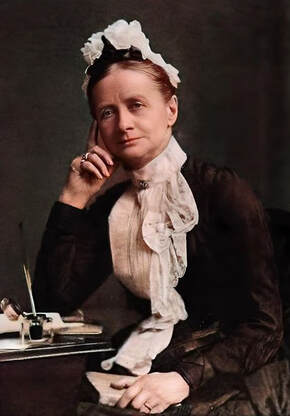
Cecil Frances Alexander is one of the most prominent names in English hymnody. She composed about 400 hymns, many of them written for children. One collection from her hand was a collection of hymns, each explaining the next phrase in the Apostles’ Creed at a level understandable by young hearts, and with applications especially pointed to their lives. In her own childhood, she began writing poems. Even then, she didn’t hide her light under a bushel, but she did hide her poems under a carpet, literally. Her father was stern, strict, and very rich. One day, he discovered his daughter’s secret writings. The family expected him to punish the wee lass, but instead he gave her a pretty box in which to keep her scribblings and invited her to read them aloud to the family every Saturday evening. With this encouragement, the young poet was off and running. As a young woman, she wrote verses to enhance the Bible lessons she taught her Sunday school students at the Anglican Church.
In 1846, at the age of twenty-eight, she published a collection, “Verses for Holy Seasons.” Two years later she published another collection, “Hymns for Little Children,” a hymnic companion to the Apostles’ Creed. We still sing “All Things Bright and Beautiful,” based on “I believe in God, the Father, maker of heaven and earth,” and “Once in Royal David’s City,” interpreting “(I believe) in Jesus Christ, our Lord, who was born of the Virgin Mary.” Also often found in collections today is “There Is a Green Hill Far Away,” reflecting on the clause, “Suffered under Pontius Pilate.” “Jesus Calls Us o’er the Tumult” is the exception in that it was not written as a children’s hymn and was composed after her marriage. The hymn first appeared in a collection called “Hymns for Public Worship”(1852), published by the Society for the Propagation of Christian Knowledge (SPCK), Tract No. 15, as a hymn for St. Andrew’s Day, November 30, displaying her priority for the Christian year. The famous composer Charles Gounod said that her verses “seemed to set themselves to music,” and Alfred Lord Tennyson commented that he wished he’d written “Burial of Moses.”
In 1850, she married Rev. William Alexander, an Anglican clergyman. At first they were sent to minister to rural churches where she embraced new responsibilities for maintaining a home and garden. She never became a mother, but continued to write poems for children throughout her life. As her husband climbed the ranks of his profession, she accompanied him to meetings in high society and often hosted dignitaries. Perhaps she was thinking of the contradictions inherent in being a comfortable Christian when she penned the stanzas to “Jesus Calls Us” one autumn evening in 1852. Her husband had spent the day writing his sermon for Saint Andrew’s Sunday. Over dinner they discussed the scripture, Matthew 4:18-20, in which Jesus called out “Follow Me!” to two brothers fishing in the Sea of Galilee. At once, Andrew (the “First-Called”) and Simon Peter (the “Rock”) dropped their nets and followed Jesus. Inspired by this conversation, Mrs. Alexander wrote this hymn of discipleship. It was read to the congregation that Sunday following the sermon.
In the 1850’s, Ireland was recovering from a period of mass starvation caused by the potato famines of 1845-1849. Over a million people had died, and another million had fled the country. Mrs. Alexander made frequent visits to those who were still struggling to survive. She traveled the soggy moorlands, bringing food, clothing, and medical supplies to farm families. Once, she went every day for six weeks to tend a woman’s infected foot. She also gave away the money she made from her hymn and poetry collections, once to fund a school for deaf children, another time to the “Derry Home for Fallen Women.”
As she wrote the words to “Jesus Calls Us,” she remembered the apostles who were asked to leave everything behind: work, home, family. Here Christ pleads, “Christian, love Me more than these!” Startled, we realize that the hymn is in present tense. Jesus calls us. Us? Yes! We are the ones called from our obsession with “the vain world’s golden store.” Jesus is motioning to us, calling us to follow Him, demanding, “Christian, love Me more!” We hear His plea, “Love Me more than these!” whether we’re at work or taking our ease with our feet up. But are we ready? Isn’t this a little extreme? Can we be honest? In the 21st century, it’s easy to feel bewildered by the “tumult of our life’s wild, restless sea.” On the evening news, we are stunned at the consequences of consumerism gone wild. The “vain world’s golden store” seeks to entrap us. We struggle to simplify the way we live, let go of our trinkets and toys, re-evaluate our relationship with the trappings of the good life. Still, Jesus whispers in our ears, “Christian, love Me more than these.”
Mrs. Alexander lived as one who was intimately aware of the suffering poor and was welcomed into their homes. One contemporary, Louis F. Benson, wrote of her, “She was as much at home in the back streets of Londonderry as in the Bishop’s Palace.” It is said that on the day of her funeral the streets filled with mourners: destitute, wealthy, Irish, English. Cecil Frances Alexander had touched their lives with her actions and with the words of her 400 poems and hymns.
How does a hymn written for a minor saint’s day (Andrew) by a Victorian hymn writer known for her pedagogical hymns for children become one of the most often sung hymns on Christian discipleship? Hymnologist Alfred Bailey captures the context of Mrs. Alexander’s hymns: “Before her marriage she had been a member of the Evangelical wing of the Anglican Church. That fact shows in her intense devotion to the religious education of children.” By contrast, William Alexander was a Tractarian (what might be called a “high church” devotee today) following the ethos of the Oxford Movement. Like many Christian women of this era, Mrs. Alexander was devoted to children’s religious education, using hymns as a tool in their education. With her hymn compositions, she included instructions on the seasons and feasts of the Christian year.
The hymn is a straightforward, concise narrative of the account in Matthew 4. All but one of the original five stanzas conclude with Christ’s imperative to his followers, past and present—“Christian, follow Me” (stanza 1); “Christian, love Me more” (stanza 3); “Christian, love Me more than these” (stanza 4). The hymn writer encourages the hymn singer to make a commitment to Christ in the final stanza. Stanza 5 is, according to Albert Bailey, “A prayer that we may hear the call and make it our heart’s desire to be loyal to the Savior.”
Victorian hymn scholar Ian Bradley notes, “Where other more evangelical women wrote hymns to evangelize and convert, or to express in deeply personal and subjective terms their own relationship with God and Christ, Frances Humphreys [Alexander] sought simply to teach. For her, hymns were primarily catechistical aids . . . . Victorian practitioners, especially Anglicans, . . . saw their work primarily as educating people in the basic doctrines of the faith and defending credal orthodoxy. Mrs. Alexander appears to have heeded this call, devoting much of her life to charitable work and social causes. She founded a school for the deaf with her sister, using funds from the sale of her poetry and hymns, participated in the establishment of the “Derry Home for Fallen Women,” and developed a district nurse service. “She was an indefatigable visitor to poor and sick.”
Returning to the central idea of Jesus’ calling, I sing this now thinking that Jesus is calling me to deal with pancreatic cancer. Since He is calling me to this, He will be with me all the way through this journey, and He will give me the strength to handle whatever that will involve. Yes, her intent was that the hymn point us to Jesus’ call to discipleship for all of us to serve the world and the church, but to do so in a way that points people to Jesus and glorifies Him. And this call is focused in Mrs. Alexander’s hymn in the direction of loving Jesus more than anything else, and encouraging others to love Him to that degree in their lives as well. To all that I add the application that this Jesus who calls His people to serve Him in every dimension of our lives includes calling us to honor Him in the difficult times as well as in the pleasant times. And so my primary desire in moving forward with my pancreatic cancer is that I might glorify Him, and that others might see that a Christian handles something like this in a radically different way than a non Christian.
Stanza 1 is based on the picture of the Sea of Galilee where Jesus called His first disciples. The story is found in Matthew 4:18-20. These men went on to become His chosen apostles through whom the word was revealed and confirmed (Matthew 10:1-4). While no one is called to be an apostle today, Jesus still challenges us to follow Him even though we may be tossed by the tumult of life’s restless sea (John 12:25-26).
Jesus calls us o’er the tumult
Of our life’s wild, restless sea;
Day by day His sweet voice soundeth,
Saying, “Christian, follow Me.”
Stanza 2 in its original text specifically mentions Andrew as one of those who heard the call. “Brothers Simon, Andrew heard it.” Remember that Mrs. Alexander wrote it for her husband’s sermon on St. Andrew’s Day in the church calendar. Most hymnals today change that to refer to the apostles in general. We are introduced to Andrew when he first follows Jesus after John the Baptist points out the Lord as the Lamb of God (John 1:35-42). Apparently, after Jesus and many of the men who later became His apostles returned to Galilee, the Lord then called Andrew with Peter, James, and John to follow Him (Mark 1:16-20). Like the others, Andrew also left all for Jesus’ sake (Matthew 19:27).
Brothers Simon, Andrew heard it
By the Galilean lake,
Turned from home, and toil, and kindred,
Leaving all for His dear sake.
Stanza 3 applies this call to each of us as individuals. Jesus calls us in such a way that we must put following Him absolutely first in our lives (Matthew 6:33). Therefore, He calls us from the worship of any idol, whether golden or mental that would stand between us and Him (1 John 5:21). And, as He later did to Peter, He tells us to love Him more (John 21:15-19).
Jesus calls us from the worship
Of the vain world’s golden store,
From each idol that would keep us,
Saying, “Christian, love Me more.”
Stanza 4 says that to follow Jesus’ call we must subordinate ourselves to Him. Our days are filled sometimes with joy and sometimes with sorrow, with both days of toil and hours of ease, but we Jesus still wants us to follow Him no matter what (Luke 9:23-26). Therefore, He continues to call us in our cares and in our pleasures (Matthew 11:28-30). And what He calls us to do is to love Him so that all of our worldly pursuits give way to our devotion to Him and His service (Mark 12:29-30).
In our joys and in our sorrows,
Days of toil and hours of ease,
Still He calls, in cares and pleasures,
“Christian, love Me more than these.”
Stanza 5 expresses the desire that we might hear this call and make it our desire to follow Him. Through His gospel, Jesus still calls us (2 Thessalonians 2:13-14). Of course, this call is done not by coercion but by persuasion (John 1:35-37). And the way that we respond to the call is by giving our hearts to complete obedience (Hebrews 5:8-9).
Jesus calls us: By Thy mercies,
Savior, may we hear Thy call,
Give our hearts to Thine obedience,
Serve and love Thee best of all.
There is no authority in the scriptures for the celebration of religious festivals such as St. Andrew’s Day. However, we do admire Andrew because he was one of the very first disciples of Jesus, and because he not only came himself but also brought his brother Peter. May we respond as did Andrew and those other early disciples to become Christ’s faithful followers and fishers of men when in His word “Jesus Calls Us.”
The tune most commonly associated with this text is GALILEE, written for the hymn by English organist William Herbert Jude (1851–1922). Paradoxically, this tune is more commonly sung in North America. Jude was born at Westleton in Suffolk, England, and began his musical career as an organist at the Blue Coat Hospital in Liverpool, where he served for a number of years. Produced specifically for Mrs. Alexander’s text, this melody first appeared in “The Congregational Church Hymnal,” edited by G. S. Barrett and Edward John Hopkins, and published in London, England, in 1887. It has become his best-known musical work. Two years later, Jude became organist at Stretford Town Hall, near Manchester. As a popular music lecturer and recitalist, he travelled extensively throughout Great Britain and even Australia.
Beginning in 1904, Jude also served as an editor for several musical magazines, including “Monthly Hymnal,” “Minister of Music,” and “Music and the Higher Life,” as well as a compiler of a couple of hymnbooks, namely “Mission Hymns” in 1911 and “Festival Hymns” in 1916. In addition to being a distinguished organist, he is also credited with an opera, “Innocents Abroad,” and some operettas, as well as many part songs and choral anthems. He died in London, England, on August 7, 1922.
Here is a link to the congregational singing of the hymn.