
Isn’t it wonderful how the Lord brings encouragement to our troubled hearts in ordinary ways at key moments in our lives? It’s almost as if He had direct access to our thoughts and emotions and knew how best to cheer us. But of course, He does! And as our loving heavenly Father, He will speak to us through indirect, but not less divine everyday means. It might be a sight that reminds us of Bible promise. It might be a friend who says just the right thing at the right moment. It might be a passage in a devotional book that touches our soul in a most reassuring way. Perhaps when we have been processing a troubling recent medical diagnosis that suddenly a thought pops into our mind that reminds us that we are not alone, but that the Good Shepherd is there, even in the valley of the shadow of death.
Or it might be when we are singing something – perhaps a hymn – that surprises us with something about the Lord that brings Him back into focus in our attention, when we had gotten too busy to remember Him, or too absorbed in some challenge to remember that we need to be looking not at the waves in the storm, but rather at the Savior who walks on the waves, and calls us to come to Himself. Since God is the one who designed music and also designed our mental and emotional capacity for responding to music, it should come as no surprise to us to remember that music can touch our souls in especially powerful ways.
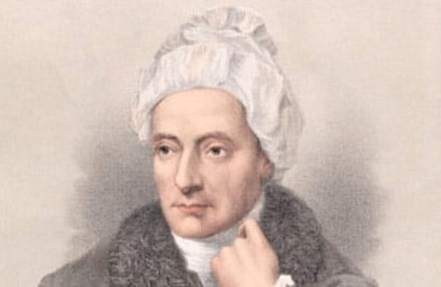
William Cowper (1731-1800) has given us a hymn that says as much. In 1779 he wrote “Sometimes a Light Surprise the Christian While He Sings.” Cowper (pronounced “Cooper”) is best known today for his 1771 hymn “There Is a Fountain Filled with Blood.” Born in Hertfordshire, England at his father’s rectory, he is regarded as one of the best early Romantic poets. To biographers he was also known as “mad Cowper” because of his lengthy bouts with severe depression. His literary talents produced some of the finest English hymn texts, but his chronic depression accounts for the somber tone of many of those texts.
Educated to become an attorney, Cowper was called to the bar in 1754 but never practiced law. In 1763 he had the opportunity to become a clerk for the House of Lords, but the dread of the required public examination triggered his tendency to depression, and he attempted suicide. His subsequent hospitalization and friendship with Morley and Mary Unwin provided emotional stability, but the periods of severe depression returned. His depression was deepened by a religious bent, which often stressed the wrath of God in an unbiblical way, and at times Cowper felt that God had predestined him to damnation. For the last two decades of his life Cowper lived in Olney, where John Newton became his pastor. He rented a room from Mrs. Unwin in a house just on the other side of a garden from the manse where Newton lived. There the two of them could sit in the shed and work on their hymn compositions together. There he assisted Newton in his pastoral duties, and the two collaborated on the important 1779 hymn collection “Olney Hymns,” to which Cowper contributed sixty-eight hymn texts.
According to John Julian in his classic 1907 “Dictionary of Hymnology,” the simple life of Cowper, marked chiefly by its innocent recreations and tender friendships, was in reality a tragedy. His mother, whom he commemorated in the exquisite “Lines on Her Picture,” a vivid delineation of his childhood, written in his 60th year, died when he was six years old. At his first school he was profoundly wretched, but happier at Westminster, excelling at cricket and football, and numbering Warren Hastings, Colman, and the future model of his versification, Churchill, among his contemporaries or friends. Destined for the Bar, he was articled to a solicitor, along with Thurlow. During this period he fell in love with his cousin, Theodora Cowper, sister to Lady Hesketh, and wrote love poems to her. The marriage was forbidden by her father, but she never forgot him, and in after years secretly aided his necessities.
Fits of melancholy, from which he had suffered in school days, began to increase, as he entered on life, much strained in means after his father’s death. But on the whole, it was the playful, humorous side of him that was most prominent in the nine years after his call to the Bar, spent in the society of Colman, Bonnell Thornton, and Lloyd, and in writing satires for “The Connoisseur” and “St. James’s Chronicle” and halfpenny ballads. Then came the awful calamity, which destroyed all hopes of distinction, and made him a sedentary invalid, dependent on his friends. He had been nominated to the Clerkship of the Journals of the House of Lords, but the dread of appearing before them to show his fitness for the appointment overthrew his reason. He attempted to take his own life with “laudanum, knife and cord,” in the third attempt nearly succeeding. The dark delusion of his life now first showed itself: a belief in his reprobation by God.
But for a time, under the wise and Christian treatment of Dr. Cotton at St. Albans, it passed away; and the eight years that followed, of which the two first were spent at Huntingdon (where he formed his lifelong friendship with Mrs. Unwin), and the remainder at Olney in active piety among the poor, and enthusiastic devotions under the guidance of John Newton, were full of the realization of God’s favor, and became the happiest, most lucid period of his life. But the tension of long religious exercises, the nervous excitement of leading at prayer meetings, and the extreme despondence to which he was so susceptible (and which Julian wrongly attributed to Julian’s own misunderstanding of doctrine in Newton’s preaching the Reformed faith and Newton’s own experience with the depravity of sinful human nature), could scarcely have been a healthy atmosphere for a shy, sensitive spirit, that needed most of all the joyous sunlight of Christianity. A year after his brother’s death, madness returned. Under the conviction that it was the command of God, he attempted suicide; and he then settled down into a belief in stark contradiction to his Calvinistic creed, “that the Lord, after having renewed him in holiness, had doomed him to everlasting perdition” (Southey).
In its darkest form, his affliction lasted sixteen months, during which he chiefly resided in John Newton’s house, patiently tended by him and by his devoted nurse, Mrs. Unwin. Gradually he became interested in carpentering, gardening, glazing, and the tendance of some tame hares and other playmates. At the close of 1780, Mrs. Unwin suggested to him some serious poetical work; and the occupation proved so congenial, that his first volume was published in 1782. To a cheerful episode in 1783 (his fascination by the wit of Lady Austen) his greatest poem, “The Task,” and also “John Gilpin” were owing. His other principal work was his “Homer,” published in 1791. The dark cloud had greatly lifted from his life when Lady Hesketh’s care accomplished his move to Weston (1786). But the loss of his dear friend William Unwin lowered it again for some months. The five years’ illness of Mrs. Unwin, during which his nurse of old became his tenderly-watched patient, deepened the darkness more and more. And her death (1796) brought “fixed despair,” of which his last poem, “The Castaway,” is the terrible memorial. Perhaps no more beautiful sentence has been written of him, than the testimony of one, who saw him after death, that with the “composure and calmness” of the face there “mingled, as it were, a holy surprise.”
Continuing according to John Julian, Cowper’s poetry marks the dawn of the return from the conventionality of Alexander Pope to natural expression, and the study of quiet nature. His ambition was higher than this, to be the Bard of Christianity. His great poems show no trace of his monomania, and are full of healthy piety. His fame as a poet is less than as a letter-writer. The charm of his letters is unsurpassed. Though the most considerable poet, who has written hymns, he has contributed little to the development of their structure, adopting the traditional modes of his time with Newton’s evangelical Calvinistic theology. The spiritual ideas of the hymns are identical with Newton’s. Their highest note is peace and thankful contemplation, rather than joy: more than half of them are full of trustful or reassuring faith. Ten of them are either submissive (44), self-reproachful (17, 42, 43), full of sad yearning (1, 34), questioning (9), or dark spiritual conflict (38-40). The specialty of Cowper’s handling is a greater plaintiveness, tenderness, and refinement. A study of these hymns as they stood originally under the classified heads of the 1779 “Olney Hymns,” which in some cases probably indicate the aim of Cowper as well as the ultimate arrangement of the book by Newton, shows that one or two hymns were more the history of his conversion (as with Newton’s “Amazing Grace”), than transcripts of present feelings.
Cowper’s best hymns are given in “The Book of Praise” by Lord Selborne. Two may be selected from them; the exquisitely tender “Hark! My Soul, It Is the Lord,” and “Oh, for a Closer Walk with God.” Anyone who knows Mrs. Browning’s noble lines on Cowper’s grave will find even a deeper beauty in the latter, which is a purely English hymn of perfect structure and stream-like cadence, by connecting its sadness and its aspiration not only with the “discord on the music” and the “darkness on the glory,” but the rapture of his heavenly waking beneath the “pathetic eyes” of Christ. It may be that which prompted Albert Bailey to famously write of Cowper in his book, “The Gospel in Hymns,” that with this melancholic poet we have one who died in the dark but who awakened in the light.
The lyrics of this particular hymn of Cowper’s have connection with two primary passages of Scripture. The first is found in stanza 3 which echoes the words of Luke 12:24. “Consider the ravens: for they neither sow nor reap; which neither have storehouse nor barn; and God feedeth them: how much more are ye better than the fowls?” The second is found in stanza 4, which echoes the words of Habakkuk 3:17-18. “Although the fig tree shall not blossom, neither shall fruit be in the vines; the labor of the olive shall fail, and the fields shall yield no meat; the flock shall be cut off from the fold, and there shall be no herd in the stalls: yet I will rejoice in the Lord, I will joy in the God of my salvation.”
Once again, the overall theme of the hymn is that our wonderful, loving, and wise God is the God of all comfort (2 Corinthians 1) who will always be near and at work to sustain us through life’s challenges, all the way home. Paul wrote that the Lord will bring to completion the work that He has begun in us (Philippians 1:6). And that will include His surprising us with blessed reminders of His watchful care when we sing.
Stanza 1 sets the theme before us, that in His kindness and compassion, the Lord will sometimes surprise us with spiritual light, a fresh reminder of His goodness, while we are singing. It may be in a private morning devotional time, or in a corporate worship gathering on the Lord’s Day. But however and whenever that moment comes, what a beautiful refreshment it will bring to our souls at times when our troubles are weighing heavily upon us. “It is the Lord who rises with healing in His wings.” There will be times when we may feel alla lone, that no one around us knows or cares about our struggles. How marvelous when the Lord, who does know and does care, “grants the soul again a season of clear shining to cheer it after rain.”
Sometimes a light surprises
The Christian while he sings;
It is the Lord who rises
With healing in His wings;
When comforts are declining,
He grants the soul again
A season of clear shining
To cheer it after rain.
Stanza 2 adds to that the suggestion of what will come next, when we can pause to contemplate what the Lord has just done, and find that we are motivated to think more about God’s great salvation, finding it “ever new.” Instead of looking ahead with fer about what may next come our way, we can be strengthened by that momentary relief to be “set free from present sorrow.” That way, we will be able to say cheerfully, “Let the unknown tomorrow bring with it what it may.” Here we can recall Jesus’ own words in the Sermon on the Mount, about now worrying about tomorrow, but trusting the Lord who cares about us who are more valuable and precious to Him than sparrows.
In holy contemplation,
We sweetly then pursue
The theme of God’s salvation,
And find it ever new;
Set free from present sorrow,
We cheerfully can say,
“Let the unknown tomorrow
Bring with it what it may.”
Stanza 3 gives us more information about how this “surprise” can prove to be a benefit for us as it reassures us that the Lord is present and at work, carrying thorough with the perfect plan He has had for us from before the foundation of the earth, having ordained all our days before one of them came to be (Psalm 139:16). Whatever “the unknown tomorrow” may bring, it will be what the Lord has planned, and He will be present with us. This God of wisdom, love, and power who gives the lilies clothing will clothe His people, too.” And so we can agree with Paul who wrote from prison to the Philippians church that they should “rejoice always.” And “not be anxious about anything.” This is the God who feeds ravens. Will He not also “give His children bread?”
It can bring with it nothing
But He will bear us through;
Who gives the lilies clothing
Will clothe His people, too;
Beneath the spreading heavens,
No creature but is fed,
And He who feeds the ravens
Will give his children bread.
Stanza 4 takes us to the powerful promise in the little, often ignored book of Habakkuk. Even if things get to the point of food deprivation (vine and fig) and economic devastation (fields and clocks), our heavenly Father is still abiding with us. Therefore our respond will be to sing His praise, confiding in Him and rejoicing in Him.
Though vine nor fig tree neither,
Their wonted fruit should bear,
Though all the field should wither,
Nor flocks, nor herds be there;
Yet God the same abideth,
His praise shall tune my voice,
For, while in Him confiding,
I cannot but rejoice.
The lyrics are in 7.6.7.6.D meter, one of the most common in our hymnals. So there are many possibilities for melodies to which the hymn can be sung, as long as one checks to make sure that the acCENT falls on the right sylLABle! In this study, the tune BENTLEY is recommended. It is very singable, and avoids the danger of people thinking of a different set of words while singing this text. John Pyke Hullah (1812-1884) was an English composer and teacher of music, whose promotion of vocal training is associated with the singing-class movement. He worked with Charles Dickens and new Felix Mendelssohn.
Hullah was born at Worcester. He was a pupil of William Horsley from 1829, and entered the Royal Academy of Music in 1833. He wrote an opera to words by Dickens, “The Village Coquettes,” produced in 1836; “The Barbers of Bassora” in 1837; and “The Outpost” in 1838, the last two at Covent Garden. From 1839, when he went to Paris to investigate various systems of teaching music to large masses of people, he identified himself with Wilhem’s system of the fixed “do,” in contrast to the moveable “do” of the Tonic sol-fa. His adaptation of Wilhem’s system was taught with enormous success from 1840 to 1860. His first-ever lesson was given at the Battersea College for training teachers (now University St Mark and St John Plymouth), in 1840, at the instigation of educationalist and college Principal James Kay Shuttleworth. His pupils included William Carter and Edmund Hart Turpin.
In 1847 a large building in Long Acre, called St. Martin’s Hall, was built by subscription and presented to Hullah. It was inaugurated in 1850 and burnt to the ground in 1860, a blow from which Hullah was long in recovering. In 1849 William Sterndale Bennett, founder and chairman of the Bach Society, invited Hullah to join his committee, with a view to producing the first English performance of Johann Sebastian Bach’s “St. Matthew Passion,” which took place on April 6, 1854. As a sight-singing pioneer, Hullah produced his popular series “Vocal Scores” (1846) and “Part-Music” (1867). A series of lectures was given at the Royal Institution in 1861, and in 1864 he lectured in Edinburgh, but in the following year he was unsuccessful in his application for the Reid professorship.
He conducted concerts in Edinburgh in 1866 and 1867, and the concerts of the Royal Academy of Music from 1870 to 1873; he had been elected to the committee of management in 1869. In 1872 he was appointed by the Council of Education as Musical Inspector of Training Schools for the United Kingdom. In 1878 he went abroad to report on the condition of musical education in schools, and wrote a very valuable report, quoted in the memoir of him published by his wife in 1886. He was attacked by paralysis in 1880, and again in 1883.
Dr. Hullah was Honorary Fellow of King’s College, London, and Professor of Vocal Music at Queen’s College, London, and Bedford College, London. He succeeded Dr. Horsley as organist of the Charterhouse (in its original London location) in 1858, and held the post until his death. He received the honorary degree of Doctor of Laws from the University of Edinburgh in 1876.
His compositions, which remained popular for some years after his death in 1884, consisted mainly of ballads (such as his musical adaptation of Charles Kingsley’s poem “Three Fishers”), but his importance in the history of music is due to his exertion in popularizing musical education, and his persistent opposition to the Tonic sol-fa system (to teach sight-singing), which had a success he could not foresee. His objections to it were partly grounded on the character of the music which was in common use among the early teachers of the system. His widow, Frances Rosser Hullah, published a biography of her late husband.
Here is a link to the song as sung at London’s Metropolitan Tabernacle.