
How are your spiritual taste buds? Do they recognize and savor the goodness of the Lord? That was David’s testimony of his experience with the Lord’s deliverance, and his challenge to the readers / singers who would use Psalm 34 in their own worship. The heading of the Psalm reads “Of David. When he changed his behavior before Abimelech, so that he drove him out, and he went away.” The inspired account is found in 2 Samuel 16-18. That must have been one of the most painful experiences in David’s life. But this one whom God regarded as “a man after My own heart” (1 Samuel 13:14 and Acts 13:22) wrote of the Lord’s deliverance in this powerful Psalm, a portion of which has been set in metrical form as the hymn “Through All the Changing Scenes of Life.”
Psalm 34 is a literary as well as spiritual masterpiece. One is tempted to say that as a lyricist, David was his best in this Psalm. It is not only rich in theological instruction and in pastoral benefit. It also reflects great poetical skill in its composition. Like several other Psalms, it is composed in an acrostic form, with each verse beginning in sequence with the next letter in the Hebrew alphabet. If we were to follow that style in a series of statements in English, it might look like this.
All my hope is in the Lord
Before His throne I make my prayer
Covenant promises will sustain me
Despair shall not reign over me
Everlasting joy surely awaits me
Forever I will dwell in His holy temple
Goodness is central to His character
etc.
David’s Psalm contains several well-known and memorable verses. The first three together are often used very appropriately and effectively as a call to worship.
I will bless the LORD at all times;
His praise shall continually be in my mouth.
My soul makes its boast in the LORD;
Let the humble hear and be glad.
Oh, magnify the LORD with me,
And let us exalt His name together.
Verse 7 has given comfort to many as they claimed its promise: “The angel of the LORD encamps around those who fear Him, and delivers them.” Verse 10 provides reassurance to us in our times of need as we read this: “The young lions suffer want and hunger, but those who seek the LORD lack no good thing.” How many great sermons have been preached on those verses over the centuries! As with all the Psalms, this one finds its best fulfilment in the Lord Jesus, as is evident as we recall what happened on Calvary’s cross in verse 20: “He keeps all his bones; not one of them is broken.” It obviously looks ahead to Jesus, doesn’t it?
One of the best is found in verse 8: “Oh, taste and see that the LORD is good.” John Piper has often referred to an analogy he has taken from Jonathan Edwards. Anyone can read about honey as something that is sweet to the taste, and examine its composition along with how it is made in a bee hive. But the only one who really appreciates that sweetness is the one who actually takes the honey into his mouth and tastes it! In Ezekiel 3, the prophet was commanded to take a scroll with God’s words.
And He said to me, Son of man, eat whatever you find here. Eat this scroll, and go, speak to the house of Israel.” So I opened my mouth, and He gave me this scroll to eat. And He said to me, “Son of man, feed your belly with this scroll that I give you and fill your stomach with it.” Then I ate it, and it was in my mouth as sweet as honey.
Is God’s Word that sweet to us? Can we testify that the Lord is good from personal experience? And can we do so in the times that are difficult and challenging as well as in the times that are pleasant and easy? David’s testimony in Psalm 34 ought to be read not just as if he had composed it after everything had been resolved. He may well have done so. But as we find him confident in the Lord afterward, we know that he was confident even during the trying time out of which the Lord had so recently delivered him. In some of the Psalms we find the psalmist crying out to the Lord for deliverance in the opening verses, and then in the second half of the Psalm praising the Lord for a deliverance that had not yet come. That’s how confident the saints can be that the Lord sees and hears and will answer, and praises God in advance of His response. Could we call that “pre-emptive praise?”
In the metrical setting of Psalm 34, we find reference to “all the changing scenes of life.” We might expand that to consider all the many and varied changing moods, emotions, challenges, struggles, experiences, occasions, and trials of life. And oh, how many there are! David’s Psalm came into being after such a hardship. And each of us face such times throughout our lives. If there is a thesaurus that offers synonyms for a word we’ve selected, there ought also to be thesaurus of moments that are like the one we’re facing. It could be a troubling diagnosis of disease, the pain of a marital conflict, the heartache of a wayward child, the unexpected loss of a job, the discovery of a necessary major costly repair, the anguish of becoming the object of mean-spirited slander, the disappointment in a friend who has betrayed your trust.
But the Scriptures are full of God’s promises, such as in Hebrews 13:5 where we read that He will never leave us or forsake us. God assures us in Deuteronomy 33:27 that He is our dwelling place, and underneath are the everlasting arms. In Isaiah 41:10 we are bolstered by this text: “Fear not, for I am with you; be not dismayed, for I am your God; I will strengthen you, I will help you, I will uphold you with My righteous right hand.” Such promises are particularly encouraging when they come from the lips of Jesus, however difficult and dark those experiences can be. In the Great Commission of Matthew 28, His final words assure us of that. “Behold, I am with you always, to the end of the age.”
In the midst of these difficult times in our lives, these “changing scenes,” many of which we will find to be very bitter to the taste, what could be more sweet than these promises of our covenant God? Not only will they be sweet, but they will enable us to do what David has done in Psalm 34, and that is to pour out to God not only our complaint (which we can certainly do!), but also our praise. This Psalm is filled with testimony of the goodness of the Lord and the blessing He deserves from our lips. In verse 6, David sang, “This poor man cried and the LORD heard him, and saved him out of all his troubles.” Will that be our song “through all the changing scenes of life?”
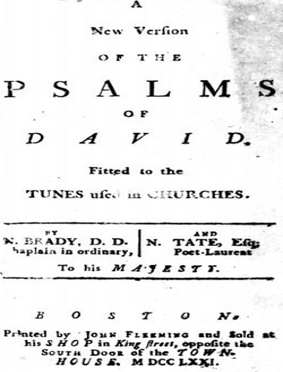
This particular metrical setting of Psalm 34 uses verses 1-4 and 7-9. It comes from the historic “New Version of the Psalms of David,” compiled by Nahum Tate (1652-1715) and Nicholas Brady (1659-1726) in 1696, revised in 1698. It followed the earlier Sternhold and Hopkins Psalter (often called the “Old Version”) as the foundational 16th-century English metrical psalter, a collection of the Psalms of David translated into rhyming, metric verse designed to be sung by church congregations. Thomas Sternhold (groom of the robes to Henry VIII) published the first small selection of 19 psalms around 1547–1549 dedicated to King Edward VI. After Sternhold’s death in 1549, John Hopkins added more psalms. The work was further expanded by Protestant exiles in Geneva during the reign of Mary Tudor.
The complete 1562 edition was published by John Day as “The Whole Booke of Psalmes, Collected into English Meter.” It included contributions from about twelve authors (including Thomas Norton, William Whittingham, and Robert Wisdom), featuring roughly 43 psalms by Sternhold and 56 by Hopkins. It became one of the most widely circulated books in the English language (second only to the Bible and the Book of Common Prayer) and remained the standard Anglican psalter until it was replaced by Nahum Tate and Nicholas Brady’s “New Version” in 1696.
The Tate and Brady “New Version” was an extremely important English language psalter that served the church during the time that congregational singing in corporate worship was exclusively and deliberately limited to the 150 Psalms. It was not until the time of Isaac Watts (1674-1748, about the same years as the life of German Lutheran musician Johann Sebastian Bach) that “hymns of human composure” began to be written and sung in English language churches. For his work in this regard, Watts became known as “the father of English hymnody.
Nicholas Brady, an English divine, was born at Bandon, County Cork, Ireland, October 28, 1659. He was educated at Westminster, Oxford, and Trinity College, Dublin. He was a Prebendary of Cork, Ireland. In 1702–05, he was incumbent at Stratford-on-Avon. Later, while incumbent at Richmond, he taught school in addition to his ministerial work. He died May 20, 1726. He published two volumes of poetry, one being a translation of Virgil’s “Æneid.” His association with Nahum Tate in making a “New Version of the Psalms of David” in 1696, which long held a dominant place in the Church of England, has given him a permanent and honored place in the history of hymnology.
Nahum Tate, the English poet, was the son of an Irish clergyman and was born at Dublin in 1652. After his graduation at the University of Dublin, he settled in London and entered upon a literary career. He soon won reputation as a poet, publishing successive volumes from time to time. In 1692, he became Poet Laureate. This Psalm version supplanted, by royal and episcopal authority, the “old version” by Sternhold, Hopkins, and others, and continued to be the authorized version of the Church of England found in the Prayer Book. It is not known which of the Psalms were translated by Brady and which by Tate, but as Tate was Poet Laureate, he is supposed to have done the greater part of the work. In addition to this joint work, he published several volumes of poetry.
Those who undertook this Psalter project at first proposed this pious design between themselves, but in a little time it was communicated, and as speedily received and nourished by persons of the highest rank, and principal authority in the nation, both in Church and in State, leading to Queen Mary II being pleased to promise it her royal countenance. And the Archbishop of Canterbury of that time, John Tillotson supported the work of these translators. When the work was finished and had passed the censure of the Archbishop, and several more of his brethren the Right Reverend Prelates, who vouchsafed to peruse it, and gave in their alterations and remarks, a petition was presented to His Majesty, William III, in council for “allowing the liberty of a public reception of it in all churches, chapels, and congregations,” which was accordingly granted.
Following the literary style of the Psalm, the text of the hymn is set in the first person singular. It is as if we are listening to David’s testimony from his own lips and from his own heart. When we sing it, it becomes our testimony as we would express it based on what has happened in our own life in the changing scenes of life. We should also, as with all the Psalms, consider what it would have meant when Jesus sang it, and especially how He would be singing it now after having endured the opposition and even crucifixion at the hands of the Jewish leadership. Through it all He loved and obeyed the will of the Father, and now in heaven He praises and magnifies the Father for the plan of redemption that is so righteously proceeding. When we put Jesus “in the driver’s seat” of the Psalm, it will be completely transformed in our thinking. And since we are “in Him,” the Psalm can become our testimony, too. Try singing it from that perspective. As you sing it, be sure to focus on tasting to see that the Lord is good!
In stanza 1, we join Jesus in affirming that regardless of our circumstances, both “in trouble and in joy,” we will maintain a spiritual posture of praise toward our loving and trustworthy God, employing our hearts and tongues to honor Him. To have such an attitude, we need to prepare ahead of time by storing up promises in God’s Word to energize our souls.
Through all the changing scenes of life,
in trouble and in joy,
the praises of my God shall still
my heart and tongue employ.
In stanza 2, we join Jesus in boasting about how the Lord delivered us from the distressing situation in which we had found ourselves. This reminds us of 2 Corinthians 1 where we are obligated to comfort others with the comfort with which God has comforted us. What a privilege is ours to become an example to others in ways that will “charm their griefs to rest.”
Of His delivr’ance I will boast
till all that are distressed
from my example comfort take,
and charm their griefs to rest.
In stanza 3, we join Jesus in inviting those who hear us to add their voices to ours in magnifying the Lord and exalting His name. A personal testimony is inserted again. For David, it had to with his dilemma with Abimelech. For Jesus it was when Satan tempted Him in the wilderness and in the Garden of Gethsemane and before the raging High Priest as well as the taunts of spectators while He hung on the cross. But the Father sustained Him, and will also sustain us.
O magnify the Lord with me,
with me exalt His name;
when in distress to Him I called,
He to my rescue came.
In stanza 4, we join Jesus in acknowledging the hosts of God, the angel army, that encamped around Him to guarantee that only what the Father would permit could happen and therefore He would remain in a secure place. The same is true for us who are in Jesus. Those angels will encamp around us as we trust the Father for support. (“Succor” is an antiquated word meaning help or comfort in hard times.)
The hosts of God encamp around
the dwellings of the just;
deliv’rance He affords to all
who on His succor trust.
In stanza 5, we join Jesus in challenging those who watch us to put God to the test and see if He will not come to their aid just as He has to us. Experience will result in their being blessed as we have been. Jesus continues to be blessed as saints and angels around the throne laud His name for the work of redemption He is perfecting. This will be true now only for those who have confidence in His truth.
O make but trial of His love;
experience will decide
how blest are they, and only they,
who in His truth confide.
In stanza 6, we join Jesus finally by inviting all the saints who have been observing God’s care for us to join us with a holy loving fear of our heavenly Father, and then to learn that they will have “nothing else to fear. When we are single-minded in serving Him with delight, “He’ll make your wants His care.” He did so with Jesus; He’s doing so with us; and He will do so for all who fear Him.
Fear Him, ye saints, and you will then
have nothing else to fear:
make you His service your delight;
He’ll make your wants His care.
As a Common Meter text, there are many possible tunes for these lyrics. One such tune that fits the words very well is Lowell Mason’s tune DOWNS. The tune WILTSHIRE is common in Great Britain, but in the US the “Trinity Hymnal” uses DOWNS. Mason (1792-1872) was the composer of more than 1600 hymn tunes, many of which are well-known in churches today. After serving in downtown Savannah at the historic Independent Presbyterian Church, he moved to Boston where he popularized the music of Bach and Handel, and is credited with establishing the teaching of music in public schools.
Here is a link to hear the tune DOWNS from the “Trinity Hymnal.”