
We all sing a hymn at the beginning of a worship service, and perhaps hear a prelude based on a hymn as we are gathering. But have you ever thought about the benefit of singing a hymn at home before you come either on Saturday evening or on Sunday morning? In most instances, it will be too late to adequately prepare our hearts for worship if we wait until we have driven into the parking lot and made our way through multiple conversations with other church members (about grandchildren, or sports, or politics, or the economy) on our way to our pews.
But what a difference it could make if our heart and mind preparation for worship began earlier. Perhaps we could have looked on-line (or remembered from last week’s bulletin) what the scripture text and sermon would be about this day. We might even be able to look at the first hymn planned for the service and begin meditating on it before the pastor stands to read the call to worship.
And if it’s not that particular hymn chosen for the day, there are many possibilities in our hymnal which would help us focus not on ourselves and our desires (will we like the music, will we see a good friend we’ve missed, will the air conditioning be too cold?), but on our great God and the fact that He is present, ready to renew our minds and hearts in joyful praise and gratitude for His covenant faithfulness.
Such a “preparatory hymn” is “Father, Again in Jesus’ Name We Meet,” first published in 1824 by Lady Lucy Elizabeth Georgina Whitmore (1792-1840). Her place in British social circles ensured her name often receiving mention. A bishop reported that, as his godmother, she purchased him a lifelong membership in the Church Missionary Society. A famous novelist noted her presence at dinner with his friends. A prominent rector wrote thanking her for her prayers and for books she had sent him. Schools and charitable organizations listed her as a donor, or, in some cases, as a board member.
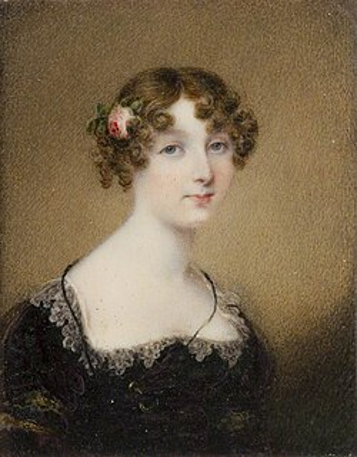
She was the daughter of Orlando Bridgeman, Second Baron Bradford (from 1794), who inherited estates in Shropshire and Staffordshire, including Weston Park, where Lucy may have been born. He was created Earl of Bradford in 1815. In 1819 she married William Wolryche Whitmore (1787-1858), of Dudmaston Hall, Bridgnorth, Shropshire. She is often referred to as “Lady Lucy Whitmore.” She had four siblings, all sons.
Whitmore also turned her hand to writing, including fourteen original hymns. With a prestigious London publishing house, she compiled a book of morning and evening prayers for each day of the week. To relevant Bible passages, she added pious petitions, such as “May the pure doctrines, and heavenly precepts that proceeded from the lips of our adorable Redeemer, sink deep into our hearts, convince us of our utter unworthiness, and bring us, in prostration of soul, to the foot of the Cross.” “Father, Again in Jesus’ Name We Meet” is the only one of her hymns to have lasted in popular use. Often used as an opening hymn, it is sometimes placed as a selection for the season of Lent, with words appropriate to a returning prodigal.
The hymn reminds us of what is really happening when we gather for corporate worship in Jesus’ name. We are not just meeting with one another, as wonderful and true as that is. God is meeting with us. That fact ought to motivate us to come to worship, and to do so with that expectancy God will meet with us there. That reality ought to astound us and cause us to pray ahead of time that God would open the eyes of our hearts that we might see Him by faith. That’s where this hymn can help us if we will use it to prepare for that meeting.
The text appears to have been inspired primarily by Luke 15:18 (the Prodigal Son: “I will arise and go to my father”) and Micah 7:18 (“God’s steadfast love and forgiveness),” as well as Matthew 18:20 (“Where two or three are gathered in My name, there am I among them”). The lyrics are set as a prayer addressed to the Lord Jesus Himself. Thus, it serves we as a very suitable preparation for worship, expecting Him to keep His promise to be among us. Such is the nature of the prayer of invocation with which our services generally begin.
Stanza 1 sings of our reverent assembly in God’s presence for worship. It describes our posture as bowing beneath His feet. Such posture is appropriate and necessary, and often missing in worship today. In many churches, a legitimate spirit of celebration includes no space for the penitential spirit that acknowledges our sin and need for daily forgiveness and restoration. It is not healthy to rush into God’s presence without first remembering that He is holy and we are not. Before we sing His praise, we need to make sure we have asked for mercy.
Father, again in Jesus’ name we meet
and bow in penitence beneath Thy feet;
again to Thee our feeble voices raise
to sue for mercy and to sing Thy praise.
Stanza 2 sings of our gratitude for God’s daily providence. Whitmore has given us powerfully descriptive words and phrases to describe the greatness of God’s goodness to us: “ceaseless care,” “all Thy works,” “day to day,” “hourly mercies,” “crowned,” “encircle.” For all of this we bless Him. We need to do this consciously in our worship, lest we begin to take for granted these many moments and acts of care from His hand.
O we would bless Thee for Thy ceaseless care
and all Thy works from day to day declare.
Is not our life with hourly mercies crowned?
Does not Thine arm encircle us around?
Stanza 3 sings of our confession when we have wandered from God’s presence. It is clearly based on the Parable of the Prodigal Son, and encourages us to see ourselves in that story as ones who have gone our own way, much to the grieving of the Holy Spirit. But we have a heavenly Father more anxious to welcome us home than we are to return home. We are truly unworthy of such “boundless love.”
Alas, unworthy of Thy boundless love,
too oft our feet from Thee, our Father, rove;
but now, encouraged by Thy voice, we come,
returning sinners, to a Father’s home.
Stanza 4 sings of the work of Christ as the sole basis by which we can approach God. We need divine mercy, and it is only available to us by Jesus’ name, Jesus’ love, and Jesus’ blood. We must politely but earnestly contend with those who suggest that there are many paths to God. It is from Jesus’ own lips in John 14:6 that we base our hope on the fact that no one can come to the Father but through Him. We add to that the words from Acts 4:12 that there is no other name under heaven but that of the name of Jesus. And this is consistent with biblical theology in that no other name is capable of bridging that gap between us and God caused by our sin and the death penalty we deserve.
O by that name in whom all fullness dwells,
O by that love which ev’ry love excels,
O by that blood so freely shed for sin,
open blest mercy’s gate and take us in.
The meter for this text is 10.10.10.10., which has a number of possible options. The “Trinity Hymnal” uses the tune LONGWOOD, which is used in the “Trinity Hymnal” was written in 1872 by Sir Joseph Barnby (1838-1896). Born in York, he became as accomplished choral director in England. His musical genius was evident quite early, as he became an organist and choirmaster at the age of twelve. He became organist at St. Andrews, Wells Street, London, where he developed an outstanding choral program (at times nicknamed “the Sunday Opera”).
Barnby introduced annual performances of J. S. Bach’s “St. John Passion” in St. Anne’s, Soho, and directed the first performance in an English church of Bach’s St. Matthew Passion.” He was also active in regional music festivals, conducted the Royal Choral Society, and composed and edited music (mainly for Novello and Company). In 1892, he was knighted by Queen Victoria. His compositions include many anthems and service music for the Anglican liturgy, as well as 246 hymn tunes (published posthumously in 1897). He edited four hymnals, including “The Hymnary” (1872) and “The Congregational Sunday School Hymnal” (1891), and co-edited “The Cathedral Psalter.”
Here is a link to the hymn as found in “Trinity Hymnal” with the LONGWOOD tune.